kingworldnews.com / April 22, 2013
Today
whistleblower Andrew Maguire spoke with King World News, providing even
more details by elaborating on the events surrounding the LBMA
default. Maguire, who recently appeared in the extraordinary CBC
production titled, “The Secret World of Gold,” also told KWN about the
ensuing panic which has taken place in the aftermath of the LBMA
default. Maguire described entities as “panicking.” Below is what
Maguire had to say in part II of his remarkable and exclusive interview.
Eric
King: “Inside that piece (“The Secret World of Gold”) you talked about
gold leasing and the mechanics of that. Jim Sinclair wanted me to
bring that up to you, the gold leasing, the mechanics of it, can you
talk about that?”
Maguire: “We did a piece on King World News
about it, about the LBMA bullion bank default. Stepping back, how did
they get to such a mismatched (trading) position where they had so
little gold and silver in their inventory to be able to back up people
coming and asking for their gold and silver? They never anticipated
that this would happen….
READ MORE
Please share this article
Tuesday, April 23, 2013

Double Top Forming In US Dollar?
The Dollar looks to have put in a DCL right in the timing band. The
12 day decline into the low has more than provided the consolidation
needed to confirm the low and recharge the Cycle. This was fairly
evident today with the Dollar rocketing out of its Cycle Low with an
impressive 0.80 move.
The Dollar is an interesting Cycle to study here because there are some varying scenarios that could be unfolding. Firstly, it’s pretty clear on the chart that the Dollar is sporting a Daily Cycle failure. Typically such a failure means that the dominant Cycle is now in decline, in this case it’s the Investor Cycle. This isn’t an unreasonable expectation; the Investor Cycle is on Week 11 and in the timing band for a top.

It’s important to understand that a Cycle failure does not have to mean a Cycle in decline though. Generally they are telling of future weak price action, but there are no hard and fast rules in Cycles around these failures. So for this reason, an Investor Cycle decline does not need to occur imminently or from a new Left Translated Cycle.
But at this point with a Daily Cycle failure and a Week 11 Investor Cycle, we should be on the lookout for a new Cycle that tops fairly early. The logical top or turn would be after a move to a double top (83.50) or a quick burst to new highs.
Please share this article
The Dollar is an interesting Cycle to study here because there are some varying scenarios that could be unfolding. Firstly, it’s pretty clear on the chart that the Dollar is sporting a Daily Cycle failure. Typically such a failure means that the dominant Cycle is now in decline, in this case it’s the Investor Cycle. This isn’t an unreasonable expectation; the Investor Cycle is on Week 11 and in the timing band for a top.
It’s important to understand that a Cycle failure does not have to mean a Cycle in decline though. Generally they are telling of future weak price action, but there are no hard and fast rules in Cycles around these failures. So for this reason, an Investor Cycle decline does not need to occur imminently or from a new Left Translated Cycle.
But at this point with a Daily Cycle failure and a Week 11 Investor Cycle, we should be on the lookout for a new Cycle that tops fairly early. The logical top or turn would be after a move to a double top (83.50) or a quick burst to new highs.
Please share this article
A Visual History Of All Asset Bubbles
Maybe not all, but certainly the vast majority of the most popular
asset bubbles since before even the Tulip Mania of 1637 (including the Kipper and Wipper currency debasement of the German 30 years War, circa 1621, which is appropriately enough deja vu in
contemporary retrospect, only the war is missing). While it may be
worth noting that all the bubbles to the right of center have been
central-bank induced (except for that amulet bubble of 2006, although
even that is likely debatable), we will not note it as it is
quite obvious even without us highlighting this simple fact. One can
only imagine what would happen to asset prices - all of them -
when the world's central banks, which are now collectively and
voluntarily "all in" on reflating the biggest asset bubble of all time
across all asset classes, decide to close the liquidity spigots (if
ever).

Please share this article

Please share this article
U.S. Equity Market Radar (April 22, 2013)
U.S. Equity Market Radar (April 22, 2013)
The S&P 500 suffered its worst losses of the year, falling by more than 2 percent this week. A combination of factors was the likely culprit. Chinese GDP growth disappointed in the first quarter, with investors remaining skeptical that China will be able to grow as fast as expected for 2013 with a relatively slow start to the year. Gold sold off sharply on Monday after a big drop on Friday in what appeared to be a market dislocation that was difficult for even seasoned investors in the space to explain. This sharp selloff in gold spilled over to other markets as investors feared it was a precursor to financial market volatility to come. Defensive groups outperformed, while more cyclical areas were hit the hardest.
Strengths
The S&P 500 suffered its worst losses of the year, falling by more than 2 percent this week. A combination of factors was the likely culprit. Chinese GDP growth disappointed in the first quarter, with investors remaining skeptical that China will be able to grow as fast as expected for 2013 with a relatively slow start to the year. Gold sold off sharply on Monday after a big drop on Friday in what appeared to be a market dislocation that was difficult for even seasoned investors in the space to explain. This sharp selloff in gold spilled over to other markets as investors feared it was a precursor to financial market volatility to come. Defensive groups outperformed, while more cyclical areas were hit the hardest.
Strengths
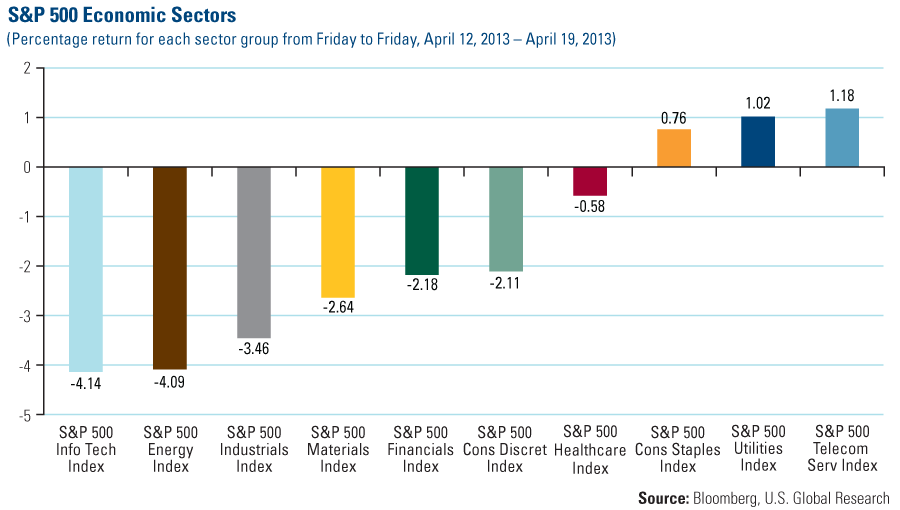
- The telecommunication services sector was the leader this week as Sprint Nextel rose by more than 15 percent on a takeout offer from Dish Network.
- The utility sector also outperformed as investors appreciated the stability and dividends that utilities offer.
- Sprint Nextel was the best performer this week as discussed above but Life Technologies rose by more than 8 percent on a takeout offer from Thermo Fisher Scientific. (more)
Monday, April 22, 2013
Switzerland Revises 1934 Banking Act to Allow Bail-in Deposit Confiscations!
 The
Swiss Financial Market Supervisory Authority (FINMA) has quietly joined
the growing parade of western nations who have quietly re-written
banking laws to allow depositor bail-ins upon the next banking crisis.
The
Swiss Financial Market Supervisory Authority (FINMA) has quietly joined
the growing parade of western nations who have quietly re-written
banking laws to allow depositor bail-ins upon the next banking crisis.If Switzerland, the once ultimate safe haven for banking deposits across the world is preparing to confiscate depositors funds, there truly is no protection anywhere other than physical gold and silver in your own possession!
In the event that a bank is failing or where its capitalization is no longer adequate, the Swiss Financial Market Supervisory Authority (“FINMA”) may take measures to improve such bank’s financial viability rather than liquidating it. “Loss absorption” and “bail-in” are important instruments to support any such measures. (more)
Subscribe to:
Posts (Atom)