Tuesday, May 31, 2011

Currency Valuations: Charting Which is Under/Over Valued….

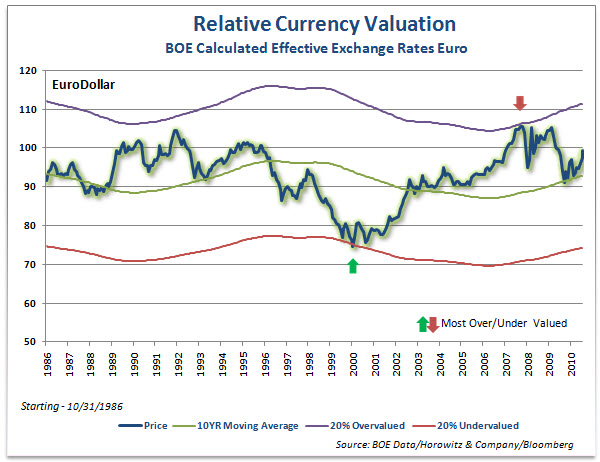
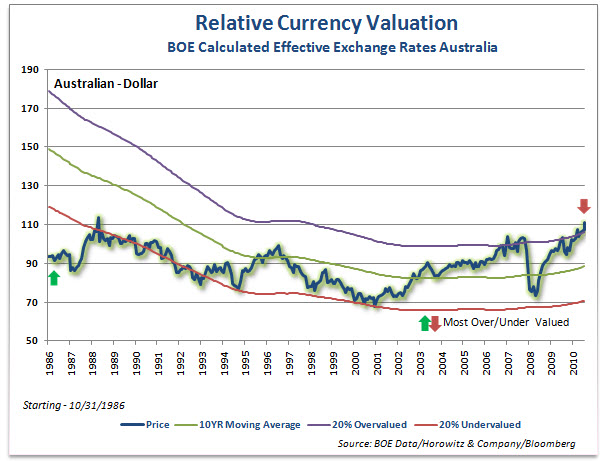
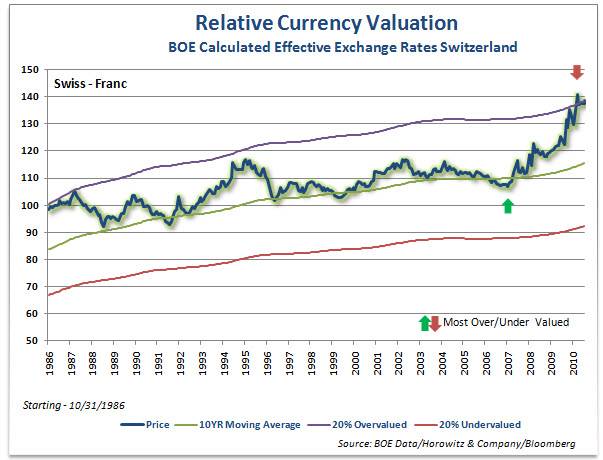
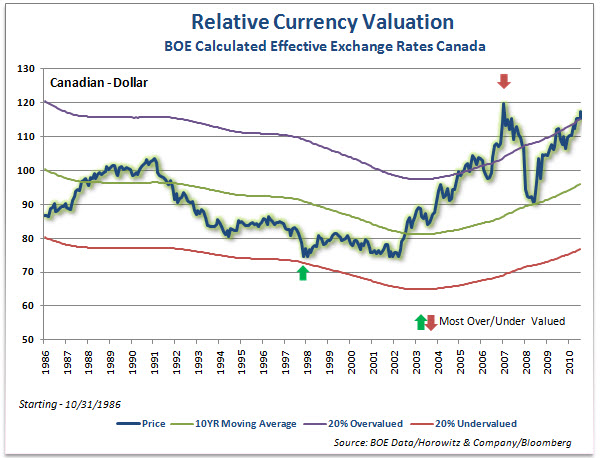
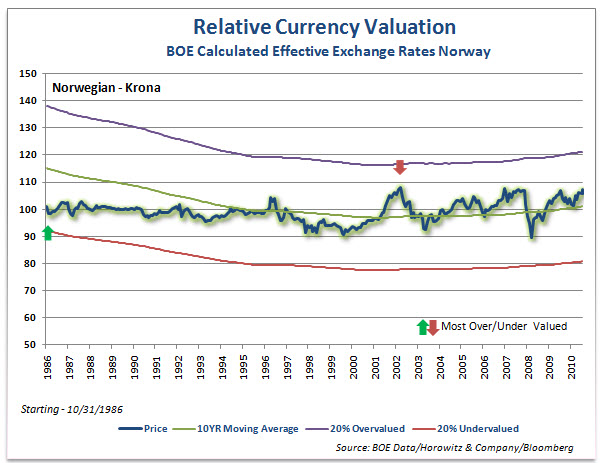
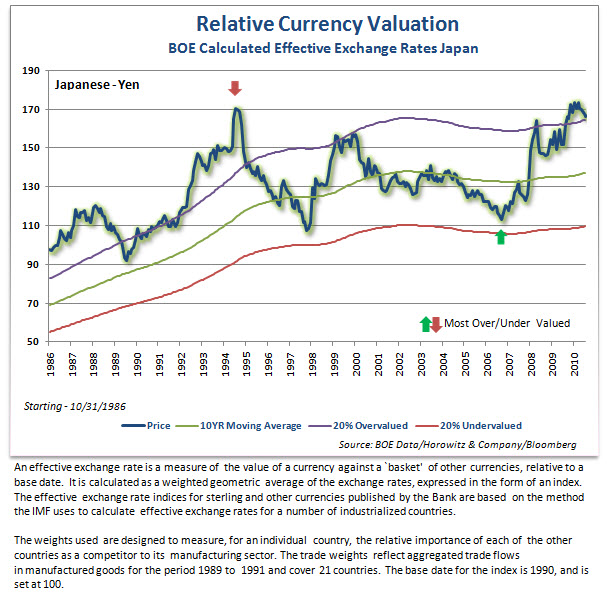
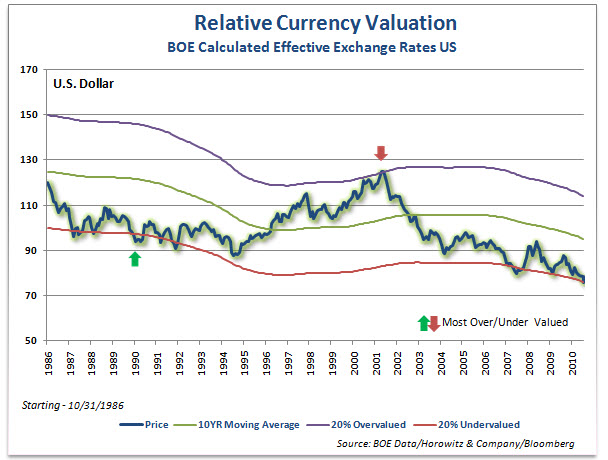
Check out the relative valuations. The U.S. dollar is well undervalued and the Yen overvalued. At least using this calculation…
The BOE states: An effective exchange rate is a measure of the value of a currency against a `basket’ of other currencies, relative to a base date. It is calculated as a weighted geometric average of the exchange rates, expressed in the form of an index. The effective exchange rate indices for sterling and other currenciespublished by the Bank are based on the method the IMF uses to calculate effective exchange rates for a number of industrialized countries.
The weights used are designed to measure, for an individual country, the relative importance of each of the other countries as a competitor to its manufacturing sector. The trade weights reflect aggregated trade flows in manufactured goods for the period 1989 to 1991 and cover 21 countries. The base date for the index is 1990, and is set at 100.
(Click on each chart to enlarge)

SEASONAL TRENDS: WHAT TO EXPECT FOR JUNE

Another month is just about in the books so the wise market player has to begin thinking a few steps ahead.  Next week will mark the beginning of June, a traditionally lackluster month for the S&P 500.  The always resourceful Stock Trader’s Almanac has the breakdown for the history of June:
  • The “summer rally” in most years is the weakest rally of all four seasons
  • Week after June Triple-Witching Day Dow down 17 of last 19
  • RECENT RECORD: S&P up 10, down 5, average gain 0.1%, ranks seventh
  • Much stronger for NASDAQ, average gain 1.2% last 15 years
  • Watch out for end-of-quarter “portfolio pumping” on last day of June, Dow down 15 of last 21, NASDAQ down 5 straight
  • Pre-presidential election year Junes: #5 S&P & NASDAQ, Dow weaker ranks #7
  • June ends NASDAQ’s Best Eight Months.

Arizona Land Sells for 8% of 2006 Purchase Price


By John Gittelsohn
Bloomberg
May 30, 2011
A 10,200-acre (4,100-hectare) desert site in Arizona sold for $32.5 million this week, five years after a group with investors including the California Public Employees’ Retirement System paid $400 million for the land.
Arcus Property Solutions LLC, a private-equity fund with about $100 million under management, paid cash for the property in Goodyear, about 60 miles (97 kilometers) southwest of Phoenix, said Kent Kleinman, a spokesman for the Gilbert, Arizona-based company. The site, now called Amaranth Land LLC, had been planned for a 42,000-home community by the Calpers- financed group when it was purchased in 2006.
The deal shows how property investors are taking advantage of a plunge in values after the real estate bubble burst in Arizona. A group of lenders, led by Goldman Sachs Group Inc., seized control of the Amaranth site in 2009 after the bust halted development, said Jeff Garrett, owner of Garrett Development Corp., the land’s manager after the foreclosure.
“Five, six years ago, people were spending $200 million or $300 million or $400 million,” Garrett said in a telephone interview. “This just sold for about eight cents on the dollar.”
The 2006 buyers were a joint venture of MW Housing Partners III LP, a real estate fund with money from Calpers and Weyerhaeuser Co.; and Scottsdale, Arizona-based Montage Land LLC, according to Arizona Corporation Commission records. The deal was funded by a $250.1 million loan and $150 million in cash, according to Terry McDonnell, publisher of Business Real Estate Weekly of Arizona in Scottsdale.
Speculative Deals
“Of all the speculative deals I’ve seen here, this was right at the top,” McDonnell said in a telephone interview. “It’s hard for me to think of a more speculative deal of this magnitude in Maricopa County.”
Calpers, the nation’s largest pension fund, had investments valued at $209.7 million in MW Housing Partners III in the fiscal year ended June 30, 2007, according to its annual report. The next year, the investment had a negative market value of $102.9 million, the fund said. MW Housing wasn’t listed as a Calpers investment in fiscal 2010, its most recent report.
Calpers doesn’t discuss individual real estate deals, said Wayne Davis, a spokesman for the Sacramento-based pension fund, which had $234.5 billion of assets as of May 24. Bruce Amundson, a spokesman for Federal Way, Washington-based Weyerhaeuser, said MW Housing invested the $150 million cash in the Amaranth purchase.
Newhall Ranch
In October 2009, Calpers severed ties with Macfarlane Partners LP, the San Francisco investment firm led by Victor Macfarlane that managed MW Housing Partners. MW Housing also led Calpers’ $970 million investment in Newhall Ranch, a master- planned community north of Los Angeles that filed for bankruptcy in 2008, wiping out Calpers’ stake.
Garth Wieger, a founding partner at Montage, the managing partner of the development, said he couldn’t comment because of a confidentiality agreement. Michael Duvally, a spokesman for Goldman Sachs in New York, declined to comment.
The listing agent for the Arizona property was Nathan & Associates Inc. in Scottsdale. The land is now used for cattle grazing with future revenue possible from selling its water rights or letting Goodyear expand a nearby landfill, said Kleinman of Arcus Property.
“This won’t be developed in my lifetime,” Kleinman, who gave his age as “mid-50s,” said in a telephone interview. “Our plan is basically buy and hold and resell after the market appreciates.”
Monday, May 30, 2011

Jeffrey Gundlach: Here's The Currency That's Better Than Gold In An Extreme Crisis


If things get really bad, forget gold.
In our interview with Jeffrey Gundlach, the legendary bond manager said it's good old paper cash that you want to have on hand. And not cash in the bank. More like cash under your bed, that you can pick up and carry (which you can't do with gold... do you really think that you're going to shave of flints from your goldbrick to pay for food at the store?).
And if you really can't stomach cash, even precious stones are better, since it's much easier to carry a few million in gems around then a few million in gold, which is way too heavy.
The discussion came after a broader talk about derivatives, which he sees as still posing potentially huge systemic risk to markets.

James Turk : $8,000 GOLD and $400 SILVER between 2013 and 2015


James Turk : ...well let's step back and look at the long term point of view I am sticking to my long term forecast that sometime between 2013 and 2015 Gold will be about $8000 and ounce and Silver will be about $400 an ounce , the ratio between the two metals will be 20 ounces of silver to buy one ounce of gold , I made this forecast back in October 2003 , obviously when the price of gold and silver was much much lower , the point I am making is that we are in a financial bust and during a financial bust like the one we have been in for several years and still few more years to go people move out of financial assets and move into tangible assets because they are looking for a safe heaven , they want to avoid counter party risk and the safest of all heavens are the precious metals because they are tangible assets with no counter party risk , so for the longer point of view we are still heading into a much much higher , you mentioned the way I approach the market which is to continue accumulating , do not view gold as an investment it really is not an investment because it does not generate cash flow it's really money and when you accumulate gold you are actually saving money and saving money is a good thing , at some point in time in the future we are gonna take these savings and either invest them or we gonna spend them or just continue to hold them , at some point in time in the future gold will be at the maximum and you want to take advantage of everything that you are saving now through the these difficult economic and financial times , in regard to the short term , I am looking for a a pop up in gold price this summer and it relates back to what happen in the summer of 1982 when the Mexican government defaulted on its debt and it sent gold up 50 percent in three months and a double in six months , the circumstance today is very similar , the government ready to default though is not Mexico , it's Greece Portugal Ireland may be even Italy who knows , any number of countries that will be defaulting on their debt and when that happens I think that could really light a fire out of the Gold price so ...be prepared for an upside jump in the gold price this summer ....

TOP 5 GRAPHS OF THE WEEK

This week we look at some of the latest economic data coming out of Japan; noting a rare occurrence of positive inflation, and observing a further trade deficit in April. Then we look at some US data, first checking in on the US consumer sentiment index, and then a proxy for investor sentiment – long term mutual fund flows. Finally the latest monetary policy interest rate decisions are covered-off.
1. Japan Inflation
As noted Japan recorded a rare positive inflation figure in April as consumer prices rose 0.3% on an annual basis, having sat at 0% for most of this year, while April 2010 saw deflation of -1.2%. A certain degree of the positive inflation figure can be attributed to temporary shortages brought about by the earthquake, but inflation had been in a mild upward trajectory anyway. Like the rest of the world, Japan had seen some impact from rising commodity prices (as can be seen in the upward trend in imports on the next chart). Meanwhile aggregate demand has probably only had a marginal impact on inflation as the Japanese economy has been in its second recession after a brief period of growth.
2. Japan International Trade
Japan reported exports of JPY 5.2 trillion in the month of April, down -13% year on year and -12% month on month. Imports were JPY 5.6 trillion, up 9% from April last year and down -1% compared to March. The April figures add another month of trade deficit as rising import costs meet relatively stable exports. The April figures did see some impact from the earthquake as supply chain disruptions weighed on exports. Overall Japan is yet to see either its exports or imports reach pre-crisis levels, which shows the weakness of the Japanese economy, but also the slow rate of growth and economic recovery in its trading partners (not to mention a rising share of global exports for China and other emerging markets).
3. US Consumer Sentiment
The Reuters/University of Michigan US consumer sentiment survey showed some improvement in the final reading for May, with the index at 74.3 vs consensus 72.4, and the April reading of 69.8. Future expectations performed well, at 69.5 vs 61.6 in April, meanwhile current conditions was basically flat at 81.9 vs 82.5 in the previous month. So while the current conditions result was not inspiring, the trajectory of the future expectations part was promising, indeed if the trajectory continues it will be positive for the medium term outlook, which is consistent with other indicators and conditions.

4. US Mutual Fund Flows
US mutual fund flows remained in positive territory in total during April, with the majority of net inflows going to bond mutual funds, showing a possible pick up in momentum after flows into bond funds dried up at the start of the year. Domestic equity flows continued to languish, while foreign equity fund flows remained positive as investors looked elsewhere for better macro-economic fundamentals. It will pay to watch this chart through the year, especially as key events unfold such as the ending of quantitative easing, and a potential short-term correction in US equities. A final thought on the chart below is the large amount of funds that have flown into bond mutual funds, this aspect will be interesting for equities when/if bond returns begin to suffer as the monetary policy stance turns later this year.

5. Monetary Policy Review
The past week in monetary policy saw six emerging market central banks announce interest rate decisions. Those that altered interest rate levels included: Israel +25bps to 3.25%, and Nigeria +50bps to 8.00%, while those that held interest rates unchanged were: Pakistan 14.00%, Turkey 6.25%, Georgia 8.00%, and Mexico 4.50%. So it was very much a continuation of the theme were emerging markets begin to take more caution in balancing the growth vs inflation risks, but also as the inflation impulse begins to taper off as policy measures and stable commodity prices begin to take effect. But the rate hikes in Israel and Nigeria show that inflation pressures are not completely gone in emerging markets, indeed Vietnam is still a hotspot of inflation.

Summary
So we saw the emergence of inflation in Japan, after a long period of deflation, however short term factors were likely the main cause of this. Meanwhile Japan’s international trade results showed stagnant growth and short term impact from the earthquake. In the US consumer sentiment improved again, heading in a promising trajectory. Also in the US long term mutual fund flows pointed to some interesting trends, and some key areas to watch in the stock and bond markets through the rest of the year. Finally, the week in monetary policy saw two emerging market economies tighten, while other emerging markets opted for caution in the growth risk vs inflation risk balancing act.

The Death of America - Doug Casey / Stefan Molyneux

Doug Casey on the Largest Criminal Entity on Earth . There are at least 7 trillion us Dollars held outside the United States , if the dollar collapses it is going to be a worldwide problem.The largest criminal entity today at large is not some Colombian cocaine gang , it's the US Government they're far more dangerous and they have a legal monopoly to do anything they want with you says Doug Casey , I rather deal with the mafia than I would with any agency in the US Government because first of all the Mafia tends to honor their word because they have no legal way of enforcing it , so it's easier to honor your word , US government never does that , and the Mafia has no legal right of enforcement , so the US government is much more dangerous and even under the worse circumstances even if the Mafia control the United States I can't believe that even Tony Soprano will try to steal forty percent people's income from them every year , he couldn't get away with it , but for some reason the US government is able to .


Doug Casey : "I'm of the opinion that most people are basically decent. The 80/20 rule. 80% of people are ok, basically. But now what about that 20%? Well, let's call them potential trouble sources, because they can go either way. But we can take 20% of that 20%, ok. And these people are the sociopaths "...Good points as usual...I like the sociopaths leading the 20% idea. Makes sense. Lack of philosophical anchors-great way to put it, reigning fear of middle class, yep, reflexive belief in gov't made up that some of those sociopaths. Got it. .  There are very few left who actually understand how, and why this country was founded, it is to escape the clutches of those who coerce and seek to control your life, starting with your mind, and right down to your very body and the space you exist in, simple as that.There is a lot more we can learn from Doug, and this is just an excerpt..