Saturday, August 4, 2012

John Butler: Death of the Dollar

John Butler Chief Investment Officer at Amphora Commodities Alpha and publisher of The Amphora Report talks to Alasdair Macleod about how America’s debt problem and political gridlock in Washington are risking the death of the dollar’s reserve currency status, and potentially leading the country on the road to a serious inflationary crisis.


from goldmoneynews:

Policy-induced inflation will triumph over deflation as a means in which credit deleveraging occurs, according to Butler. This is because it simply is not in governments or banks’ interests for a deflationary collapse to occur. As a result he expects central banks such as the Fed will continue to print money, and may resort to ever more blatant methods of doing so should more conservative policies fail to generate their desired level of inflation. This could result in purchases of corporate debt and perhaps even commodities.

Butler argues that though the eurozone’s debt crisis is a serious problem that should not be taken lightly, not enough attention is being paid to the severity of the debt and deficit issues facing America. He argues that the US is in worse shape than Europe on this score, and that the dollar’s status as a reserve currency actually makes it far more vulnerable than the euro to a currency crisis. Gold and silver will continue to benefit — the latter likely dramatically — from the increasing flight from the greenback. This podcast was recorded on 31 July 2012.

Should We Be Worried About The Truckers?

The Dow Theorists are flipping out.

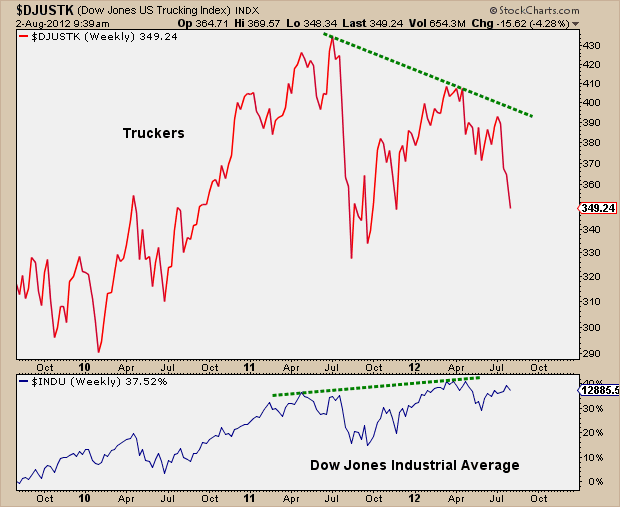
What this group wants to see is the Dow Jones Transportation Average make new highs whenever the Dow Jones Industrial Average takes out a previous peak. Dow Theory states that they need to confirm each other. In an uptrend both should be making new highs, and when one doesn’t, there’s a problem. Same thing in a down trend – when one average makes a new low, the other should follow. If there is a divergence, it’s considered a positive.

So this Spring, when the Dow Industrials took out their 2011 highs, we were waiting for the Transports to confirm. They never did.

Today I wanted to look at a chart of just the Truckers vs the Dow Jones Industrials Average to show just how weak this space looks right now:

So should we be worried about what the truckers are telling us?

I think so.

Rapidly Approaching Demise of Japan, Martin Armstrong


Rapidly Approaching Demise of Japan


click here to read

Mickey Fulp’s Masterful Monthly Market Review

The Mercenary Geologist and I got together for our monthly review of the markets. There was lots of action, but what a difference a day makes. But the important issues of the day far eclipsed the market wrap-up. The Fed basically said nothing, other than they are very concerned about the poor state of the economy and will do what needs to be done, can anyone say money printing? Oh and by the way, the US Postal Service is broke, insolvent and bankrupt. They’re going to miss a $5.5 billion payment towards retiree health benefits that they would like to do away with anyway. There was another major flash crash that took place at major market maker Knights operation. But never fear, the SEC is on the case and heads are not gonna roll.


Drought - $8.00 Corn – Now What?

By Mark Soderberg, Archer Financial Services
Six weeks ago I wrote a story titled “As Temperatures Heat Up – Will the Corn Crop Shrivel Up?” At that time Dec-12 corn prices were very near the $5.65 level, having just started to rebound off the $5.00 spring lows. I suggested that if the nation’s Corn Belt didn’t receive beneficial rains and relief from the searing heat very soon that prices would continue to soar as crop prospects would diminish. My fear was that if production prospects slipped towards the 13 billion bushel level, prices would have to surge toward the $6.50 - $7.00 level in order to ration demand and ensure supplies didn’t run out. Never did I envision that the record heat and drought conditions would not only persist, but worsen over such a vast area of the Midwest. Recently, the state climatologist in Iowa declared this year’s drought the worst since 1936. Both corn and soybean crop ratings are rapidly declining toward the all time lows recorded in 1988.
At the moment only 24% of the nation’s corn crop is rated good or excellent, while 48% of the crop is rated poor to very poor. Given the current crop conditions I sense the market has discounted an average yield for this year’s corn at 130 bu. per acre, well below the current USDA forecast of 146 bpa. In addition we’ll likely see the harvested acre’s be reduced as a larger percentage of this year’s crop is abandoned. At present as Dec-12 corn prices chop around the $8.00 level I sense the market has discounted this year’s corn crop at just under 11.2 bil. bu. If demand for the 2012 corn crop were left unchanged at 12.720 bil. bu., the resulting ending stocks would fall to negative 600 mil. bu. Obviously prices had to surge to levels high enough to reduce demand by at least 1 bil. bu. in order to maintain minimal supplies ahead of the 2013 harvest. At the moment it is unclear if the $8 level has accomplished this. What is also unclear is whether the crop can still manage to reach the 11.2 bil. bu. level. I’ve seen estimates as low as 10.5 bil. bu.

Chart provided by APEX
The good news is, we are already seeing evidence that the rationing process has begun. Ethanol production for the last four weeks has fallen below levels needed to reach the corn usage estimate of 5.050 bil. bu. My guess is it is over estimated by 30 – 50 mil. bu. Also export demand has completely collapsed as demand shifts to cheaper supplies from South America. Here too, I expect the USDA’s export forecast is 30 – 50 mil. bu. too high. The end result is likely to show an extra 60 to 100 mil. bu. of corn supplies left over from last year. Going forward however, I suspect we have not yet seen the highs in Dec-12 corn. I believe a correction will be limited to the $7.40 - $7.60 area before prices surge back above the current highs of $8.20 once harvest is under way and the true extent of damage to this year’s corn crop is more evident. How high will prices ultimately go? At 11 bil. bu. I suspect Dec-12 corn will peak between $8.50 - $9.00. If production were to slip to 10.5 bil. bu., prices will likely have to reach $9.50, possibly $10.00 per bu. There is already a growing list of livestock, hog, and poultry groups lobbying the EPA to reduce or eliminate the ethanol mandate for the balance of 2012 and all of 2013. Given the elections this coming November, I’m near certain action this drastic will not occur. However if the $10 price level is attained post election, I’d argue the odds of the mandate being lifted would grow dramatically.

Richard Russell - Brutal Times, Here Is The Key Going Forward


Today the Godfather of newsletter writers, Richard Russell, wrote about life during the Great Depression and the unknown but extremely important index that everyone needs to watch going forward: “The 30 Dow Industrial stocks portray the industrial capabilities of the US. But suppose there was an Index that portrayed the industrial capabilities of the entire civilized world? Happily, we now have just such an index. Dow Jones developed it, and they call it GDOW. It's made up of 150 major blue chip international stocks, and it includes all 30 D-J Industrial stocks plus over 100 other major international blue chips.” (more)

The Next Four Years by Gerald Celente

In the summer, 2012, issue of the Trends Journal, Gerald Celente explains that, despite Obama’s or anyone else’s promises, change will not occur until we as individuals change. Those who wait for a leader to emerge who will do the right thing wait in vain:


I the Person = We the People

What will it take to change the course of the future? As America, the world superpower, gears up to elect its commander-in-chief, each candidate touts his leadership experience; Obama the Osama Slayer vs. Romney the Corporate Commando. Each lists his credentials, saying in effect, “this is why I should lead and why you should follow your leader.”

And what will they lead us to? Economic nirvana, world peace, environmental renewal, social harmony, cultural foment, spiritual enlightenment? (more)