Monday, January 2, 2012

Silver Awaiting Pivot Low

Since its Sept-Oct recovery rally peak at $35.71, spot silver prices have stair-stepped to the downside towards a retest of the Sep 26 spike low at $26.02. If violated and sustained, this should trigger a final bout of long liquidation that presses silver into a minimum target zone in the vicinity of $25.00, but possibly into the $22.00-$20.00 target support zone, where I will be expect price stability ahead of the emergence of a sharp recovery rally period.

At this juncture, only a sudden sharp upside reversal that hurdles and sustains above $31.70 will neutralize my still-bearish near-term outlook for silver and the iShares Silver Trust ETF (SLV).

Silver Wheaton (SLW), too, is on the defensive, and also still points lower, into an optimal target zone of 23.75 to 22.00 prior to my expectation of a significant intermediate-term low, followed by a powerful new bull leg in its longer-term bull trend.

At this juncture, only a rally that hurdles 32.00 will neutralize my current outlook.

What will Stocks do in 2012?

Today is it for stocks in 2011, what will 2012 bring?

For the 2012 the Dow Jones is on track to close up 5.9%. The S&P 500 is set to close up 4 points which is only a .3% increase for the year, basically flat. The NASDAQ is down 37 points for 2011, down 1.4%. So what about 2012, how will stocks do?

It was a volatile year to say in the least. Volatility was high throughout 2011, with the S&P 500 climbing 9% at its peak, and falling 14.5% to its bottom. The CBOE Volatility index was up about 29% this year.

As for 2012, Mastery considers the opinion of Doug Kass. Kass was on CNBC earlier this week, here are his comments:
"I think the S&P will eclipse the early 2000 high of around 1,525 — in the beginning I think the market is range bound but by late spring and early summer I think we see (bullish) catalysts move the market." Best part is Kass believes the Occupy Wall Street will have a positive impact on stocks. Here is the video (commentary continues below):


Keep in mind fellow Masters Doug Kass was on the money for 2011 saying we would have a bunch of volatility, the market would trade sideways and the S&P 500 would finish the year almost unchanged.

Money Today - January 2012


Money Today - January 2012
English | PDF | 100 pages | 39.7MB


Money Today is a comprehensive, easy-to-read personal finance magazine that steers clear of the jargon that's common to money-related issues. Most important, it is utilitarian, offering readers clear tips on managing their money.

read it here

How To Strategically Default On Your Home And Live Scott-Free For Years


Millions of Americans have been sitting pretty in homes for years as they wait out the foreclosure process–for free.

The question is this: Should you?

It's something millions of home owners should think about, especially if the home they bought during the housing bubble is now worth far less.

Even when "strategic default" makes economic sense, many homeowners don't, simply out of fear and guilt.

There certainly are risks to weigh – a temporarily wrecked credit score for one thing – but draining cash with big monthly payments for a home value that might never return can be a big waste.

"A large number of Americans who are underwater on their mortgages would be better off financially if they walked away from their homes," says Brent White, a University of Arizona real estate expert.

"They don't because we have a double standard...individuals are told they have a moral obligation to pay their mortgages and corporations understand that contracts are to be breached when it's not economically efficient." (more)

Saturday, December 31, 2011

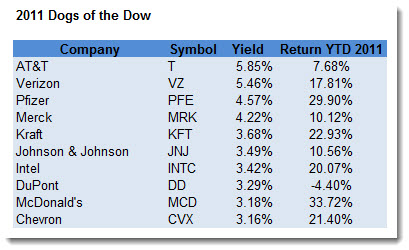
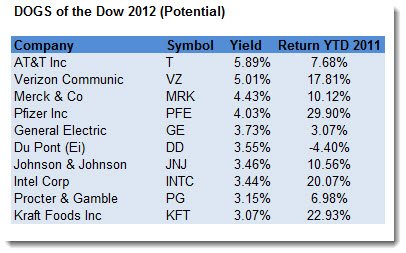
How Did Those Dogs (of the Dow) Do in 2011? Lineup for 2012

The Dogs of the Dow is one of the easiest screens to run. Simply find the 10 highest yielding stocks in the DJIA and viola, you have the Dogs.

So far in 2011, the Dogs have returned a whopping 17% on average. Not bad considering all of the things that went wrong this year. Let’s take a look at the names from the most recent litter.

As it stands now, the list for 2012 has only a few new names that have changed. Chevron (CHV) is out and Proctor & Gamble is in. McDonald’s (MCD) is also out and will be replaced by General Electric (GE).

It is a simple strategy that is rotated/rebalanced once a year and has done a decent job of beating the DJIA over time.

For more, check out Dogsofthedow.com.

George Soros Sees Gold as the “Ultimate Asset Bubble”

Gold is set to finish its 11th consecutive year of gains, the longest winning streak in at ninety years, and is on the brink of a bear market, says George Soros. The billionaire who called it the “ultimate asset bubble” two years ago, reduced his gold and gold related by 99 percent in the first quarter of 2011, according to the Securities and Exchange Commission data.

Betty Liu reports on Bloomberg Television’s “In the Loop.”

Gold Bubble Seen by Soros on Brink of Bear Market


Source: Dec. 29 (Bloomberg)~~~

See also

George Soros Says Markets Are `Always Fallible’


Billionaire investor George Soros talks about global financial markets and his philanthropy. He speaks with Francine Lacqua on Bloomberg Television’s “Eye To Eye.” (Source: Bloomberg)Oct. 10 (Bloomberg)

Avoid The Generation Debt Trap

There is a worldwide generation that is marked by young, highly educated individuals who are often mired in unmanageable debt. In the United States it is called "Generation Debt," a phrase coined by author Anya Kamenetz. In Europe, it is called the "1,000 Euro Generation," a moniker credited to an internet novel published in Italy. How can young people all over the globe avoid this trap? Read on to find out.

Unmanageable Debt
Unmanageable debt is debt that can't be serviced without significant hardship to the borrower. More technically, it refers to non-housing related debt in excess of 8% of a person's gross income. The figure often comes into play when calculating eligibility for loans, particularly housing.

When it comes to housing loans, your front-end ratio , which consists of the four components of your mortgage: payment principal, interest, taxes and insurance (often collectively referred to as PITI), should not exceed 28% of your gross income. Your back-end ratio, also known as the debt-to-income ratio, should not exceed 36% of your gross income. The difference between the two is where the 8% figure comes from.

To calculate your maximum monthly debt based on these numbers, multiply your gross income by 0.36 and divide by 12. For example, if you earn $35,000 per year, your maximum monthly debt expenses should not exceed $1,050, of which not more than $816.60 should be dedicated to housing. That gives you about $233 a month to cover your car payment, school loans, credit cards and all other forms of debt. For those just starting out in the working world and earning a small salary, this really doesn't provide much room to service debts.

How Does it Happen?
There are many factors that lead to unmanageable debt. For one, there is the high cost of a college education, which CollegeBoard.org cites as $28,500 for one year at a f our-year private institution and $8,244 for one year at four-year public school, during the 20011-2012 school year. Students pay the price in the hope of securing high-paying jobs.

Some students are lucky enough to have their parents' help or scholarships to cover the cost, but many students are not this fortunate. According the FinAid.org, two-thirds of students graduate with some debt; the average undergraduate student loan debt is nearly $23,186, while graduate students, depending on the degree, end up owing an average of between $42,898 and $118,500.

If students accumulate credit card debt or lines of credit during school to pay for rent, food, car leases and other living expenses, their total debt upon graduation can really add up. As a result, many students start their careers with a considerable debt burden.

Housing: Buy, Rent or Move Back Home?
After crunching the numbers to address the question of where to live once they graduate, many young people realize that they can't afford to pay a mortgage on top of servicing their existing debt. Others decide to buy and end up house poor, and more than a few move back in with mom and dad, ending up as boomerangs.

Unrealistic Expectations
In addition to the costs of education and housing, a pervasive culture of consumerism encourages additional consumption, turning luxury items into necessities. Travel, cell phones and computers are among the possessions everyone seems to have. Everyone wants to live "the good life," but because not everyone can afford these items, particularly young people who are already carrying significant student debt loads, credit cards and borrowing often fill the gap.

Few people remember that things weren't always this way. In the not-so-distant past, people worked a lifetime to achieve their financial goals, and their goals were often modest. A house in the suburbs (not a McMansion ) was a huge achievement; in 1950, that home was about 983 square feet, but by 2011 the average size had ballooned to 1,800 square feet, according to the National Association of Home Builders. Similarly, baby boomers may recall that their parents' vacations were infrequent and often involved domestic travel. Other luxury items such as high-end cars and designer clothes have also become more common; in fact, marketers frequently refer to the "under-40 luxury consumer" as a key demographic.

Today, the affordability of travel, easy access to credit and heavy marketing efforts have changed the dynamic. Young people grow up seeing the lifestyles that their parents enjoy, and they want to live that way too, but without working for decades to achieve it. The end result is often unmanageable debt.

The Bottom Line
In our fast-paced consumer culture, the truth is that slow and steady still wins the race. Simple decisions, such as not spending more than you earn and learning to delay purchases until you can pay for them in cash, go a long way toward getting your financial house in order. In most cases, the biggest challenge you face isn't financial, but the need to curb your desire to spend.

While the lure of spending can be hard to resist, take your grandmother's advice and appreciate what you have instead of complaining about the things you lack.