Saturday, December 24, 2011

2012 Outlook: Gold Is Battered, Bruised, But Not Beaten


Like a prizefighter who has taken a few upper cut blows, gold might be a bit woozy, but the metal’s longer-term uptrend is hardly on the ropes.

As in many financial sectors, gold’s price direction has been guided by headlines, particularly out of Europe on the sovereign debt situation, and the volatility caused by swiftly changing news has made many markets a bit punch-drunk.

The December price break for gold came as several events aligned. First, the market was never able to retest its all-time nominal high in August of $1,923.70 an ounce. Second, gold was one of the few star performers this year and when equity and other markets soured, money managers needed to raise cash to meet margin calls and shore up positions elsewhere. Third, with investors spooked by the continued inability for eurozone leaders to convincingly shore up their union, these investors sought safety in the most liquid vehicle available – cash – again pulling profits from gold.

Gold might be down about 16% from the August highs, but it’s still up roughly 14% from the 2010 settlement of $1,421.40, basis the nearby futures, which still makes it one of the best performers this year.

The yellow metal may be in a consolidation mode for the time being, resting and building a base to rally again, just like that prizefighter whose corner man keeps him in shape to go the distance.

Market watchers said the structural strength for gold remains intact, with most Western nations’ global interest rate policies falling or near zero, which makes the opportunity cost of holding gold negligible. The sovereign debt crisis in Europe still makes people nervous about holding fiat currencies. With the amount of liquidity floating around from quantitative easing programs from central banks like the Federal Reserve, fears that when the global economy starts to show decent growth again it will be difficult to rein in that stimulus.

Mark Leibovit, editor the VRTrader newsletter, said he remains overall bullish, but concedes the washout gold experienced in early December has done damage to technical charts.

“We might hit bottom in a month or so. How far it might go depends on how the technicals unfold. Short-term it’s held the September lows of $1,531. But we have to see it perform in both time and price to confirm it. What might it take do so? We’d need to see the equity market improve, Europe improve, and maybe a QE3,” he said, referring to a possible third quantitative easing by the Federal Reserve.

Leibovit said it’s possible that gold prices could have further room to fall, especially if a scenario unfolds like what happened following the bankruptcy of Lehman Brothers in September 2008. Price were already in a downdraft prior to the Lehman news, but a month later gold fell as far as $681, basis a front-month continuation futures chart.
This could happen if gold prices take out the $1,531 level, he said. In 2008 there was a 34% correction for gold. Based on that calculation, prices could drop to $1,270, Leibovit said.

Gold rebounded after the trip to sub-$700, but he pointed out that it still took about six months to confirm the bottom.

“We could see gold’s bottoming take anywhere from two to 12 months. But the bull market is still intact; we’ve seen these moves before. I think longer term $3,000 or $4,000 gold is possible in an inflationary environment,” he said.

BNP Paribas, which updated its precious metals forecast for 2012 on Dec. 20 to reflect the recent selloff, downgraded its outlook for gold prices by $250 an ounce to $1,775. The bank says “with high uncertainty likely to remain a major feature of the markets, gold could be vulnerable to further episodes of price correction.” However, they do not believe the bull market is over and are “still positive towards the gold price in 2012 and 2013.”

Sterling Smith, commodity trading adviser and senior market analyst at Country Hedging, said gold is putting in a bottom now, but said it will likely trade “sideways” for a while. The fundamentals for gold have not changed, he said.

“The EU problems will lead to some QE there and here maybe more mortgage-backed securities buys (by the Federal Reserve). If that happens, then it will help gold rise. Gold is still an asset; central bank buying will push it higher. Look six to nine months down the line and we can see gold back at $2,000,” he said.

While gold might benefit from any safe-haven buys at these lower price levels, the worries about Europe moving into a recession could cause the metal to be trapped in a tug-of-war, said Bob Siegel, president Cabot Capital Group, a money management firm.

“I see it range bound because it’s struggling to compete with the huge global concern that is the EU and the dampening effect on commodities. If it gets to be a depression (in Europe) it could get out of hand. Gold in the end is the ultimate store of value, though it is not as strong as some think it should be,” he said.

Gold is plagued by competing influences. The EU woes supports gold, but investors who seek liquidity pressure the metal, he said.

COULD GOLD REPEAT ANOTHER DOUBLE DIGIT RISE IN 2012?

In a word: sure. But much depends on the strength of the dollar, physical demand out of Asia and any new crises that may develop.

The forecast for gold to return to seeing a “two” as the front number in 2012 is shared by several investment banks. Morgan Stanley, TD Securities, Bank of America-Merrill Lynch and SEB Merchant Banking are among some of the banks who see gold either averaging above $2,000 or at least trading to that level at some time during next year.

Based on gold prices around $1,600, a move to $2,000 would be about a 23% rise.
Leibovit said he sees inflation coming down the road, the question is, “when does it kick in?”

Gold could continue to weaken into January, but he said gold investors need to consider a longer term view than six months or even a year. They should be taking at least a three to five year perspective.

Tom Winmill, portfolio manager of the Midas Fund, said there’s a good chance for gold to see another strong year.

“It’s very possible that it can be very strong year after year after year. We think the key component to gold is that it’s denominated in dollars. How high it can go will be dependent on how much money is created. With the two QEs, $2.2 trillion was created. There will be more money created down the road…. We (the U.S.) will be adding more money because we are borrowing. The borrowing represents the future creation of new money,” he said.

For 2012, Winmill is forecasting $1,950 by the end of the year, with a high of $2,200 and a low of $1,650.

The low interest rate environment is important to the gold outlook, Winmill said. “You can’t view rates in a vacuum – at Midas we view inflation rate next to the real yield…. The two-year bonds yield is 25 basis points. The 12 month CPI is (3.2%), so the negative real rate is (3%). That is destroying savings. Our view is as people become more aware of the destruction of wealth they will there will be a stampede into hard assets – gold, diamonds, real estate,” he said.

4 Cheap Agriculture Stocks for 2012: POT, CF, DE, AGCO

After several years of strong earnings growth and skyrocketing share prices, suddenly the agriculture stocks don't look so hot.

The sell off began earlier in 2011 and hasn't stopped. As a result, the fertilizers and the farm equipment manufacturers are now dirt cheap as investors have fled the sector.

What's going on? Didn't we just hear that the emerging market middle class is spending more on food and is adopting the western diet which means higher food prices from here until the end of time?

Supply and Demand Story Still Intact

Nothing has changed in the supply/demand story. Farmers are still running full throttle even though 2011 was a record year for farming income in the United States. The outlook is still very positive for further growth in 2012.

In the farming equipment category, demand is expected to remain strong, especially for high horsepower equipment. Farm-machinery sales are projected to rise between 5% and 10% in 2012.

With the agriculture stocks being beaten down in the last few months, that means this could be an opportunity to buy into the agriculture sector at very attractive levels.

The following four companies have solid earnings with some growth expected in 2012. But they are also extremely cheap, with forward P/Es well under the S&P 500 average of 12.7.

4 Cheap Agriculture Stocks for 2012

1. Potash Corporation (POT)

Potash is one of the largest fertilizer companies in the world. This Zacks #3 Rank (hold) produces about 20% of the world's potash as well as phosphates and nitrogen.

Forward P/E: 10.9
2011 expected EPS growth: 80%
2012 expected EPS growth: 19%

2. CF Industries Holdings (CF)

CF Industries is the second largest nitrogen fertilizer maker in the world. This Zacks #2 Rank (buy) is also the third largest publicly traded phosphate producer. With a low single digit P/E, this is the cheapest the stock has been, on a valuation basis, since the Great Recession.

Forward P/E: 6.1
2011 expected EPS growth: 162%
2012 expected EPS growth: 2%

3. Deere & Company (DE)

Deere manufactures farm and construction equipment in 30 countries worldwide. This Zacks #2 Rank (buy) has been in business since 1837. It just posted a record fiscal 2011. It's bullish on fiscal 2012 as well.

Forward P/E: 9.9
Fiscal 2012 expected EPS growth: 17.2%
Fiscal 2013 expected EPS growth: 6.7%

4. AGCO (AGCO)

AGCO manufactures agriculture equipment, including tractors, combines, sprayers and forage equipment through distributors in 140 counties. The CEO recently commented that demand is still strong in the emerging markets.

Forward P/E: 9.5
Fiscal 2011 expected EPS growth: 88.4%
Fiscal 2013 expected EPS growth: 13.4%

Feeding the World

Diets and food consumption patterns are changing as the global middle class grows. Yet the agriculture stocks have sold off like no one is going to be eating tomorrow. With valuations as low as they are, the agriculture stocks are a good value buy heading into 2012.

William O’Neil Offers Six Market Signals to Look For Before Investing in 2012

It has sort of been an “IBD” kind of day around here … in this post the founder of Investor’s Business Daily (and “godfather” of CANSLIM) William O’Neil takes to Forbes to discuss the 6 Market Signals he wants to see before going “all in bull” in 2012. I am not as focused on ‘the big bang’ market signal as the CANSLIM devotees – I tend to take my signals from the action of the individual stocks…. when a good lot of them begin acting healthy (outside of defensive sectors) my radar starts perking up. Devout CANSLIMers on the other hand look for a Follow Through Day (FTD) as explained:

….a day where a major index is up at least 1.7% in price with higher volume than the previous day. A great example is the NASDAQ FTD on October 18, 1990. Typically this occurs 4-7 days after a new rally begins and significantly increases the chances of a sustainable uptrend. No bull market has ever started without one.

———————–

Here are Mr. O’Neil’s thoughts:

Don’t get me wrong, I’d love to have a good market to operate in. But before investing aggressively on the long side in 2012, investors should be looking for the environment to prove itself in the following ways:

  • A FTD, as described above, accompanied by leading stocks breaking out from sound consolidation areas (recognizable chart patterns).
  • Because the market environment has been so poor, I’d like to see a second FTD. Given the lack of conviction seen in individual stock breakouts and weak rally attempts lately, the next market rally needs to prove itself, in a big way.
  • I’d like to see at least one real catalyst. None of the major economic or political issues weighing on the market have been resolved.
  • I’d also like to see more new issues in the IPO market. (splashy IPOs such as Zynga and LinkedIn aren’t enough)
  • New leadership should be emerging in traditional growth industry groups (such as, financial, technology, retail).
  • Fewer short setups on leading growth stocks and more constructive long chart patterns.

Keep in mind these are not predictions, but rather expectations that may or may not be met. Until they are, keep your powder dry and your watch list fresh. Our day will come.

Facebook's Stock Has Gone Flat On The Private Markets

Shares of Facebook have gone totally flat in the private market of SharesPost.

SharesPost said today it completed an auction of 150,000 shares at $32.00 per share, giving it an implied valuation of $80 billion. It's been sitting at that valuation for a few months now.

Maybe once Facebook opens up its books, investors will see great growth, and the valuation will rise.

Volatility Index: Has Fear Subsided or Just Seasonality

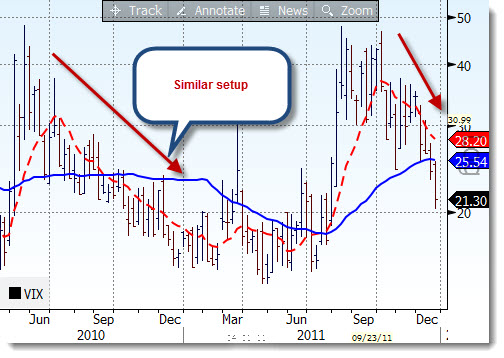
Levels of the CBOE Volatility Index (VIX) have been steadily creeping lower. Fear in our minds has certainly not subsided, despite the “Bazooka” introduced by Europe and the not so steady rise in equity prices. We haven’t seen these levels of VIX (i.e. Sub 21) since July of 2011. As a matter of fact, the recent pattern in the VIX is very similar to that of what developed between May of 2010 until April of 2011. During this time period the market moved higher by approximately 25-30% after shaking out all the extreme volatility.

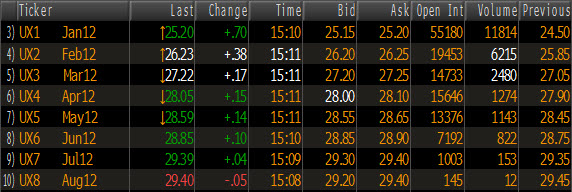
One could make the argument that with the unemployment levels improving and the Fed’s continued Zero Interest Rate Policy (ZIRP) that these levels are warranted. However, the spreads on the VIX Futures contracts paint a very different story. Most seem to be pricing in the fact that volatility will increase after the first of the year. As it stands, there is currently an almost 20% premium between the VIX Index and the front month futures contract that expires January 2012. The VIX index is currently trading at approximately $21 and the front month future is at $25.20. See table below for other futures expirations.

Water Stocks Worth Watching In 2012 : CGW, ERII, FIW, ITT, MSEX, PHO, PIO, TTEK, WTS, YORW


Despite the fact that water consumption has doubled the rate of population growth, investors still pay zero attention to the essential commodity. Over the past year, water-related equities have fallen right along with the rest of the market. Sector measures like the PowerShares Water Resources (ARCA:PHO) sit closer to their 52-week lows rather than their highs.

However, the long-term picture for water-related firms is still quite rosy. As incomes and populations in a variety of emerging nations continue to rise, the demand for water is also increasing. These incomes are moving water beyond the basic requirements needed for drinking, cooking and hygiene. Analysts estimate that over the next 20 years, India is expected to see its water demand more than double and China's will rise by 30%. The World Resources Institute projects that overall water demand will increase by more than 50% over the next 15 years in emerging market nations and by more than 15% in developed markets.

Given the long-term bullishness towards the water theme, investors may want to consider adding that type of stock to a 2012 portfolio. Here are some stocks and funds to watch for in the coming year.

Desalination Growth
Abundant natural gas and renewable energy has many nations now turning to desalination as a way to solve their water problems. Analysts at Pike Research estimate that cumulative investment in new plants will reach $87.8 billion worldwide from 2010 to 2016. This bodes well for engineering and construction firm, Tetra Tech (Nasdaq:TTEK). The company has been designing desalination facilities in Florida since the 1990s and developed California's first desalination plant. The firm continues to expand globally as well. In addition, Energy Recovery (Nasdaq:ERII) designs and manufactures products that allow plants to capture lost power, often with up to 98% efficiency. These two stocks offer an interesting pair to play the growth in worldwide desalination.

Big Dividends in Water Utilities
Investors who are looking for income can find plenty of opportunities in the water sector. Middlesex Water (Nasdaq:MSEX) currently yields about 4% and has increased its dividend in each of the last 39 years. Similarly, The York Water Company (Nasdaq:YORW) just paid its 564th quarterly dividend and yields 3.2%. Both offer investors a wide range of infrastructure assets as well as water-reservoir exposure. These firms should continue to see outperformance as more portfolio focus is put on equity income.

The ETF Plays
Finally, for investors wanting to take advantage of the entire spectrum, there are plenty of exchange-traded funds (ETFs) that invest in the sector. The First Trust ISE Water Index Fund (ARCA:FIW) tracks the top 36 water stocks and has been the best performer in the category this year. The fund features a variety of water-equities including ITT (NYSE:ITT) and Watts Water (NYSE:WTS). Investors looking for more of a global focus can refer to the Guggenheim S&P Global Water Index (ARCA:CGW) and PowerShares Global Water (ARCA:PIO).

The Bottom Line
Despite the pressures facing our water systems, investors continue to ignore the precious commodity. Going into 2012, stocks within the sector offer a unique investment that should pay off in spades. Adding some of the previous funds or individual equities makes an ideal play in the New Year.


Mother Jones USA - January/February 2012


Mother Jones USA - January/February 2012
English | 72 pages | HQ PDF | 60,8 Mb

Mother Jones is an independent, nonprofit magazine dedicated to bringing you smart, fearless journalism. Winner of the 2008 National Magazine Award for General Excellence, MoJo is committed to gutsy, no-holds-barred investigative reporting that asks tough questions and gives you real answers. Mother Jones is uncensored, irreverent, not beholden to special interests -- and obligated only to you.

read it here