Ron Griess of the Chart Store suggests that the 200 day is the wrong technical indicator to focus on regarding Gold.Looking back to this run, he suggests the 300 day is the more supportive index:
>
click for larger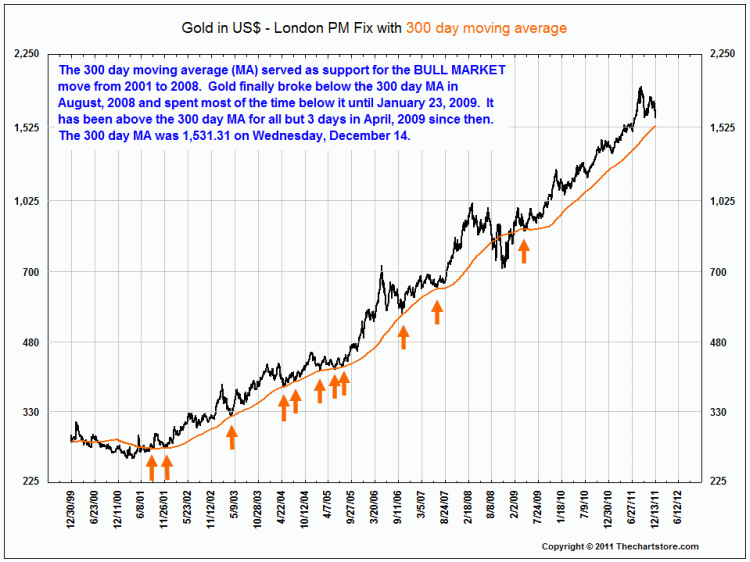
Ron Griess of the Chart Store suggests that the 200 day is the wrong technical indicator to focus on regarding Gold.Looking back to this run, he suggests the 300 day is the more supportive index:
>
click for larger
And so the focus shifts to the quietest neighborhood on the block: "The negative [Moody's] outlook on the province [of Ontario] reflects the softening economic outlook, Ontario's growing debt burden, and the extended timeframe to achieving a balanced budget." What's next: someone dares to question the stability of Canadian banks which as we it turns out may have a few hundred billion in hyper-rehypo assets (Canadian Imperial Bank of Commerce (re-pledged $72 billion in client assets), Royal Bank of Canada (re-pledged $53.8 billion of $126.7 billion available for re-pledging)) pledged there... and there... and there... and so, ad inf.
From Moody's:
RATINGS RATIONALE
The change in the outlook reflects Moody's assessment of risks surrounding the province's ability to meet its medium term fiscal targets given the recent slowdown in provincial economic growth and the resulting risks to the province's ability to stabilize the recent accumulation in debt.
"The negative outlook on the province reflects the softening economic outlook, Ontario's growing debt burden, and the extended timeframe to achieving a balanced budget," said Moody's Assistant Vice President Jennifer Wong, lead analyst for the Province of Ontario.
The province's Fall 2011 statement, released in November, revised its forecasts down for provincial growth in 2011 and 2012 to 1.8% and 1.8% from 2.4% and 2.7%, respectively. The provincial economy is particularly affected by the moderation in US growth, given its higher export share relative to other Canadian provinces and the high proportion of international exports (roughly 80%) destined for the US.
The province set out in its 2011-12 budget a plan to return to fiscal balance in 2017-18. Moody's has highlighted that the extended period of fiscal consolidation presents an element of risk in achieving the planned consolidation path, and a risk to stabilizing and reversing the recent deterioration in the province's financial position. At March 31, 2011, Ontario's net direct and indirect debt, at roughly 200% of consolidated revenues, was at the high end of the spectrum for Canadian provinces, whose ratings remain in the narrow range of Aaa to Aa2.
The slowdown in provincial economic growth presents a challenge to the already lengthy planned consolidation path, particularly given the strong expense growth seen in recent years. Expense growth leading up to the recent downturn was relatively robust, highlighting the challenge ahead. Indeed, expense growth averaged 7% annually in the five years to 2007-08, with health expenses having grown at an average of 8%. The fiscal plan presented in the 2011-12 budget assumed expense growth of roughly 2% annually for the duration of the plan.
Nevertheless, Moody's reports that Ontario's high investment-grade rating reflects high debt affordability and the high degree of fiscal flexibility inherent in the institutional framework governing the way Canadian provinces operate. The current low interest rate environment has enabled the province to issue long-term debt bearing historically low coupons. While the proportion of revenues consumed by interest payments has increased with the recent accumulation in debt, this remains manageable given the province's fiscal flexibility. Moreover, the province's large and diversified economy and growing population provides access to a broad and productive tax base and, as such, remains a source of credit strength.
While Ontario retains sufficient fiscal flexibility inherent in the institutional framework to adjust its fiscal outcomes, thereby improving its financial position, difficult policy decisions are required.
"We believe that increased fiscal discipline will be required to sustain debt affordability," said Ms. Wong. "If a credible plan to address the fiscal imbalance and stabilize the debt burden is not implemented in the next provincial budget, expected in March 2012, downward pressure on the province's Aa1 rating would emerge."
Moody's P-1 rating on Ontario's commercial paper program remains unchanged.
The Province of Ontario is Canada's largest province, representing approximately 40% of national GDP. The province's population measured approximately 13.2 million in 2010.
WHAT COULD CHANGE THE RATING UP/DOWN
A rating upgrade is unlikely in the near term given the current context of continued consolidated deficits and debt accumulation.
An inability to address continued consolidated deficits and to stabilize the debt burden over the medium term would put downward pressure on the rating. Further downward revisions to growth would also place pressure on the province's ability to achieve medium term fiscal targets and would place negative pressure on the rating. Finally, if debt affordability were to deteriorate due to higher-than-expected increases in debt levels or a significant rise in interest rates, the province's fiscal flexibility would be reduced, exerting downward pressure on the rating.
The methodologies used in this rating were "Regional and Local Governments Outside the US", published in May 2008, and "The Application of Joint-Default Analysis for Regional and Local Governments", published in December 2008.
Please see the Credit Policy page on www.moodys.com for a copy of these methodologies.
REGULATORY DISCLOSURES
Although this credit rating has been issued in a non-EU country which has not been recognized as endorsable at this date, this credit rating is deemed "EU qualified by extension" and may still be used by financial institutions for regulatory purposes until 31 January 2012. ESMA may extend the use of credit ratings for regulatory purposes in the European Community for three additional months, until 30 April 2012, if ESMA decides that exceptional circumstances arise that may imply potential market disruption or financial instability. Further information on the EU endorsement status and on the Moody's office that has issued a particular Credit Rating is available on www.moodys.com.
For ratings issued on a program, series or category/class of debt, this announcement provides relevant regulatory disclosures in relation to each rating of a subsequently issued bond or note of the same series or category/class of debt or pursuant to a program for which the ratings are derived exclusively from existing ratings in accordance with Moody's rating practices. For ratings issued on a support provider, this announcement provides relevant regulatory disclosures in relation to the rating action on the support provider and in relation to each particular rating action for securities that derive their credit ratings from the support provider's credit rating. For provisional ratings, this announcement provides relevant regulatory disclosures in relation to the provisional rating assigned, and in relation to a definitive rating that may be assigned subsequent to the final issuance of the debt, in each case where the transaction structure and terms have not changed prior to the assignment of the definitive rating in a manner that would have affected the rating. For further information please see the ratings tab on the issuer/entity page for the respective issuer on www.moodys.com.
Information sources used to prepare the rating are the following :
parties involved in the ratings, parties not involved in the ratings, public information, and confidential and proprietary Moody's Investors Service information.
Moody's considers the quality of information available on the rated entity, obligation or credit satisfactory for the purposes of issuing a rating.
Moody's adopts all necessary measures so that the information it uses in assigning a rating is of sufficient quality and from sources Moody's considers to be reliable including, when appropriate, independent third-party sources. However, Moody's is not an auditor and cannot in every instance independently verify or validate information received in the rating process.
It’s that time of year again and I’m not talking about the holiday season… What I am talking about is another major market correction which has been starting to unfold over the past couple weeks.
I have a much different outlook on the markets than everyone else and likely you as well. However, before you stop reading what I have to say hear me out. My outlook and opinion is based strictly on price, volume, inter-market analysis, and crowd behavior and you should put some thought as to what I am saying into your current positions.
My fundamental thinking is also a contrarian one. I feel that gold and silver have risen because of obvious reasons being printing of money but also fears that fiat currenecies will become obsolete in the next 5 years.
The problem with that thinking is that most or all the bad news has come out with Europe and we know there are still major issues to resolve but the end of the world did not happen. Looking forward 5 years countries will have stopped acting like teenagers spending more money they they have on their credicards and start creating budgets which they will abide by.
What does this mean? It means the global economy as a whole will be stronger than ever before. We may have a few bumps along the way but I feel countries and individuals will be better than ever 5 years from now
Two weeks ago I sent my big picture outlook to my subscribers, followers, and financial websites warning of a major pullback. You can take a quick look at what the charts looked like 2 weeks ago: http://www.thegoldandoilguy.com/articles/the-currency-war-big-picture-analysis-for-gold-silver-socks/
Since my warning we have seen the financial markets fall:
SP500 down 2.6%
Crude Oil down 4.4%
Gold down 9.6%
and Silver down 12.2%
If you applied any leverage to these then you could double or triple these returns through the use of leveraged exchange traded funds. The amount of followers cashing in on these pullbacks has been very exciting to hear. The exciting part about trading is the fact that moves like this happen all the time so if you missed this one, don’t worry because there is another opportunity just around the corner.
While my negative view on stocks and precious metals will rub the gold and silver bugs the wrong way, I just want to point out what is unfolding so everyone sees both sides of the trade. I also would like to mention that this analysis can, and likely will change on a weekly basis as the financial markets and global economy evolves over time. The point I am trying to get across is that I am not a “Gloom and Doom” kind of guy and I don’t always favor the down side. Rather, I am a technical trader simply providing my analysis and odds for what to expect next.
Let’s take a look at some charts and dig right in…
In short, stocks and commodities are under pressure from the rising dollar. We have already seen a sizable pullback but there may be more to come in the next few trading sessions.
Overall, the charts are starting to look very negative which the majority of traders/investors around the world are starting to notice. With any luck they will fuel the market with more selling pressure pushing positions that my subscribers and I are holding deeper into the money.
Now that the masses are starting to get nervous and are beginning to sell out of their positions, I am on high alert for a panic washout selling day. This occurs when everyone around the world panics at the same time and bails out of their long positions. Prices drop sharply, volume shoots through the roof, and my custom indicators for spotting extreme sentiment levels sends me an alert to start covering my shorts and tightening our stops.
Hold on tight as this could be a crazy few trading sessions….


