Tuesday, August 30, 2011

Value Play: Arch Coal (ACI)
 In the last 2 days, stocks have come back to claim almost half of the value that was lost
 in the August correction. However, there are still some stocks out there that took such a beat-down that they still present a valuable buying opportunity. One such stock is Arch Coal (ACI).
After today's rally, shares are currently trading at $20.27 a share. Over the past 12 months, Arch Coal Inc (ACI) shares have traded between $16.91 and its 52-week high of $36.99. Arch Coal Inc shares are now trading with a P/E Ratio of 19.4 and EPS of 0.98.
Dahlman Rose & Co. analyst Daniel Scott wrote in a note to investors that the sector should see gradually increasing volumes for its products. He expects to see rising prices for thermal coal in the U.S., which is used to generate electricity. Prices for hot-burning metallurgical coal used to make steel will remain flat in 2013 after dropping from current high levels into 2012, Scott wrote:
Scott wrote that producers suffered from high costs, but he sees cost inflation moderating from current levels.
He released his 2013 earnings forecasts, ratings and 12-month price targets for U.S. coal producers:
-- Arch Coal Inc.: Reiterated "Buy" rating and price target of $38. Estimated earnings per share of $1.82 in 2011, $3.88 in 2012 and $4.29 in 2013.
Another Bear Market Coming? Here’s How To Avoid Its Bite
So says John Nyaradi (wallstreetsectorselector.com) in an article* which Lorimer Wilson, editor of www.munKNEE.com (It’s all about Money!), has further edited ([ ]), abridged (…) and reformatted below for the sake of clarity and brevity to ensure a fast and easy read. Please note that this paragraph must be included in any article re-posting to avoid copyright infringement. Nyaradi goes on to explain:
click to enlarge
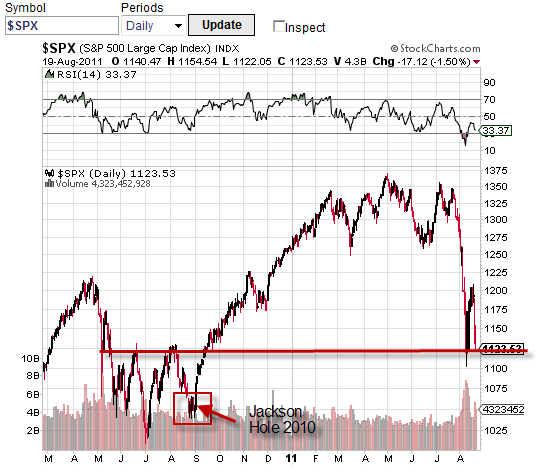
Chart courtesy of stockcharts.com
In the chart of the S&P 500, above, you can see how the index has taken a sharp decline since the highs of mid-July. It is now below its 200 day and 50 day moving averages (red and blue lines) and has broken several long term trend lines. Furthermore, the 50 ma has crossed below the 200 day ma, forming what is widely known as the “death cross” which is a quite reliable statistically proven technical indicator [see here (1) for a recent article on the current "death cross" event]. While not perfect, as no indicator is, the “death cross” has managed to sidestep the biggest part of every recent bear market, while its counterpart, the “golden cross” has captured significant gains during bull markets.
However, it should also be noted that support at the 1120 level has been tested several times and so now the bears will have to push through that level to confirm that we are actually in the beginning days of a new bear market.
It is my opinion that this trading range will not continue for very long and that we’ll see a directional breakout, either up or down, within the next few weeks. Technical and fundamental conditions would indicate that the likely probability of that move would be down. If that turns out to be the case, as investors and traders, we have several choices if we believe a new bear market is upon us:
- to “buy and hold” which is the conventional wisdom and which I believe is quite ineffective in today’s volatile markets since the major indexes are still far below where they were in 2000 at the beginning of the “tech wreck” more than 11 years ago.
- to head for the safety of cash which many investors have done or to head for the safety of Treasury bonds and bills which have also seen a huge influx of funds in recent months and days. This strategy gets you out of harm’s way if the market indeed does continue its downward trajectory.
- to actually attempt to profit from declining markets and to do that, investors/traders today can use inverse exchange traded funds that move opposite to the action of the underlying index…
- to use put options, either as portfolio insurance on currently held positions or as directional bets in search of profits.
So from the above discussion we can conclude that we are at the very least in a significant correction of an ongoing bull market or either in or close to entering a new bear market. Coming days will tell us which way things will go and confirm this one way or other.
Conclusion
Whatever happens, exchange traded funds offer the power and flexibility to seek profits in any market environment.

Rice May Rally 22% by Yearend as Thai Buying Elevates Costs, Curbs Exports
Rice may rally 22 percent by yearend as Thailand, the world’s largest exporter, buys the grain from farmers at above-market rates, pushing up costs for importers and fanning global inflation even as economic growth slows.
The price of 100 percent grade-B Thai rice, the regional benchmark, may rally to $750 per metric ton by Dec. 31, according to the median estimate in a Bloomberg News survey of seven exporters, traders and millers conducted last week. That target is $50 higher than the median estimate in a separate Bloomberg survey undertaken in the first half of this month.
The surge may complicate matters for central bankers and policy makers around Asia who are already struggling to cool rising prices. Rice was the only grain separating the world from a food crisis, Abdolreza Abbassian, senior economist at the United Nations Food & Agriculture Organization, or FAO, said in February when worldwide food costs rallied to a record.
“If the sources of supply are actually inflating the prices for their commodities, regardless whether there’s supply or not, that’s going to keep prices elevated,” Abah Ofon, an analyst at Standard Chartered Plc, said by phone from Singapore. “That would keep risks for food inflation elevated.” (more)
Is the S&P500 Cheap?
I was somewhat surprised by a Bloomberg article discussing how cheap the S&P is (mentioned here this AM). Its not that Bloomie has suddenly become a cheerleader, but rather, this piece reflects the beliefs of a large chunk of classically trained value mutual fund managers.
Here’s a Bloomberg excerpt:
“At 1,176.80, the S&P 500 is trading at 10.8 times analysts’ forecast for profits in the next 12 months of $109.12 a share. For the P/E ratio to reach its five-decade average of 16.4 without shares appreciating, earnings would have to fall to about $71.76 a share, 22 percent below the last 12 months, data compiled by Bloomberg show.
Should companies meet analysts’ profit estimates, the S&P 500 must advance to about 1,790 to trade at the average multiple of 16.4 since 1954, according to data compiled by Bloomberg. That’s more than 50 percent above its last close. Futures on the S&P 500 expiring next month gained 1 percent to 1,185.9 at 7:48 a.m. in London today.” (emphasis added)
Of course, left unsaid is what if analysts estimates are too high; Historically, the fundie community has overestimated earnings growth by a factor of 2X.
Also unsaid was the impact of recession on earnings. A 22% drop during a recession is hardly a Great Depression collapse; its not even a Great Recession drop. Indeed, that line of thinking ignores the overhang of housing, the deleveraging consumer, and tight credit conditions — all of which could easily persist for years to come.
Bottom line: The Reagan Recession came at the end of a 16 year bear market, plus benefited from Volcker breaking the back of inflation. The threat today is a Japan like deflationary spiral, including falling asset prices and an unwillingness for investors to buy up for a dollar of earnings.
In other words, a falling P/E could be evidence of an ongoing deflationary phase, and not proof that markets are cheap.
The World’s Supreme Test for Gold

This excerpt comes from The Vancouver Sun of October 1933. It is a fascinating article. I strongly recommend that you read it in its entirety here. (It should take you no more than 3 minutes to do so.)
The article wrestled with one economically-perplexing question: Did gold become money because people wanted gold in a “special way” or is gold wanted by people just because gold is considered (legal) money? The article remarked that some economists believe it is the former, while others believe it is the latter.
The article---and its question posed---must be understood in context, however. In April of 1933, U.S. President Franklin D. Roosevelt ordered that all gold held by American citizens was property of the United States Treasury and, as such, by May 1933 all American citizens must turn in their gold to the Federal Reserve and/or an affiliate banks.
In other words, gold was no longer deemed (lawful) money in the United States. The article, therefore, pondered the question: Would the demand for gold remain even though the metal was no longer considered money?
The article’s author took the position that, regardless of if gold is deemed legal money, people want gold and that is what ultimately drives its demand. But gold was still considered money in other countries like France, Italy, Belgium, Germany, Holland, and Switzerland. In fact, the author noted that “Frenchmen” were regularly entering into the London Gold market to purchase gold even though it cost those business men a heavy premium compared to simply redemption at their own Bank of France. Why pay this premium?, the author asked. No need to ask why; just note that it is happening, the author said.
But what if the above-mentioned countries followed suit with the US and Britain and made gold “not money” anymore? What then for the demand for gold?
Time will tell, the author concluded.
Let us hope that if [the test of gold] materializes we shall profit by its lesson, for that lesson will be of great importance in clearing people’s minds upon some fundamental principles concerning the nature of “money”---and its “management.”
The author would be satisfied to know that history has answered this question and, in addition, has vindicated his position---that gold is desired and wanted by the people not because it is deemed legal money but because it is the truest money. After 70 years, history has proved that people desire gold regardless of what governments call it or deem it.
And right now---at a gold spot price at about $1900 per ounce---the people are showing their strong desire for gold is only beginning to be rekindled. The “supreme test” of gold has been completed. But it has not ended. Not until, that is, gold has been deemed “legal” money once again.
Gold is money.