Thursday, June 30, 2011

"Screaming Fundamentals" You Must Own Gold And Silver Now


This report lays out an investment thesis for gold and one for silver. Various factors lead me to conclude that gold is one investment that you can park for the next ten or twenty years, confident that it will perform well. My timing and logic for both entering and finally exiting gold (and silver) as investments are laid out in the full report.

The punch line is this: Gold and silver are not (yet) in bubble territory, and large gains remain, especially if monetary, fiscal, and fundamental supply-and-demand trends remain in play.

Introduction

In 2001, as the painful end of the long stock bull market finally seeped into my consciousness, I began to grow quite concerned about my traditional stock and bond holdings. Other than a house with 27 years left on a 30 year mortgage, these holdings represented 100% of my investing portfolio. So I dug into the economic data to see what I could discover. What I found shocked me. It's all in the Crash Course in both video and book form, so I won't go into that data here.

By 2002, I had investigated enough about our monetary, economic, and political systems that I decided that holding gold and silver would be a very good idea, poured 50% of my liquid net worth into precious metals, and sat back and watched.

Since then, my appreciation for and understanding of the role of gold as a monetary asset and silver as an indispensable industrial metal have deepened considerably.

Investing in gold and silver is still a good idea. Here's why.

Why own gold and silver?

The reasons to hold gold and silver, and I mean physical gold and silver, are pretty straightforward. So let’s begin with the primary reasons to own gold.

  1. To protect against monetary recklessness
  2. As insulation against fiscal foolishness
  3. As insurance against the possibility of a major calamity in the banking/financial system
  4. For the embedded 'option value' that will pay out if and when gold is remonetized

By ‘monetary recklessness,’ I mean the creation of money out of thin air and the application of more liquidity than the productive economy actually needs. The central banks of the world have been doing this for decades, not just since the onset of the great financial crisis. In gold terms, the supply of above-ground gold is growing at roughly 3% per year, while money supply has been growing at nearly three times that yearly rate since 1980.

Now this is admittedly an unfair view, because the economy has been growing, too, but money and credit growth have handily outpaced even the upwardly distorted GDP measurements by a wide margin. As the economy stagnates under this too-large debt load while the credit system continues to operate as if perpetual expansion were possible, look for all the resulting extra dollars to show up in prices of goods and services.

Real interest rates are deeply negative (meaning that the rate of inflation is higher than Treasury bond yields). This is a forced, manipulated outcome courtesy of central banks that are buying bonds with thin-air money. Historically, periods of negative real interest rates are nearly always associated with outsized returns for commodities, especially precious metals. If and when real interest rates turn positive, I will reconsider my holdings in gold and silver, but not until then. That is as close to an absolute requirement as I have in this business. (more)

Wednesday, June 29, 2011

“WESTERN CENTRAL BANKS DON’T HAVE 30,000 TONS of GOLD” & MORE - John Embry


Money Market Funds Might Need Bailout Again

The Wall Street Journal raised the specter of another money market fund crisis that could require bailout of money market funds that have unwisely invested too heavily in the short-term debt of European banks caught up in the contagion of sovereign debt problems in Greece and elsewhere.

The WSJ lead editorial excoriated the mutual fund industry for reaching for yield on money market funds by loading up on European bank securities equal to 50% of their $2.7 trillion assets. Forbes also raised this issue by quoting Jim Grant’s Interest Rate Observer on Saturday as to huge position by Fidelity and BlackRock’s money market funds in European securities that may be worth less than the funds’ purchase price.

US money market funds apparently hold far too risky a position in the short-term debt of the European banks because they are the repository of sizable investor money being held on the sidelines until the economic future becomes clearer. However, some 40% of this paper has a maturity of 7 days or less, so that it would require an inability to refund these very short-term obligation for there to be a crisis.

These French, German, Dutch, British banks face potentially troublesome write-downs from the possible debt default of Greece and its ramifications for Ireland, Portugal, Spain and Italy. European banks have loans outstanding to these nations of over $1.5 trillion.

In the wake of Lehman’s bankruptcy in September, 2008, a large money market fund holding an unwise batch of Lehman bonds, and suffered from its net asset valuation falling below the sacrosanct $1.00 a share. This event triggered a panic among holders of money market funds– which are supposed to be almost as safe as short term Treasuries.

The Federal Reserve was forced to guarantee the hundreds of billions ordinary citizens held in these funds, which were basic savings that were thought to be entirely secure. When the crisis quieted down, the guarantee was removed. Let’s hope there is no repeat of the 2008 crisis in the money market fund industry.

Google Delivers Cash flow and future stock growth : GOOG

Google (NASDAQ:GOOG) is saving large organizations millions by persuading them to swapMicrosoft (NASDAQ:MSFT) Office applications for Google’s so-called cloud-based software as a service. Should this alone entice you to add Google to your portfolio?

At least one 25,000-person organization, InterContinental Hotels, has taken its employees off Microsoft email and Office applications and moved them on to Google’s Cloud Apps, according to the New York Times. For a typical business, Google charges $50 a user each year to use its email and office applications that are delivered from Google’s computing systems. InterContinental estimates that Google Cloud Apps will save it millions.

And InterContinental is not the only one to stick a knife in the heart of Microsoft’s $20-billion-a-year, 60%-operating-margin, Office business. Others that switched to Google Cloud Apps, according to the Times:

  • The National Oceanic and Atmospheric Administration, (25,000 employees)
  • State of Wyoming, (10,000); and
  • McClatchy Group (8,500).
  • Microsoft is fighting back by introducing its Office 365 for $72 a year. While the idea of competing with Microsoft Office has been around for a while, Google appears to be the first to gain significant traction — it has improved its offerings considerably since they were first introduced.

Google’s revenue just from the four clients mentioned above could total $3.4 million (assuming they are paying full price), and almost 100% of Google Cloud App customers renew the service. Most likely, these employees are likely to be drawn into other Google revenue-generators, so the relatively tiny Cloud App revenue could benefit Google in other ways.

Nevertheless, an investor in Google shares at its current price ($494) must consider the rest of its business — and whether Google has the potential to deliver compelling upside surprises beyond Cloud Apps.

Google’s stock had a great run between its 2004 IPO at $80 and its September 2007 peak of $567 — rising at a compound annual growth rate of 92%. But the stock has since bounced around and is now trading 15% below that peak.

Nevertheless, Google’s financial performance has been spectacular – its revenue is up 36.7% a year over the last five years, and its net income of $8.4 billion rose at a five-year average annual rate of 42.2%. Meanwhile, Google’s cash balance beginning in 2006 grew at an annual rate of 33% to $35 billion at the end of 2010, while holding barely any debt.

Google’s most recent quarterly performance was worse than expected due to its massive hiring campaign. In the first quarter of 2011, Google’s net income of $2.3 billion was up 18% from the year before, but its adjusted earnings of $8.08 share was 3 cents below analysts surveyed by FactSet.

While Google revenue rose 27% to about $8.6 billion, which was 37% better than analysts expected, Google’s expenses grew faster than revenue — with Google adding 1,916 employees to end March 2011 with more than 26,300 workers.

Is Google investing too much in its human capital to generate a positive return to its capital providers? No way – it’s earning huge returns on capital. After all, it’s producing positive EVA Momentum, which measures the change in “economic value added” (essentially, profit after deducting capital costs) divided by sales.

In 2010, Google’s EVA momentum was 3%, based on 2009 revenue of $23.7 billion, and EVA that grew from $3.1 billion in 2009 to $3.9 billion in 2010.

And Google’s stock valuation is reasonable — trading at a price-to-earnings-to-growth (PEG) ratio of 0.94 (where 1.0 is considered fairly valued). Google’s P/E is 18.7 on earnings expected to climb20% to $35.43 a share in 2012.

While I don’t expect Google Cloud Apps to make a big difference in overall revenue, Google stock is likely to pop if all those new employees can invent services that actually generate new sources of revenue growth.

At its current price, there could be more risk by not investing and missing Google’s upside over the longer term.

Jay Taylor: Turning Hard Times Into Good Times


Profiting From and Protecting Yourself Against Government Incompetence


click for audio HOUR #1 HOUR #2

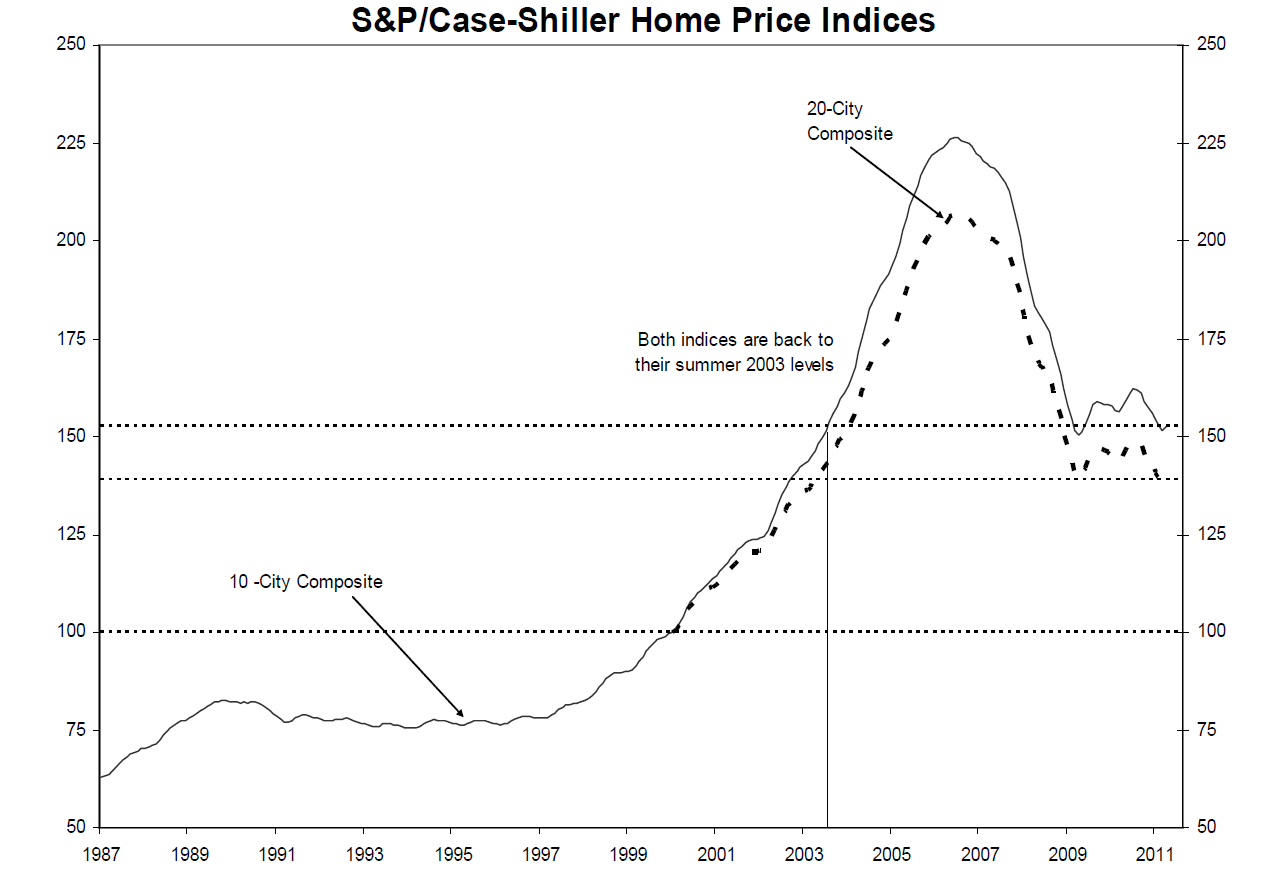
Case-Shiller Home Price Indices

Case Shiller Home Price Indices showed a monthly increase in prices for the first time in eight months. This was for the month of April, which is usually the beginning of the best six months of the year for home sales. (See this chart of Non Seasonally adjusted Existing Home Sales)

Davied Blitzer of S&P Indices noted “However, the seasonally adjusted numbers show that much of the improvement reflects the beginning of the Spring-Summer home buying season. It is much too early to tell if this is a turning point or simply due to some warmer weather”

~~~

Wayne Madsen : Goldman Sachs Stole 1.3 Billion from Libyan Sovereign Wealth Fund

Wayne Madsen was recently in Tripoli so he is reporting on what he saw in Tripoli .Life is normal in Tripoli he says ..... Obama will send 10,000 Troops home from Afghanistan then send 50,000 to Libya! He promises to get all the troops home by 2012... the day after he's re-elected, right!?!If Obama sends troops to Libya and the American people do not up rise he will be considered a dictator. Congress has already voted against the war in Libya 295 to 123. They have only agreed to funding NATO. If that happens the Patriot Act could go into full effect. police state! Although it is almost already a police country. 1 out of 35 American adults are in prison on parole or on probation, that is 1 out of 35 that have lost their constitutional right to bare arms against a tyrannical govt