Saturday, March 17, 2012

IS the FED SELLING EUROPE’S GOLD DURING INTERVENTIONS, GOLD DIVE & WHAT’S NEXT – Jim Sinclair

King World News
Friday, March 16, 2012

CLICK ON PICTURE THEN CLICK ON MP3 TO LISTEN TO THIS EXCLUSIVE INTERVIEW

March 15, 2012

Today legendary trader and investor Jim Sinclair told King World News that a number of European countries are beginning to ask themselves where the gold is coming from which is being used for interventions in the gold market. Sinclair also said some European countries are beginning to think it’s their gold, stored by the US Fed, which is being used for these interventions. But first, here is what Sinclair had to say about the recent plunge in gold: “Eric, this has been going on since $248 in gold. Any idea or concern that this kind of intervention is going to cause the gold bull market to cease or shorten or even contain where it will potentially go is simply wrong.”

Jim Sinclair continues:

“Every time you intervene in any market or any time you intervene economically, it’s the same as using a controlled drug. The first application gives you the best high you’ll ever have. After that you have to do more and more just to near duplicate what you expected.

The selling down of the gold, what this means now is time….

READ MORE

J.P. Morgan Chase's Ugly Family Secrets Revealed

In a story that should be getting lots of attention, American Banker has released an excellent and disturbing exposé of J.P. Morgan Chase's credit card services division, relying on multiple current and former Chase employees. One of them, Linda Almonte, is a whistleblower whom I've known since last September; I'm working on a recount of her story for my next book.

One of the things we were promised by the lawmakers who passed the Dodd-Frank reform bill a few years back is that this would be a new era for whistleblowers who come forward to tell the world about problems in our financial infrastructure. This story now looms as a test case for that proposition. American Banker reporter Jeff Horwitz did an outstanding job in this story detailing the sweeping irregularities in-house at Chase, but his very thoroughness means the news may have ramifications for Linda, which is why I'm urging people to pay attention to this story in the upcoming weeks.

The Cliff's Notes version of the story goes something like this: Late in 2009, Chase's credit card services division sold a parcel of nearly $200 million worth of credit card judgments to a debt collector at a discount. This common practice in the credit-card industry is a little like a bookie selling the outstanding debts of his delinquent gamblers to a leg-breaker for 25 cents on the dollar. If the leg-breaker gets half the delinquents to pay, the deal works out for both sides -- the bookie gets 25 percent of money he wasn't going to collect, and the leg-breaker makes a 100 percent profit. (more)

2012: The Beginning of The End, Full Movie, Lindsey Williams Oct 2011


This is the entire 3 DVD set by Lindsey Williams in one video. It is titled, "2012 The Beginning of The End." It was made available in October 2011. It is over 3 hours long. This video covers the following: What in this world is going on. Division among the Elite. The Dollar - Debt - Fear - Fuel in 2012. Why 2012 and not 2000. The Devils Messiah according to the Elite. Divine Manifestation. 2012 predictions from the Elite.

Egon von Greyerz: Gold Will React to the $120 Trillion of Additional Debt

from King World News:

Today Egon von Greyerz told King World News that global debt has increased 140% in the last ten years. Von Greyerz also said even though the massive creation of debt has yielded virtually no GDP growth, the gold market will soon react to the money printing binge. Egon von Greyerz is founder and managing partner at Matterhorn Asset Management out of Switzerland. Here is what von Greyerz had to say: “We are all focused on the short-term and that’s natural, but let’s step back and look at the longer-term picture because that is really what is important for us today and for the next few years. The bigger picture is so important because very few people understand that the last 100 years are exceptional in history.”

Egon von Greyerz continues: Read More @ KingWorldNews.com

Three in 10 young adults live with parents, highest level since 1950s

After graduating from Brown University in 2009 with a bachelor’s degree in comparative literature and completing a Fulbright scholarship in Brazil, Cassie Owens was left with a few dollars on her stipend and no job in sight. So, Ms. Owens returned home to her mother in Philadelphia.

“I moved back home pretty much for lack of money and prospects,” she says. Owens’s cousin, Evon Burton, who also returned home after graduating from Morehouse College in 2009, adds, “The choice is to go out and be in debt or to pursue your dreams and save up money at home, in a safe, stable environment.”

Owens and Burton are among the scores of so-called “boomerang kids,” young adults who move out of the family home for school or work and then return home. Unable to find well-paying work in a weak economy, escalating numbers of young adults – as many as 3 in 10 – are returning home to the family nest, resulting in the highest share of young adults living in multigenerational households since the 1950s, according to a Pew Research Center report released Thursday. (more)

What Closing The Straits Of Hormuz Will Mean

While WTI hovers around $105.5 (slightly underperforming USD strength), Brent has notably outperformed with the Brent-WTI spread now edging towards $20 (from under $15 two weeks ago). Given the increasing tension, we thought it useful to get a grasp of just what an oil-supply shock means. BNP points out that in all but one of the historical oil price shocks of the last 40 years, equities have notably underperformed oil (understandably) but the higher the oil price rise, the higher the chance of negative absolute returns for stocks. We also note that oil prices tend to rise in anticipation of the crisis and then explode (so arguing that we are discounting an event is proved moot) and the impact (in lost supply) from closing the Straits of Hormuz is an order of magnitude larger than the next five largest events. Regionally, positioning favors the middle-eastern oil producers obviously with Asian EM nations set to suffer dramatically worse than DMs.

Global Oil Supply Shocks...

According to the IEA, 24% of the Global oil consumption passes through that strait. If tensions in Iran increases and this possibility becomes a reality then that would lead to a big tail event.

A further spike of 20% in the oil price will be a serious threat to the global economy and we believe in that scenario the equity prices will quickly decouple from the oil prices as we show above in retrospect to the previous oil price shocks.

Oil Price Action During Periods Of Shock...

And how to position regionally: Oil Consumption Minus Production As % of GDP...

Crucially the stage is not yet completely set for demand crushing oil spike although current levels will already be sufficient to drive sector rotation.

Source: BNP Paribas

Friday, March 16, 2012

South African Gold Production Dives Again To 90 Year Lows

Gold’s London AM fix this morning was USD 1,646.75, EUR 1,262.26, and GBP 1,052.57 per ounce.

Yesterday's AM fix was USD 1,662.00, EUR 1,271.61 and GBP 1,057.93 per ounce.

Gold fell more than 2% in New York yesterday and closed at $1,643.80/oz. Gold fell in Asia and its low hit $1,635.66/oz and high of $1,649.9/oz, and is now trading sideways in Europe at $1,647.05/oz.

Gold recovered some strength on Thursday after a drop in the prior session attracted bargain hunters, however a strong dollar and diminished expectations of more QE in the US made the yellow metal vulnerable to more selling.

Gold has dropped around 8% since late February as institutional funds appeared to have closed out of their bullish gold bets on worries the Fed will not embark on another round of QE to keep interest rates and borrowing costs low. The dollar hit an 11 month high against the yen and a 1 month peak against the euro on Thursday on growing hopes of a US economic recovery and continuing rises in U.S. bond yields.

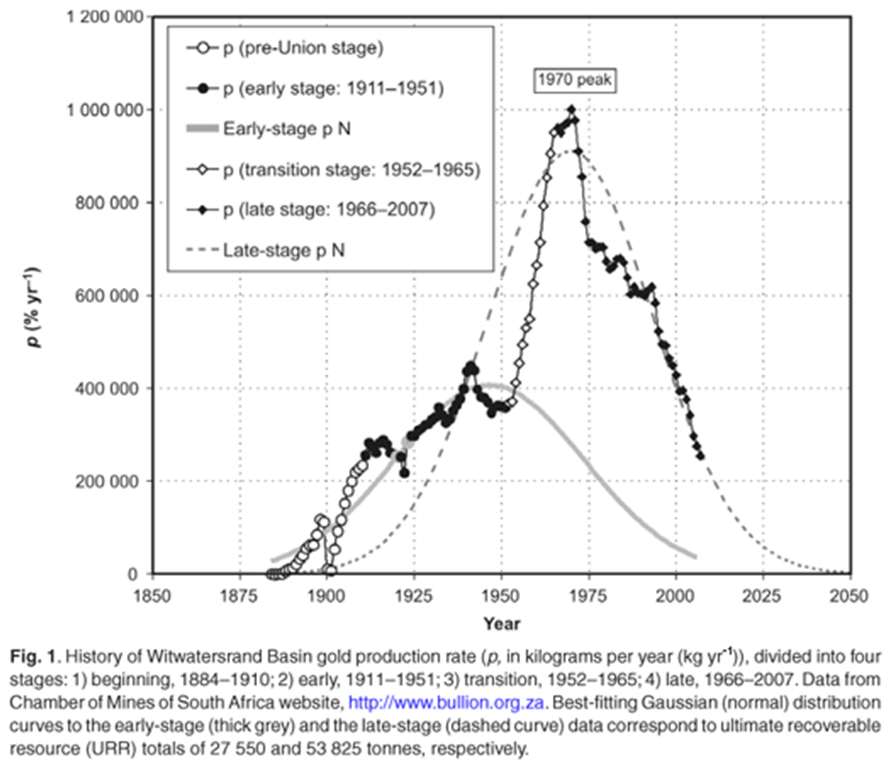
South Africa's gold output fell again in January and was down a very large 11.3% in volume terms in January. Annual gold production is set to be close to 220 tonnes which is a level of gold production not seen since 1922 (see chart below).

The falls were seen only in the gold market with production of other minerals holding up with total mineral production down only 2.5% compared with the same month last year.

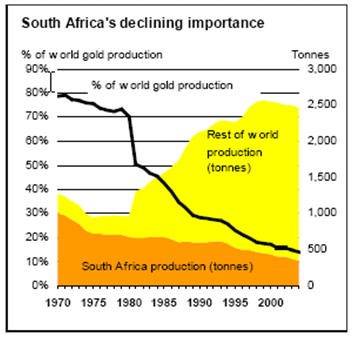
South Africa as recently as two decades ago was the world's largest producer of gold by a huge margin. Only 40 years ago South Africa produced more than 1,000 tonnes of gold per annum but will only produce some 220 tonnes in 2012. Production peaked in 1970 and has been falling steadily and sharply since.

The nearly 80% fall in South African gold production has led to it being recently overtaken by China, Australia and the U.S. It is now even at risk of being overtaken by Russia.

The scale of the collapse is such that it is worth considering the possibility that the Apartheid regime may have exaggerated the size of South African gold production. Indeed, similar questions could be asked of the massive increase in China's gold production in recent years and whether Chinese gold production tonnage figures are exaggerated.

The massive 11.3% decline in South Africa was more than even that seen in December when gold output fell by 8.2%.

The continuing output decline is due to many of the country's biggest gold mining operations having reached the ends of their lives and having closed down.

Old mines that are still operating are mostly getting deeper and deeper with safety concerns a limiting factor, while new operations coming on stream tend to be either small by comparison, low grade, or both.

South Africa's continuing gold production decline is not cyclical and is permanent and is another bullish factor for the gold market in the long term.

Geological constraints mean that there is little prospect of any serious reversal in the trend. Geological and the lack of any major gold finds anywhere in the world in the last 20 years also suggest that the supply side of the gold equation remains bullish.

The decline in South African production has been a major contributor to at best flat global gold production over the past few years.

Indeed, some data suggests that global gold production may have peaked in the early 2000s.

In the light of the continuing strong fundamentals, this is another healthy correction in the gold market as investment demand is set to remain strong for the foreseeable future while supply remains tight.

Also, central banks are increasingly reluctant to sell their gold reserves and indeed some increasingly wealthy and powerful central banks are adding to their reserves or attempting to gain control of the reserves of smaller debtor nations.