Wednesday, December 28, 2011

India Slows Rush for Gold

It appears even Indian demand for gold falls under the age old supply/demand dynamic of Economics 101. Despite a cultural affinity for the yellow metal, sky high prices are finally having a real impact on end demand. The WSJ takes a look:

  • Many Indians are either scaling back or eliminating their gold purchases outright. The drop-off in demand is exposing cracks in what gold investors have traditionally perceived as a solid support for global prices. With many of its religious and cultural traditions steeped in the precious metal, India historically has been the world’s biggest consumer of gold, much of it cast into jewelry. Gold plays a particularly important role in wedding ceremonies, and physical demand for gold usually rises significantly in the fall and winter, which are considered auspicious times for getting married.
  • This year, however, the wedding season dovetailed with a rapid depreciation of the rupee against the dollar as investors fled India amid jitters about the broader economy. India’s imports of gold fell to 20 million metric tons in November, down as much as 75% from a year earlier, according to estimates from the Bombay Bullion Association, an industry group for the country’s gold dealers.
  • Many investors and analysts believe that is a key reason why gold prices haven’t bounced back even though concerns about Europe’s debt load and the viability of euro persist.
  • Roughly a third of global demand for gold in the form of jewelry, or 649.9 metric tons, came from India in the year ended Sept. 30, according to the World Gold Council. Ornate necklaces, armlets, earrings, bangles, gold chains and finger rings are an essential part of a Hindu bride’s trousseau and are usually bought by her parents.

Chart of the Day - Genuine Parts (GPC)

The "Chart of the Day" is Genuine Parts (GPC), which showed up on Friday's Barchart "All Time High" list. Genuine Parts on Friday posted a new all-time high of $61.65 and closed up 1.77%. TrendSpotter has been Long since Dec 2 at $59.52. In recent news on the stock, Genuine Parts on Oct 18 reported Q3 EPS of 97 cents versus the consensus of 94 cents. Management said it sees gradual gross margin improvement in fiscal year 2012. Genuine Parts Company, with a market cap of $9.3 billion, is a distributor of automotive replacement parts in the U.S., Canada and Mexico.

gpc_700

Martin Armstrong: The Coming Financial Border Controls


The Coming Financial Border Controls

It's Berlin All Over Again


click here to read pdf

BB&T Is a Top Banking Buy for 2012

BB&T Corp. (NYSE:BBT) — Although it’s ranked the eighth largest U.S. bank by assets and 1,750 operating branches, BB&T is considered a regional bank. It operates mostly in the southeast United States, and has managed to remain profitable despite the turmoil in the banking system.

In 2009, the company earned $1.15, down from $2.71 in 2008. But it earned $1.16 in 2010, and is expected to earn $1.84 in 2011. And S&P expects BB&T to earn $2.60 in 2012.

Technically BB&T is in a bullish channel that is approaching its bearish resistance line. It has already made significant progress against overwhelming resistance, and last week even broke through the top of its bullish channel. Thus, momentum could push this stock through the major resistance at just over $26 with a target in the mid-$30s by March.

The company pays a dividend of 64 cents for a 2.51% yield and has a history of increases.

Trade of the Day – BB&T Corp. (NYSE:BBT)

Funny Pic

Case Shiller: Home Prices Fell 3.4% Year-over-Year

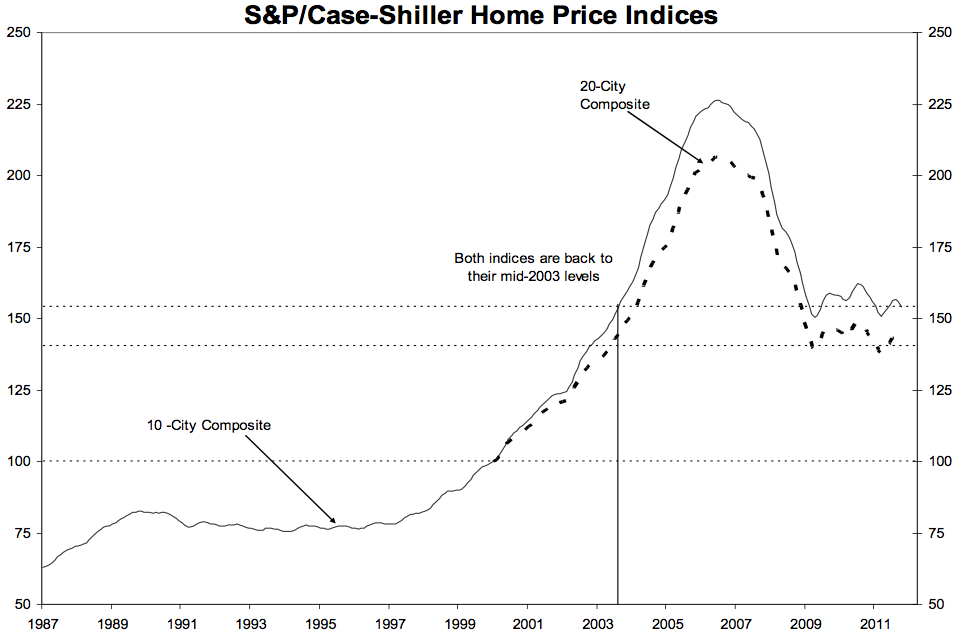
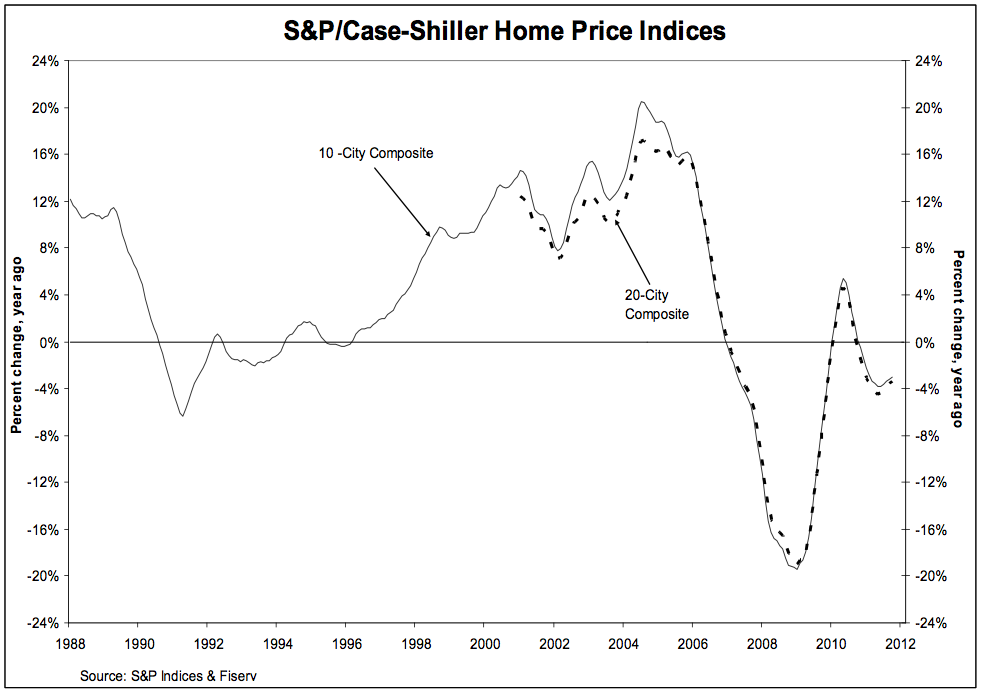
U.S. home prices fell ~1.2% respectively in October versus September, with 19 of 20 cities covered by the indices decreasing over the month. Year over year drops of the 10- and 20-City Composites fell -3.0% and -3.4% respectively versus October 2010.

As of October 2011, average home prices across the U.S. are back to their mid-2003 levels. (See chart below) Measured from their June/July 2006 peaks, the peak-to-current declines for the 10-City Composite & 20-City Composite are -31.9% and -32.1%, respectively.

>

click for larger chart


Source: S&P Case Shiller

>

More charts after the jump

>

~~~

Year over Year Percentage Price Change in Case Shiller Home Price Index

>

~~~

20 Metropolitan Region Monthly changes

Spanish Implosion Coming Up

Mike 'Mish' Shedlock

My friend Bran from Spain sent a pair of articles in Spanish that highlight the impossible situation facing Spain. The links below have a target of Google Translations.

Need to Cut 40 Billion Euros from 90 Billion

Spain needs to cut 40 billion euros from its budget to meet its deficit target for 2012. The problem is there is only 90 billion of expenses to 'play with' according to an article in Libre Mercado: The maze of Montoro: save 40,000 million without "social cuts"

To reach the deficit target agreed with Brussels, the new finance minister will have to come to his office with scissors ready.

The key figure is 4.4%. This is the deficit target committed to the EU by 2012. Would overcome a difficult situation in Spain, both to their partners as compared to international investors. In theory, 2011 will end with a deficit of 6% (so say government forecasts), this would leave a hole of 16,500 million for the coming year.

The problem is that almost no one believes any longer in these figures. Funcas predictions published yesterday, which included a deficit of 8% this year. With this figure, the gap would be closed would be about 40,000 million.

To climb this column, Treasury can raise taxes or trust fund to increase the current rates. The first has been ruled out by [Prime Minister] Rajoy, at least in the short term.

The following graph shows the distribution of state revenues by item. As seen, the vast majority, almost 70% comes from direct taxes and social contributions (income tax and companies mainly). Obviously, these items depend very much on the economic activity, any slowdown could even make predictions of the Government go down, which would make the situation even more complicated.


With this background, most of the adjustment will have to come, necessarily, on the expenditure side. At his inauguration, Montoro says he will not come to the Treasury to "make cuts, but to make reforms."

65% of spending is directed to pay the debt, the Ministry of Labour and Social Security (pensions).

The rest (35%) will have to come almost all the adjustment. This is a 91,000 million euros. Imagine the magnitude of the task.

Mission Impossible

The article says debt, pensions, and unemployment are not touchable. Also, Prime Minister Rajoy has ruled out tax hikes (for the short-term) whatever that means.

The entire setup is mathematical nonsense. Should the prime minister resort to tax hikes, it will plunge Spain even deeper into recession.

Spanish unemployment is already 22.8%.

Spain's Hidden Deficit

A second article discusses Spain's Hidden Deficit
One of the foremost experts on national circumstances says "Rajoy has no room to bring out all the hidden deficit and will not." Their main argument is the experience of what happened in Greece, where Papandreou, just come to power deficit brought to light hidden by the previous government and that is the source of the recent seizures in the debt market.

The challenges for 2011 will close with a deficit equivalent to 6% of GDP today seem to me almost insurmountable. Especially considering the revenue performance.

The data announced yesterday by the Tax Office indicated, namely that fiscal consolidation measures have saved up to 8.167 million in November, including the reduction in the VAT rate to 4% on the purchase of new housing, at a cost to the exchequer audience estimated at 115 million euros.

According to the Tax Agency , the comparison between the total amount of regulatory impacts and increased revenues accumulating to November (761 million) it follows that in the absence thereof, the tax revenues would decline recorded in 2011 around -4%, "in line with the fall of the aggregate tax base of taxes in the first three quarters."

This drop in real income-without 'extraordinarios'-explains the suspicion that the real deficit will grow as and when the accounts of the autonomous communities, municipalities and social security itself, which will close this year with a deficit, when expected a surplus of four tenths of GDP, about 4,000 million euros. Especially considering that during the second half of the year the economy has performed worse than the first. And in this context, appear with a deficit of 7% or 8% before the markets seems to be a problem for the new government.
The simple translation is Spain's budget deficit is bigger than they say and revenues are expected to drop next year by 4%.

Bran writes ... "This article tells us that the new government cannot afford to bring out all the debt into the open because when Greece did so, the markets abandoned the country. For each 1% the deficit is off target, another 10 billion must be cut from 2012. People are placing the deficit for 2011 at 7 or 8% as opposed to the planned 6%. FUNCAS gave the 40 billion cut needed mentioned above based on 8% deficit this year."

The Prime Minister apparently thinks if he does not admit the debt and the worsening deficit, the market will ignore the problem. We will soon find out for how long.

Mike "Mish" Shedlock