
Friday, December 16, 2011

A Devastating Dollar Short-Squeeze Is Gathering Steam
The Dollar Index has blasted through key resistance at 80, threatening to “unwind” carry-traders who borrowed dollars for next to nothing in order to speculate on other assets. Chief among those assets is gold, which got savaged yesterday in a $100 selloff that seems hell-bent on testing September’s key low. The low lies at 1543, basis the Comex February contract, but we doubt that it will hold. In fact, earlier, we had told subscribers there was a 60% chance that February Gold was about to dive to at least 1459, a technical target derived from our proprietary Hidden Pivot Method. We shall see. In any event, gold and silver – as well as crude oil, the euro and the commodities complex– will come under heavy selling pressure if the short-squeeze on the dollar continues.
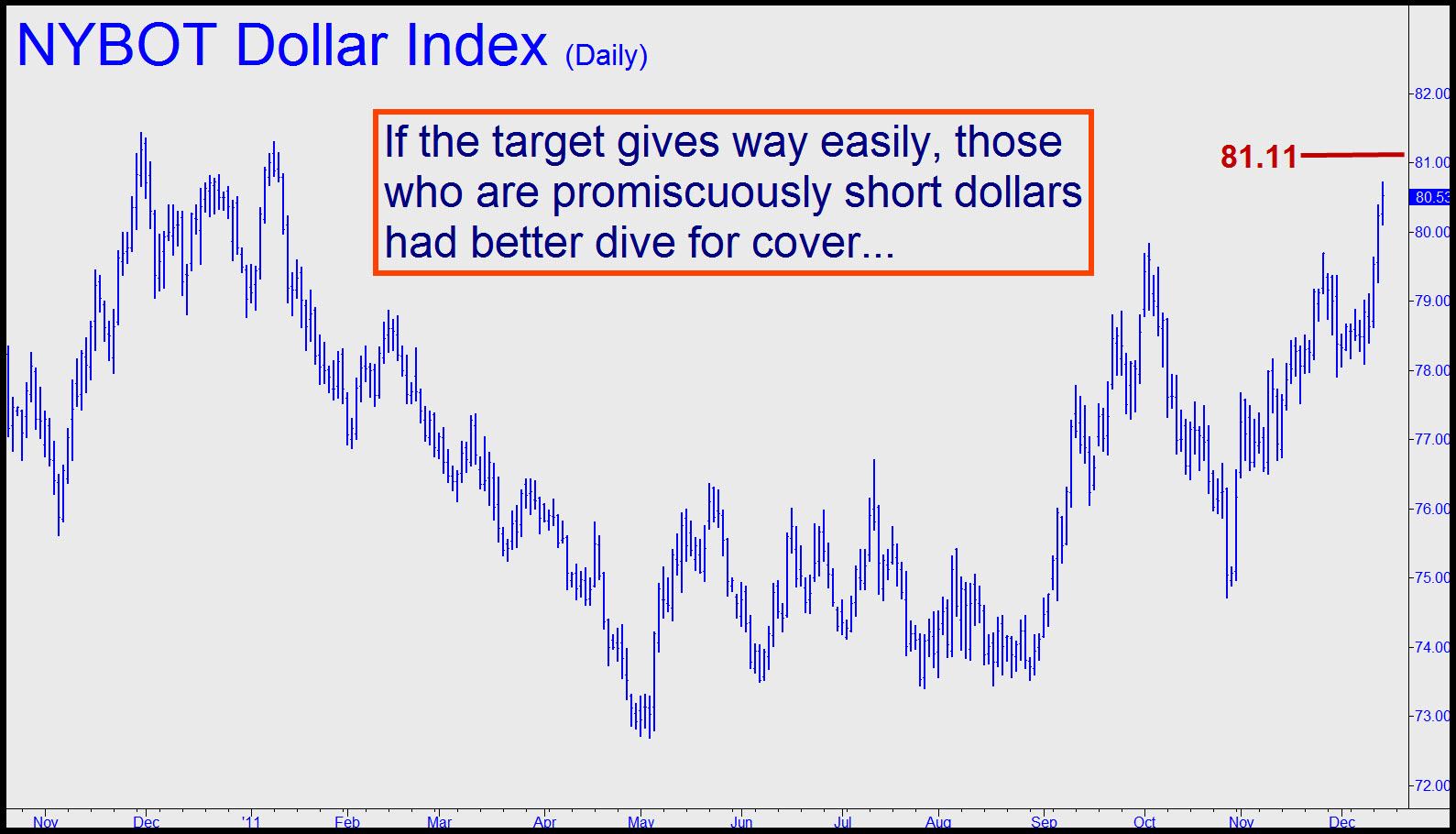
Concerning the U.S. dollar’s powerful surge, although it was driven initially by fears over the possible collapse of Europe’s financial house of cards, the rally has taken a life of its own that is being driven by dollar short-covering. The buying is not yet at panic levels, but a surge will be impossible to stop once if it picks up any more speed. Although the central banks can affect the markets for a short while with talk of bailouts, all of them acting together are puny relative to the quadrillion-dollar juggernaut that is about to fuel an unwind of the dollar carry-trade. Over the years, we’ve written many times about this potential Mother of All Short Squeezes. The paradox was, and is, that the dollar is intrinsically worthless, a form of debt rather than money. In point of fact, as we have pointed out here numerous times, the $20 bills in your wallet are worth no more, fundamentally, than the $1 bills. Even so, that’s not going to help the Masters of the Universe who borrowed dollars promiscuously in order to leverage them to the sky.
From a technical standpoint, we’ve been expecting the NYBOT Dollar Index to hit a Hidden Pivot rally target at 81.11 and then back off. The surge is closing on that number now, up from around 75 in late October. But if the pivot resistance gives way easily — and especially if buyers re-energize the rally by pushing above the 81.44 peak recorded last November – the central banks and all those who are short dollars are in for some very rough sailing. So will those who have been betting on a politically-induced rally in the euro. Our target for the March 2012 contract is 1.2556, and we expect it to hold. If not, the fragile credit edifice that has been holding Europe together is all but certain to crumble.
Why Crude Oil Prices May Not Affect Pump Prices
Since Oct. 4, the price of West Texas Intermediate (WTI) crude oil is up 33%, but the news media has barely given this story a second look. If the price of oil is up that much, presumably the price of gas should be crippling the wallets of consumers. So why haven't we noticed?
The reason is because the wholesale price of gasoline on Oct. 4 was $2.61 and two months later on Dec. 2 the average wholesale price had only risen 1 cent to $2.62. We've all learned that when oil rises in price so does the price of gas. So why not this time?
The Tale of Two Oils
There are actually 161 different types of oils traded according to the International Crude Oil Market Handbook, but if you ask an oil investor they will tell you about WTI and Brent Blend crude oil. WTI oil is refined in the Midwest and Gulf Coast area and is the traditional source of the majority of the oil used in the United States. If you want a high quality oil, you want it to be sweet and light and that comes from a low sulfur content and low specific gravity. WTI is lighter and sweeter than Brent Blend crude which makes it higher quality and more expensive in normal market conditions. WTI is the oil that is traded at the New York Mercantile Exchange (NYMEX) making it the traditional benchmark for oil traders around the world.
Brent Blend crude is a more sour oil because of its higher sulfur content. It is actually a mixture of multiple types of oil that come from the North Sea, and when oil markets are acting in a way that is considered normal, Brent Blend crude is largely used in Europe. It doesn't take much to knock the oil market out of balance. Because of changes in the North American oil landscape, European companies are finding it more profitable to export their oil to the United States.
That North American change is a shift in the way oil moves. In the past, oil has moved north from the Gulf Coast, but the recent discoveries in Northern states as well as Canada have sent oil moving south. Cushing, Okla. is where WTI is housed and priced. Because of these new flows, the Wall Street Journal recently called Cushing the "Roach Motel" of oil. Oil can get in but it can't get out. This, along with other geopolitical issues has caused a change in the oil markets; this is a change that is good for the consumer, at least for now.
We Love Brent!
Because of the problems with WTI oil, Brent Blend crude has become the benchmark for gas prices, at least for now. While WTI has seen a 33% increase since Oct. 4, Brent Blend crude has seen a modest 7% increase and because gasoline prices are not strictly correlated to oil prices, this has caused the consumer to see an average price at the pump of $3.29 as of Dec. 2.
The Bottom Line
The oil market is a volatile market. Wars, weather events and broken pipelines are just a few of the many factors that could make what we pay at the pump see a steep increase virtually overnight but for now, consumers are the beneficiaries of this recent changing of the guard in the oil market.
Housing Prices Will Bottom in 2012: Freddie Mac
Housing prices are likely to move lower and bottom out in 2012 with modest appreciation likely in 2013, Freddie Mac(FMCC.OB) Chief Economist Frank Nothaft said in his outlook on Wednesday.
The Freddie Mac Housing Price Index is forecast to dip by 1% in 2012, marking the sixth consecutive year of declines. The index is expected to move higher by 2% in 2013.
The economist said in his report that national indexes masked sizable variation in local house-price performance. "Some markets have appreciated over the past year and are likely to gain further in 2012, while those markets with higher vacancy rates and relatively large distressed sales will continue to see downward price pressure over the next year."
Mortgage rates are likely to stay "very low" at least till mid-2012 thanks to the Fed's "Operation Twist". The economist also expects housing market to be better in 2012 though not "robust".
Nothaft believes the rental market could provide some support to housing activity in 2012. "A full-fledged recovery in the housing sector will likely elude the U.S. in 2012, but new construction and home sales are expected to be greater than in 2011," he wrote, pointing to rising rents and falling vacancies in most markets. "Good rental market fundamentals and a dearth of new apartment completions should translate into more starts of rental buildings with five or more units, pushing total housing starts up slightly more than 10 percent in 2012."
The better fundamentals in the rental market could also drive up refinancing and origination volume of multi-family loans.
On the other hand single-family originations and refinancing activity might see a decline. "While single-family refinance volume is currently strong, many borrowers have already locked in relatively low rates, or are constrained (because of being underwater or having late payments) thus reducing refinance activity over time," according to Nothaft. " Further, somewhat higher mortgage rates in the second half of 2012 (after the expiration of 'Operation Twist') will reduce financial incentives to refinance."
The economist predicts economic growth will likely strengthen to about 2.5% in 2012, with the stronger-than-expected data in recent months providing evidence that momentum is beginning to pick up again. The unemployment rate will continue to edge lower but remain "uncomfortably above 8 percent", he wrote.
Thursday, December 15, 2011
Is the Gold Bull Really Dead?
by Greg Hunter’s USAWatchdog.com:

Economist Dennis Gartman announced in his newsletter, yesterday, that he has sold all of his gold. I don’t know if it was physical or paper gold in an ETF (exchange traded fund), but it is gone. According to Bloomberg, Gartman said, “Since the early autumn here in the Northern Hemisphere gold has failed to make a new high. . . . Each high has been progressively lower than the previous high, and now we’ve confirmation that the new interim low is lower than the previous low. We have the beginnings of a real bear market, and the death of a bull.” Mr. Gartman thinks so much damage has been done to the price of gold and to market psychology that, in his words, “. . . wholesale liquidation, and perhaps forced liquidation, shall be the outcome.” (Click here to read the complete Bloomberg story featuring Mr. Gartman’s call on Au.)
I think Mr. Gartman is a trader at heart, but there is a big difference between a gold trader and a gold investor. Traders are usually looking at the short term, and in the short term, Gartman is probably correct. The price of gold will probably sell off some more before this move is through, but the gold bull is hardly finished. I say this because of two main reasons. Unprecedented global debt is reason number one. More debt has been created than ever before in human history.

Subscribe to:
Posts (Atom)