
Friday, November 4, 2011

Barton Biggs Boosts Bullish Stock Bets: AAPL, CSCO, MSFT, CAT, DE, EMR, GE
 Barton Biggs, the hedge fund manager who bought stocks when the market bottomed in 2009, boosted bullish bets on equities in his Traxis Global Equity Macro Fund after European leaders took action to contain the debt crisis.
 The fund's net long position has risen to 80 percent, Biggs, the founder of Traxis Partners LP, said in an interview with Betty Liu on Bloomberg Television's "In the Loop" program. That compares with 65 percent on Oct. 17 and 40 percent about a month before that, and near 85 percent six months prior.
The Standard & Poor's 500 Index is surging the most in a month since 1987, advancing 12 percent amid speculation European leaders will solve the crisis, after slumping from May through September. Investors remain too pessimistic, meaning the rally will continue as they change their mind, he said.
"There's a tremendous amount of money that's trapped out of stocks," Biggs said today. The rally is "going to continue for a while."
Stocks gained last week after the European rescue fund was boosted to 1 trillion euros ($1.4 trillion) and investors agreed to a voluntary writedown of 50 percent on Greek debt. Today, Italian and Spanish bonds fell, while global stocks retreated from a three-month high on concern European leaders will struggle to raise funds to contain the crisis.
"This morning, all of the wise men of Europe and the economists are very negative about this European deal that was worked out last week," Biggs said. "The general feeling is that the right thing to do is to cut back on risk and that it is going to be a flop, and that all they did was kick the can not very far down the road again."
"I am inclined to feel differently," Biggs said.
The investor said he likes technology stocks such as Apple Inc. (AAPL), Cisco Systems Inc. (CSCO), Intel Corp. and Microsoft Corp., which he called "incredibly cheap and undervalued." He also favors industrial companies such as Caterpillar Inc. (CAT), Deere & Co. (DE), Emerson Electric Co. (EMR) and General Electric Co. (GE)
Biggs said that while he's not buying European stocks, he is drawn to their valuations.
"I must admit I don't own hardly any European stocks, but I'm intrigued by them because they are so cheap, and because it would certainly be a contrarian trade," he said.
Louise Yamada: Gold & Silver Report
from King World News:

Gold – Hugged the Uptrend Line
by Louise Yamada Technical Research Advisors, LLC (“LYA”)
Top German news outlet: Just a "matter of time" before Greece leaves the euro
Spiegel continues to pile it on. Following yesterday's heartfelt thanks to G-Pip (as he is now known due to his impact on the EURUSD with every single public appearance), today they follow it up with: Greek Exit From Euro Zone Just A "Matter Of Time." To wit: "Despite its location on France's glamorous Cote d'Azur, Wednesday evening's meeting likely won't be a pleasant one for Giorgios Papandreou. The Greek prime minister is set to meet with German Chancellor Angela Merkel and French President Nicolas Sarkozy. None of them, one presumes, will be in the mood to enjoy their enchanting surroundings...Should Greek voters, frustrated by round after round of deep austerity measures, reject the bailout deal, it could result in an uncontrolled national bankruptcy. Markets will likely remain nervous until the results of the ballot are in -- meanwhile the euro will move even closer to the abyss. As if to highlight the dangers, German banks on Wednesday announced they were postponing their acceptance of the Greek debt haircut until after the referendum. Without voluntary bank approval, Greece faces a disorderly bankruptcy which could accelerate contagion throughout the euro zone. Papandreou's decision, said European Commissioner for Energy Günther Oettinger, "puts the euro in even greater danger."
More:
Greek Exit From Euro Zone Just A "Matter Of Time"
Last week, it looked as though the euro had been saved. Now, in the wake of Greek Prime Minister Papandreou's announcement of a national referendum on the bailout package for his country, the common currency is even closer to the abyss. Still, say German commentators, it may have been the right move.
Despite its location on France's glamorous Cote d'Azur, Wednesday evening's meeting likely won't be a pleasant one for Giorgios Papandreou. The Greek prime minister is set to meet with German Chancellor Angela Merkel and French President Nicolas Sarkozy. None of them, one presumes, will be in the mood to enjoy their enchanting surroundings.
Leaders of the world's most powerful economies begin arriving on France's south coast on Wednesday night for the Thursday kick-off of this year's G-20 summit. Host Sarkozy had been hoping the gathering would focus on raising funds to boost the effectiveness of the euro backstop fund, the European Financial Stability Facility (EFSF), but the success of the meeting is now in doubt. Papandreou's announcement on Monday evening that he was planning to hold a referendum on the EU bailout package for his country has shocked and infuriated his would-be benefactors -- and sent global markets into yet another tailspin.
The news came less than a week after an all-night bargaining session in Brussels that resulted in an agreement to slash Greek debt by 50 percent, make a further €130 billion in loans available to the country and leverage the EFSF to €1 trillion. Markets immediately calmed and the euro began climbing against the dollar. (more)
Shocking chart shows inflation is now soaring above 11%
We’ve been very, very clear that we will not allow inflation to rise above 2 percent. We could raise interest rates in 15 minutes if we have to. So, there really is no problem with raising rates, tightening monetary policy, slowing the economy, reducing inflation, at the appropriate time. That time is not now.
Federal Reserve Chairman Ben Bernanke
December 6, 2010
With all of the problems in Europe, protests on Wall Street, and middle east conflicts over the last year, something that has escaped scrutiny by prime time media stars and the general population is the consistent rise in prices across all consumer goods and services. While the Federal Reserve says they have inflation under control, their continued intervention into the financial and monetary systems of the global economy is leading us down a road that may very well lead to high inflation rates similar to those we saw in the 1980′s, or perhaps something much, much worse.
For the Federal Reserve, policymaking these days is about deciding which of two imposing evils to take on – a decidedly moribund economy or the increasing threat that inflation poses to battered consumers.
For much of the slow slog out of the financial crisis, the Fed which is meeting this week and will issue its policy statement Wednesday, has managed to train its gaze on jump-starting growth through its various quantitative easing measures.
But recent indicators show that inflation is posing an equally daunting threat that further monetary accommodation from the Fed might serve only to aggravate.
The pressure has come primarily through measures that Fed Chairman Ben Bernanke likes to call “transitory” – namely, the volatile but steady rise of food and energy prices that don`t make up core inflation measures but usually impact consumers more.
Economists increasingly believe that while the so-called core Consumer Price Index (CPI) measure has remained around the 2% level that pleases the Fed, headline inflation that includes things such as groceries and gasoline is becoming a growing menace. The more inclusive inflation measure is at 3.9% and hammering at consumers, including the 14 million who remain unemployed.
…
“Because of the level of debt that we have in this country and indeed over in Europe as well, market forces demand deflationary depression to occur,” said Michael Pento, president of Pento Portfolio Strategies and economist at Agora Financial. ”
But because we have such an activist Federal Reserve and central bank in Europe, every time they step into manipulating the market by depreciating the currency, we have these huge spikes in inflation.”
…
Pento advises investors to disregard pronouncements from the Fed that inflation is under control.
“They`re being mendacious,” he said. “They are trying to fool you into believing that inflation is not a problem.”
Source: Money Control
As of this month, we have reached Ben Bernanke’s 2% threshold for the official Consumer Price Index measure. The CPI-U (Urban measure, which includes food and energy) has reached 3.9%. And those are the official numbers.
Unofficially, if inflation was calculated the same way as it was in 1990, the CPI would show a staggeringly different number.
According to Shadowstats, we are now seeing price inflation rates of over 11% – almost three times higher than the official numbers.
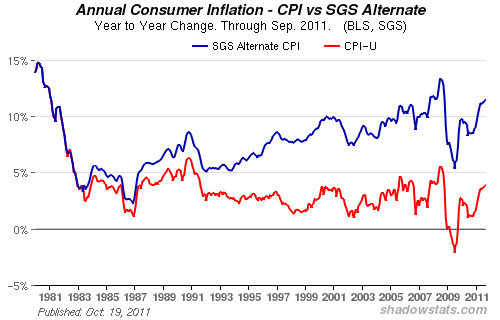
Perhaps Ben Bernanke, Tim Geithner and President Obama don’t see it, but consumers are certainly feeling its effects. As a result, even though Americans’ wages are stagnating in nominal terms, they continue to spend money, which has analysts wondering what’s going on. They conclude that we’re spending more as a direct result of Federal Reserve machinations:
Americans are making a little more money and spending a lot more.
Under normal circumstances, that would be a troubling sign for the economy. But a closer look at some new government figures suggests another possibility: People are saving less money because they’re earning next to nothing in interest.
Saving is already difficult because of more expensive gas and food. It’s even tougher because of the lower returns — the flip side of super-low interest rates that the Federal Reserve has kept in place since 2008 to help the economy.
Critics say the Fed is punishing those who play by the rules — those careful enough to set aside money for savings or people who built up a nest egg and are living on fixed incomes that depend on interest.
Source: ABC News
What choice are people left with? They may not be consciously aware that inflation is over 10%, but their pocket books sense it. Why leave money sitting in a bank account when your cash savings will be decimated within a year? Equity investment has become too risky, with markets swinging 2% – 3% daily. This leaves only one option. Spend.
Curiously, this is the same activity we hear about consumers engaging in at the onset of high inflation periods. When money becomes worthless, it seems, the people shift it into hard goods as soon as they can. For some this may mean precious metals purchases, for others it may be flat screen TV’s or iGadgets. For the purposes of this demonstration in consumer spending habits in response to economic and monetary conditions, we don’t care what they’re buying – just that they are spending dollars as fast as possible.
Last year, Gonzalo Lira warned of a hyperinflationary tipping point by early 2012. While his time lines may have been off, likely because of the untold number of financial, economic and monetary variables at play, the consequences will be nonetheless as devastating as he describes.
What the mainstream commentariat will make of all this will be really something: When CPI reaches 5% by the winter of 2011, pundits and economists and the Fed and the Obama administration will all say the same thing: “Happy days are here again! People are spending! The economy is back on track.”
…
2012 will be the bad year: I predict that hyperinflation’s tipping point will be no later than the first quarter of 2012. From there, it will accelerate. By the end of 2012, I would not be surprised if the CPI for the year averaged 30%.
By that point, the rest of the economy – unemployment, GDP, all the rest of it – will be in the toilet. By that point, the rest of the economy will no longer matter: The collapsing dollar will make 2012 the really really bad year of our Global Depression
Much of how this plays out is dependent on capital flows and confidence. Right now, it looks like Europe may have received a stay of execution. That will be short-lived, and eventually all of our worst fears about the EU will materialize. Once that happens, we’ll have entered the next phase of this economic crisis – and it will be global. Shortly thereafter – and we’re talking perhaps months or a couple years – the US dollar will follow suit and collapse just like the Euro will.
Leading up to this we should see, as Lira forecast, steadily rising official CPI inflation rates. We’re officially at 2% and 3.9% on the CPI and CPI-U respectively. When the CPI hits 5%, consider that a warning sign that the good old days of a stable currency are almost finished.
One caveat we must add to this, is that governments and central banks around the world are doing their darnedest to hide what is really happening, so high inflation rates and hyperinflation may come out of nowhere and surprise all of us with their speed and severity. Furthermore, there is always the possibility of a complete loss of confidence in the world’s reserve currency resulting from a credit-event of some type that involves foreign debt holders unloading their dollars in a period of hours or days, as opposed to years.
Whatever the case, once the event horizon is crossed it won’t take long for us to follow in the footsteps of Germany (1923), Hungary (1946), Yugoslavia (1994), Argentina (2001), and Zimbabwe (2008),.
Author: Mac Slavo
Subscribe to:
Posts (Atom)