Friday, November 4, 2011

Shocking chart shows inflation is now soaring above 11%
We’ve been very, very clear that we will not allow inflation to rise above 2 percent. We could raise interest rates in 15 minutes if we have to. So, there really is no problem with raising rates, tightening monetary policy, slowing the economy, reducing inflation, at the appropriate time. That time is not now.
Federal Reserve Chairman Ben Bernanke
December 6, 2010
With all of the problems in Europe, protests on Wall Street, and middle east conflicts over the last year, something that has escaped scrutiny by prime time media stars and the general population is the consistent rise in prices across all consumer goods and services. While the Federal Reserve says they have inflation under control, their continued intervention into the financial and monetary systems of the global economy is leading us down a road that may very well lead to high inflation rates similar to those we saw in the 1980′s, or perhaps something much, much worse.
For the Federal Reserve, policymaking these days is about deciding which of two imposing evils to take on – a decidedly moribund economy or the increasing threat that inflation poses to battered consumers.
For much of the slow slog out of the financial crisis, the Fed which is meeting this week and will issue its policy statement Wednesday, has managed to train its gaze on jump-starting growth through its various quantitative easing measures.
But recent indicators show that inflation is posing an equally daunting threat that further monetary accommodation from the Fed might serve only to aggravate.
The pressure has come primarily through measures that Fed Chairman Ben Bernanke likes to call “transitory” – namely, the volatile but steady rise of food and energy prices that don`t make up core inflation measures but usually impact consumers more.
Economists increasingly believe that while the so-called core Consumer Price Index (CPI) measure has remained around the 2% level that pleases the Fed, headline inflation that includes things such as groceries and gasoline is becoming a growing menace. The more inclusive inflation measure is at 3.9% and hammering at consumers, including the 14 million who remain unemployed.
…
“Because of the level of debt that we have in this country and indeed over in Europe as well, market forces demand deflationary depression to occur,” said Michael Pento, president of Pento Portfolio Strategies and economist at Agora Financial. ”
But because we have such an activist Federal Reserve and central bank in Europe, every time they step into manipulating the market by depreciating the currency, we have these huge spikes in inflation.”
…
Pento advises investors to disregard pronouncements from the Fed that inflation is under control.
“They`re being mendacious,” he said. “They are trying to fool you into believing that inflation is not a problem.”
Source: Money Control
As of this month, we have reached Ben Bernanke’s 2% threshold for the official Consumer Price Index measure. The CPI-U (Urban measure, which includes food and energy) has reached 3.9%. And those are the official numbers.
Unofficially, if inflation was calculated the same way as it was in 1990, the CPI would show a staggeringly different number.
According to Shadowstats, we are now seeing price inflation rates of over 11% – almost three times higher than the official numbers.
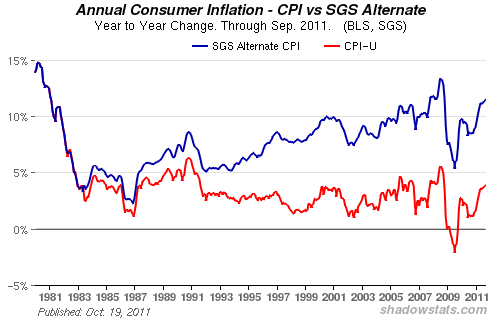
Perhaps Ben Bernanke, Tim Geithner and President Obama don’t see it, but consumers are certainly feeling its effects. As a result, even though Americans’ wages are stagnating in nominal terms, they continue to spend money, which has analysts wondering what’s going on. They conclude that we’re spending more as a direct result of Federal Reserve machinations:
Americans are making a little more money and spending a lot more.
Under normal circumstances, that would be a troubling sign for the economy. But a closer look at some new government figures suggests another possibility: People are saving less money because they’re earning next to nothing in interest.
Saving is already difficult because of more expensive gas and food. It’s even tougher because of the lower returns — the flip side of super-low interest rates that the Federal Reserve has kept in place since 2008 to help the economy.
Critics say the Fed is punishing those who play by the rules — those careful enough to set aside money for savings or people who built up a nest egg and are living on fixed incomes that depend on interest.
Source: ABC News
What choice are people left with? They may not be consciously aware that inflation is over 10%, but their pocket books sense it. Why leave money sitting in a bank account when your cash savings will be decimated within a year? Equity investment has become too risky, with markets swinging 2% – 3% daily. This leaves only one option. Spend.
Curiously, this is the same activity we hear about consumers engaging in at the onset of high inflation periods. When money becomes worthless, it seems, the people shift it into hard goods as soon as they can. For some this may mean precious metals purchases, for others it may be flat screen TV’s or iGadgets. For the purposes of this demonstration in consumer spending habits in response to economic and monetary conditions, we don’t care what they’re buying – just that they are spending dollars as fast as possible.
Last year, Gonzalo Lira warned of a hyperinflationary tipping point by early 2012. While his time lines may have been off, likely because of the untold number of financial, economic and monetary variables at play, the consequences will be nonetheless as devastating as he describes.
What the mainstream commentariat will make of all this will be really something: When CPI reaches 5% by the winter of 2011, pundits and economists and the Fed and the Obama administration will all say the same thing: “Happy days are here again! People are spending! The economy is back on track.”
…
2012 will be the bad year: I predict that hyperinflation’s tipping point will be no later than the first quarter of 2012. From there, it will accelerate. By the end of 2012, I would not be surprised if the CPI for the year averaged 30%.
By that point, the rest of the economy – unemployment, GDP, all the rest of it – will be in the toilet. By that point, the rest of the economy will no longer matter: The collapsing dollar will make 2012 the really really bad year of our Global Depression
Much of how this plays out is dependent on capital flows and confidence. Right now, it looks like Europe may have received a stay of execution. That will be short-lived, and eventually all of our worst fears about the EU will materialize. Once that happens, we’ll have entered the next phase of this economic crisis – and it will be global. Shortly thereafter – and we’re talking perhaps months or a couple years – the US dollar will follow suit and collapse just like the Euro will.
Leading up to this we should see, as Lira forecast, steadily rising official CPI inflation rates. We’re officially at 2% and 3.9% on the CPI and CPI-U respectively. When the CPI hits 5%, consider that a warning sign that the good old days of a stable currency are almost finished.
One caveat we must add to this, is that governments and central banks around the world are doing their darnedest to hide what is really happening, so high inflation rates and hyperinflation may come out of nowhere and surprise all of us with their speed and severity. Furthermore, there is always the possibility of a complete loss of confidence in the world’s reserve currency resulting from a credit-event of some type that involves foreign debt holders unloading their dollars in a period of hours or days, as opposed to years.
Whatever the case, once the event horizon is crossed it won’t take long for us to follow in the footsteps of Germany (1923), Hungary (1946), Yugoslavia (1994), Argentina (2001), and Zimbabwe (2008),.
Author: Mac SlavoRetail Stocks: “A Really Nice Contrarian Play” Says Strategist
Just in time for the holiday season, signs of softness showed up in the October retail same-store sales data —sales at stores opened less than one year. Overall sales increased a weaker-than-expected 3.7% from a year ago. Luxury retailers were hit the hardest, posting a combined year-over-year drop of 5.9%. Companies like Saks (SKS) and Nordstrom (JWN), as well as big box chains Costco (COST) and Target (TGT) are among the major retailers that fell short of analyst estimates.
Regardless, the overall sector is outperforming the broader market and technical strategists like Ryan Detrick of Schaeffer's Investment Research point to charts like the SPDR Retail etf (XRT), which is up 10% year-to-date, to support his bullish take.
"It's a really nice contrarian play," Detrick says in the attached video. "It's quietly one of the strongest sectors, yet again we continue to hear about all these troubles in the overall economy and U.S. consumer."
He's not denying there are economic headwinds and even points out the weakness in the latest polls that gauge consumer spending sentiment. The National Retail Federation predicts holiday sales will rise 2.8% to $466 billion this year versus a 5.2% increase in 2010. And the latest Gallup poll taken last week shows that Americans plan to spend a total of $712 on gifts this holiday season versus $715 estimated last year at the same time. The softness in sentiment is exactly why Detrick is going full steam ahead into the retail sector.
"We want to see that negativity or at least lowered expectations heading into the Christmas season, because with lower expectations you can have that upside surprise," says Detrick. "We think people will still be spending money; they say one thing, but go and do another."
From November through December retailers can make up to 40% of their annual revenue. It's a critical time period, so headwinds like the 9.1% unemployment rate, a housing depression, sustained high gas prices, and general uncertainty about the recovery are not to be taken lightly. "Nonetheless, price action is what really matters," says Detrick.
He's looking for retail stocks that have increasing earnings, strong price action, and he pays attention to analyst ratings. This leads to some of his favorite stocks in the sector: Chipotle (CMG), Costco (COST), McDonald's (MCD), Hansen Natural (HANS), Amazon.com (AMZN).
"When you have a sector that is quietly leading, people continue to hammer down on reasons not to like it, that's a sector that we're gonna take note of, and be long," he explains.
And if you're not willing to take a chance on individual retail stocks, Detrick recommends the SPDR Retail etf (XRT). He say it's the "easiest, cheapest, most efficient way" to get into retail.
Forget Gold or Silver. This Precious Metal is Extremely Undervalued
 As of Oct. 27, gold spot prices were hovering around $1,747 per ounce. Platinum, on the other hand, was selling for about $1,636 an ounce.
This means it takes just 0.93 ounces of gold to buy an ounce of platinum. Or, from another perspective, you could trade in one ounce of gold for 1.07 ounces of platinum.
It's not so much the size of the gold premium that matters -- the very existence of a premium is highly unusual. In fact, gold hasn't been worth more than platinum since 2008. Before that, you have to go back to January 1992 to see the last time the yellow metal traded this far above parity to the white one.
This has been a one-sided relationship throughout the years. Platinum almost always has the upper hand over gold, in terms of price. That's to be expected, considering platinum is about 30 times rarer. Annual platinum production is just a tiny sliver compared with that of gold.
That's what makes this such an odd occurrence.
The last time it happened was December 2008, when gold was soaring as a safe haven, just as weak auto sales were sapping demand for platinum (which is commonly used in catalytic converters). In that particular case, platinum retook gold just a few days later and went on to post a powerful 130%-plus gain during the next two years.
This time around, the extreme ratio has persisted for a couple months. It's not so much because platinum prices have nosedived (they're down about 9% for the year), but rather because gold is in the 11th year of a bull market and continues to soar. Prices have climbed another 25% since the start of the year.
On Jan. 1, it took 1.25 ounces of gold to buy one ounce of platinum. That exchange rate has now slipped all the way below 1:1. This is more than just a statistical aberration...
As you can see from the chart below, we've been in unprecedented territory.
Platinum has traded about 64% above gold on average during the past decade. Based on this, and with gold at $1,747 an ounce, you might expect platinum to have surged above $2,800 an ounce. Instead, it has sunk below $1,650.

This means either gold is too expensive, or platinum is too cheap. Personally, I think it's the latter. Speculators might consider this an opportune time to enter a pair trade by going long platinum and short gold. This would remove any outside influences and just capture the performance of one metal against the other.
This strategy has a high probability of success because there's no reason for platinum to be below gold. But I'm not a trader, nor am I betting against gold. I think the better solution for long-term investors is to simply overweight platinum -- and not just because a chart tells them to.
Action to Take --> Platinum group metals (PGMs) are irreplaceable and will remain in high demand. Auto production is expected to rise, which should boost demand. There are looming strike threats in South Africa, home to 80% of the world's supply. As my colleague David Sterman recently pointed out, the world's other major producer, Russia, has warned that output will begin falling.
You won't find any publicly-traded U.S. platinum companies. But First Trust has conveniently packaged all of the world's top suppliers in one place. For a modest annual cost of just 0.70%, the First Trust ISE Global Platinum fund (Nasdaq: PLTM) offers a diverse global basket of 24 major producers, including well-positioned leaders such as Impala Platinum and Anglo Platinum.
The exchange-traded fund (ETF) was punished during the selloff and was down nearly 50% for the year before a strong rally in October. But I still think this in an opportune entry point for long-term investors.
Thursday, November 3, 2011
Porter Stansberry: Get ready... The worst is yet to come
Here's the fact: America's standard of living is falling at a faster pace today than at any time since the Great Depression. Specifically, the real median income is down 9.8% since the fall of 2008. Additionally, Americans have lost roughly $5.5 trillion in asset value, or about 8.6% of their wealth.
When you talk about a depression, what you're really talking about is a collapse in the standard of living. That's what's happening today, right now, in our country. But people continue to go about their lives as though nothing is happening. Certainly, our politicians don't want to draw attention to the problem. Instead, they are behind the campaign to "paper over" these losses with schemes like "quantitative easing."
These schemes do nothing to make our economy more productive. They're designed instead to make prices rise so people (hopefully) won't notice how poor they're becoming.
If you've been reading my newsletters since 2008, none of this is a surprise to you. I've been warning month after month, year after year, that the government's efforts to paper over our bad debts won't work. And they won't work for two primary reasons…
First, soaring levels of high-powered money (like the Federal Reserve's asset base) will eventually cause prices to rise. That means the savings of millions of Americans – and the value of their wages – will fall in real terms. That's exactly what's happening. That's why our standard of living is falling so precipitously.
Second, the impact of this inflation and the uncertainty about its impact on the economy will cause entrepreneurs and corporations to delay or cancel major capital investments. That's the primary reason we have yet to see any rebound in employment.
The best way to see what's really happening in our economy and to our standard of living is to look at the value of the stock market through a sound-money lens. You can pick whatever sound money you like. Of course, most people won't ever do this… It would never even occur to them that the dollar is not sound and that it's distorting the value of everything in our economy.
Here's the real situation in America:

That's what the S&P 500 looks like when you price stocks in ounces of gold instead of in U.S. dollars. You'll see we are now below the lows we saw in 2009. Unfortunately, few people understand this… They've never thought about it this way before. And as a result, they're simply not doing enough to protect themselves.
They don't know this is what's really happening, because Washington keeps papering over these problems with more borrowing and more printing. But you can't solve a debt crisis by going deeper into debt. You can't reverse inflation by printing more money.
If I could magically wave a wand and change just one thing about my fellow citizens… I'd make them realize paper money is a crime.
It allows politicians to rob creditors to bail out debtors. It's a tool that's used to take value away from savers and give it to reckless borrowers. It's how both political power and economic power remain vested in Washington D.C.
Now… the politicians and their backers on Wall Street will swear up and down that their policies and the actions of the central bank (which has more than doubled its assets via nearly $3 trillion of asset purchases) aren't causing the inflation. It's as if, in their minds, printing trillions of dollars in new money has no impact on our economy.
It's simply a lie.
But that's not the worst part. The worst part is all that new money will end up in the hands of the people who caused this crisis in the first place.
Let me give you one example. Below, you'll find a chart of Genworth Financial. It's a mortgage-insurance/life-insurance company. It was spun out of GE Capital during the midst of the 2000s financial boom.
Without the bailout of the financial system, via $700 billion in TARP money and more than $2 trillion in quantitative easing, there's no doubt in my mind that Genworth would have gone bust because of losses in its mortgage-insurance unit. But that's not what happened. Instead, Genworth Financial became the No. 1-performing stock in the U.S. from the spring of 2009 until the spring of 2010.
It held on to those gains as long as the Central Bank continued its quantitative easing policies. And when QE finally ended in the summer of 2011… guess what happened to Genworth? I bet you can guess without even looking at the chart.

Paper money took the biggest loser, the company that had made the worst bets with the most leverage… and turned it into the biggest winner… at least, temporarily. For this, we all paid a massive, invisible tax: the largest decrease in real wages since the Great Depression.
This isn't how America should work. The rich and the powerful in New York and Washington D.C. shouldn't have the right to impoverish the rest of us simply to bail out their backers and their cronies.
My guess is… sooner or later… our creditors and the American people will wake up to what's happening to our money. And as I've been warning, they will be furious. What's scariest to me is to see how this anger is manifesting itself in the Occupy Wall Street movement. These folks are blaming capitalism for these kinds of problems. But this has nothing to do with capitalism. Paper money was Marx's idea. But try explaining that to any of those folks…
What's happening to our country is a crime. The ramifications of these kinds of manipulations will be decades of mistrust and social unrest. Unfortunately, this is a long way from being over. The price inflation that will inevitably result from the Fed's actions of 2009, 2010, and 2011 are only now beginning to manifest. The worst is yet to come. And it's going to be a lot worse.
What A JP Morgan “Mistake” Will Do To The Price of Silver
 So as we sit here pondering the myriad of Global Monetary Implosions happening as we speak one thing always seems to come back to the forefront..
 What happens to the price of SILVER if JP Morgan is caught up in all this mayhem and goes down?
Zerohedge.com just posted a very plausible scenario where the CDS’s that are imploding in Europe could easily destroy the top 5 US banks that trade 97% of these toxic derivatives.
Clearly JP Morgan is in the cross-hairs of the current derivative implosions…but what does that mean for SILVER? A LOT!
I believe that JPM is the ONLY large seller of silver left on the COMEX and LBM. They are also in charge of the “silver short hot potato” that has destroyed many companies that tried to control the silver bull including Bear Stearns, AIG, Drexal Burnham and more going back decades. No one in their right mind would take the short side of silver unless they had to defend “the system” which is precisely what JPM is trying to do.
So while JPM fights to keep the price of silver down with massive derivative shorts their multi-trillion dollar CDS book is blowing up! JPM is on the edge of the cliff and will drag everyone to the depths of the abyss as they go down.
Remember…if JPM is destroyed then there will be NO SELLERS left in the silver pits.
NOT ONE SELLER!
None at $50.
None at $100
None at $500
None at $1,000
NONE!
Of course the global market for silver will shut down before the EXCHANGES are exposed as the corrupt entities that they are. Watch for claims of “FORCE MAJEURE” to be used in their defense.
Very soon we will know the REAL “Fair Market Value” of silver and you can bet it will start with 4 DIGITS!
The end game is upon us so stock up on all the physical silver you can and trade every single electronic blip and every scrap of paper money for SOMETHING REAL….