Saturday, September 17, 2011

Mayor Bloomberg predicts riots in the streets if economy doesn't create more jobs

Mayor Bloomberg warned Friday there would be riots in the streets if Washington doesn't get serious about generating jobs.


"We have a lot of kids graduating college, can't find jobs," Bloomberg said on his weekly WOR radio show.

"That's what happened in Cairo. That's what happened in Madrid. You don't want those kinds of riots here."

In Cairo, angry Egyptians took out their frustrations by toppling presidential strongman Hosni Mubarak - and more recently attacking the Israeli embassy.

As for Madrid, the most recent street protests were sparked by widespread unhappiness that the Spanish government was spending millions on the visit of Pope Benedict instead of dealing with widespread unemployment.

Bloomberg's unusually alarmist pronouncement came as President Obama has been pressuring reluctant Republicans to pass his proposed job creation plan.

"The damage to a generation that can't find jobs will go on for many, many years," the normally-measured mayor said.

Bloomberg gave Obama kudos for coming up with a jobs plan.

"At least he's got some ideas on the table, whether you like those or not," he said. "Now everybody's got to sit down and say we're actually gonna do something and you have to do something on both the revenue and the expense side."

And everybody's got to share in the pain.


The streets of Cairo erupted in violence this spring. (AP Photo)

"When you start picking and choosing which groups do and do not, that's when it becomes unfair in a lot of people's minds," the mayor said. "But we're all in this together."

Obama didn't create this economic mess, it developed "over long periods of time," Bloomberg said.

Obama's approval rating has sunk along with the economy, but the ratings of the Republicans who have stymied his attempts repair the damage are even worse, most polls show.

Already, House Speaker John Boehner, an Ohio Republican, has drawn a line on raising taxes on the rich to pay for Obama's proposed $447 billion jobs plan, which aims to help the middle class.

Euro Oversold As Shorts Surge To Highest Since June 2010

For those seeking an oversold security, look no further than the EUR, which in the week ended Sept. 13, was the biggest FX loser, as non-commercial exposure rose 50% to a net short of -54,459 from -36,443 contracts the week before. This is the most bearish net exposure in the EUR since June 2010, and positions the currency for a short squeeze, although if history is any guide it still has a ways to go: the 2010 trough was -114k net contracts hit in May of 2010, just after it became apparent that Europe is falling apart. Also, despite speculation that traders have left the safe-haven status of the CHF following last week's SNB intervention, the Swiss Franc retained its bullishness, with net exposure remaining long, although declining modestly from 7,549 to 5,493 contracts. Also not surprising is that bullish bets in the JPY rose from 32,787 to 34,955 after declining past week. It seems that Yoda will be watching, watching, watching his Bberg terminal very closely in the coming days.

Why Oil Prices Could Fall No Matter What Happens Next

When oil prices start to decline, investors and economists get worried. Oil prices in large part reflect global sentiment towards our economic future – prosperous, growing economies need more oil while slumping, shrinking economies need less, and so the price of crude indicates whether the majority believes we are headed for good times or bad. That explains the worry – those worried investors and economists are using oil prices as an indicator, and falling prices indicate bad times ahead.

But oil prices have to correct when economies slow down, or else high energy costs drag things down even further. And the current relationship between oil prices and global economic output is not pretty. In fact, every time the cost of oil relative to global production has hit current levels – and that’s after the sharp corrections earlier this month – an economic slump, if not a recession, has followed, according to a Reuters article.

The “warning signal” that is currently flashing red is the Oil Expense Indicator, which is the share of oil expenses as a proportion of worldwide gross domestic product (specifically, it is oil price times oil consumption divided by world GDP). Since 1965, this indicator has averaged roughly 3% of GDP and has only exceeded 4.5% during three periods: in 1974; between 1979 and 1985; and in 2008. Each period saw severe global recessions.

In 1973/‘74, the Arab oil embargo sent oil prices rocketing skywards in the world’s first “oil shock.” In 1979, a revolution in Iran knocked out much of that country’s oil output and catalyzed the world’s second oil shock. And, of course, in 2008 the housing bubble collided with speculative buying of new debt instruments and a commodities boom to propel oil prices to a record high of US$147 a barrel, which helped to trigger the global financial crisis and the worst slump since World War II.

So where are we right now? Well, Brent crude prices would have to fall to the low US$90s per barrel for the Oil Expense Indicator to drop below 4.5%. Instead of that, Brent prices have been above US$100 per barrel for more than six months (aside from an intraday low of US$98.97 on August 9) and are still hovering between US$105 and US$110.

Oil prices play a major role in global economic growth because oil is crucial to every part of the economy. It powers manufacturing as well as food and commodities production, it fuels transportation, and it is a building block for industries like plastics and electronics. When oil prices stay too high for too long, they choke out economic growth.

Merrill Lynch analysts agree, writing in a recent note: “The last two times that energy as a share of global GDP neared … the current level, the world economy experienced severe crises: the double dip recession of the 1980s and the Great Recession of 2008.”

So we face two options: oil prices come down sharply, or we enter a recession, which will drag oil prices down. Either way, crude has to get cheaper.

That being said, remember that there are many forces at play in the oil markets, not the least of which is supply. At present the world’s most important supplier, Saudi Arabia, is pumping out more oil than it has for 30 years. In July the country produced 9.8 million barrels per day (bpd), lifting total OPEC production to 30.05 million bpd.

If they want, the Saudis can exert considerable influence over prices by reducing supply. And they may want to do just that. Oil analysts generally agree the Saudis want to see oil prices remain above US$85; lower oil prices would impair the country’s ability to meet its spending obligations. Iran, Kuwait, and other OPEC countries similarly want to see oil prices remain strong, to meet their spending requirements. Current OPEC governor Mohammad Ali Khatibi, of Iran, recently said that the cartel’s members have not set a desired price level but some think US$80 to US$90 is appropriate, while others want prices to remain above US$100 a barrel.

On top of that, no one is yet predicting a reduction in global oil demand. The International Energy Agency (IEA) reduced its forecast for demand growth, but still expects the world to consume 1.2 million more barrels of oil each day next year than this year. Similarly, OPEC reduced its demand growth estimate, but still foresees oil demand rising by more than 1 million barrels of oil a day over the next 12 months.

So, oil prices will come down when the economy falls too, but if oil goes on a tailspin à la 2008, expect to see OPEC step up to the plate, tighten the market, and support prices, so that its members can continue to pay their bills.

The Economic Collapse - The Video


Friday, September 16, 2011

Gold price capped by move to 'risk' trades

Renewed hope that key eurozone nations will agree to a new bailout for Greece encouraged gains on world stock markets yesterday, with German chancellor Angela Merkel and French president Nicolas Sarkozy standing by commitments to help Greece remain in the eurozone. The yield on 10-year Greek government bonds now stands at over 25% – a cost of borrowing that is clearly unsustainable without financial help from other European countries.

The gold price continues to consolidate above Jim Sinclair’s key price level of $1,764, though both it and silver came under selling pressure yesterday as hedge funds moved back into stocks on the “good” news regarding France and Germany’s support for Greece. With regards silver prices, as the Got Gold Report notes in its analysis of the latest silver COT report, there appears “much less confidence on the part of the commercials for lower silver prices than last year when their net short positioning was much higher and silver prices were much lower.” The silver price is a coiled spring ready to shoot higher.

The continuing problems in Greece have many analysts and investors fearful of the kind of credit crisis that could make 2008 look like a mere warm-up act. As Poland’s finance minister Jacek Rostowski has noted, Europe’s sovereign debt crisis threatens not just the survival of the current eurozone, but the actual European Union itself. If – owing to the strains of the debt crisis – countries were to leave the eurozone, this would deal a serious blow to the ambitions of those who favour continuing European political integration. This would call into question the EU’s entire raison d'être, leading to a loss of legitimacy that could have profound political implications for the continent.

For this reason, EU officials will be straining to maintain the eurozone in its existing form, with European Commission President Jose Manuel Barroso putting forward proposals for “Eurobonds” that would be issued jointly by eurozone nations. But this is of course a politically toxic proposal in Germany, with many Germans understandably annoyed by the notion that they should pay to support more profligate EU states. Thus, it seems only a matter of time until the European Central Bank is forced to resort to money printing on a massive scale in an effort to maintain the eurozone.

In other news yesterday, the UK’s Consumer Price Index (CPI) rose last month and now stands at 4.5%. Establishment economists in Britain are of course talking about this as a “temporary” surge in prices that will subside in the coming months. But with the Bank of England said to be ready to embark on another round of money printing, this looks unlikely to say the least.

The $1 Trillion Student Loan Market Begins To Implode

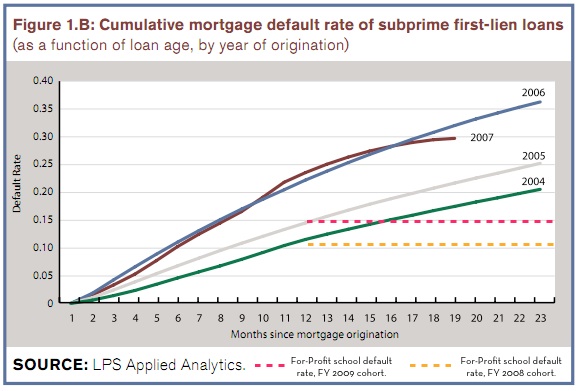
We seem to have entered an era of perpetual and unshakeable financial bubbles and the next ripe bubble to burst is in the student loan market. Student loan debt has become the fastest growing debt sector throughout the economic recession. Growth at for-profit colleges has been incredible and tactics used at these institutions reflects patterns seen with the subprime mortgage operators. They target low income markets and exploit government backed loans and pump them through local area lenders. It is a bubble of mammoth proportions and it is no surprise that data released by the Department of Education only a few days ago reflects a default pattern reminiscent of the subprime crisis. Default rates on student loans at for-profit institutions are absolutely abysmal. There is no question now that the student loan bubble is now the next market to pop. What will be the consequences of the $1 trillion student loan market contracting?

For-profit student loans the new subprime

subprime debt college debt

Source: RortyBomb

“(Department of Education) The U.S. Department of Education today released the official FY 2009 national student loan cohort default rate, which has risen to 8.8 percent, up from 7.0 percent in FY 2008. The cohort default rates increased for all sectors: from 6.0 percent to 7.2 percent for public institutions, from 4.0 percent to 4.6 percent for private institutions, and from 11.6 percent to 15 percent at for-profit schools.”

This rate is horrifying. The ways these are measured are reflected by two-year default cohorts so you have 15 percent of the entire group defaulting within two-years! The real default rate is much worse if we tracked these out for the life of the loan. In other words, you have many going to for-profit paper mills and coming out with very little job prospects but with the added burden of massive student loan debt. Clearly the student did not benefit but the profits at these institutions are enormous. The government backing is the only way these lenders and schools even survive. If a bank had to lend their own precious money you think they would give someone $40,000 or even $100,000 in student loans to pursue a degree at an unranked paper mill? Reminds you of people buying tiny condos in Florida for $500,000 with no verifiable income. (more)

That IPO Pop? Majority of 2011 U.S. Listings Are Underwater: P, EPOC, LNKD, Z


wsjlogo.gif

More than half of the U.S.-based companies making their domestic stock-market debuts this year are trading below their offer price, an ominous backdrop for any companies hoping to come public.

For any investor who bought—and held—these so-called underwater stocks in their portfolios over the course of the year, it is a painful reminder that even deals that did well their first day in the spotlight can crater later.

Among the companies trading below their IPO prices are Internet radio firm Pandora Media Inc., which popped 8.9% on its first day of trading during its debut in June, and physicians' hand-held software maker Epocrates Inc., which gained 37% in its first day in February.

The poor year-to-date performance among U.S.-based companies—so far this year, 63% of the 76 new listings are underwater, according to data tracker Dealogic—can be blamed primarily on the overall stock market, which itself has been sinking for the past two months. When stocks in general aren't doing well, IPOs suffer in turn and companies reconsider the listing plans.

Standard & Poor's 500 since early July that is weighing on IPOs, but also the stomach-churning ups and downs that have racked the market in recent weeks.

"It's not so much the level of the market but this kind of volatility that makes it difficult to price" new issues, said Tim Curry, a lawyer at Jones Day who works on technology-company IPOs in Silicon Valley.

Case in point: Earlier this month Groupon decided to cancel a roadshow it had planned and put its IPO on temporary hold because of stock-market volatility. It is reassessing its timing on a week-by-week basis,

"Until volatility settles down, it's going to be a while before the IPO market comes back in a meaningful way. I think the IPO market will be very selective, at best, and we're advising most clients to wait at least until" the Federal Reserve meeting Sept. 20-21, said Brian Reilly, head of U.S. equity capital markets at Barclays PLC.

Dealogic, which tracks stock and bond deals, says the current IPO backlog of 144 deals valued at $28.3 billion is the highest year-to-date number of deals since 2007.

The IPO market is seen as important to the economy because public stock offerings are a key way growing companies can raise large sums of capital that can be spent on advertising, new offices, new employees and other expenses.

And yet the biggest hindrance to the IPO market picking up may be the economy itself.

Sanjay Unni, who leads the securities practice at Berkeley Research Group, said the biggest issues weighing on stock prices and the ability to launch IPOs appear to be "larger macro issues that will determine how profitable companies will be once they float."

"Much of the movement on the downside has been, and continues to be, unanswered systemic risks in the global economy," such as Greece's sovereign debt crisis and the direction of the U.S. economy, Mr. Unni said. "Until those issues are resolved, we won't see a recovery in IPOs."

However, there is a bright spot for new issuers: Though the majority are underwater, the performance to date for IPOs is better than stocks in general. IPOs that came out in 2011 are down 6.5% on average from pricing as of the close Tuesday. The IPO stocks collectively performed better than Standard & Poor's 500 index, adjusted for the time period each company was public. Exactly half of 2011 IPOs are trading below the respective S&P 500 performance.

Also, some of the best new stocks have managed to stay above their IPO prices, though they have declined from their first-day pops. Professional-networking site LinkedIn Corp., which gained 109% in its May debut, ended Tuesday above its $45 IPO price but below its first-day closing price of $94.25.

Some have even managed to push higher: real-estate site Zillow Inc., which popped 79% on its first day in July, closed Tuesday above both its IPO and its first-day close.

Still, the news that the bulk of listings so far this year are underwater follows a nearly empty August for IPOs in the U.S. as companies cautiously evaluate the environment for new stocks.

With only two IPOs completed amid a declining broader market in August—the slowest month since July 2009, according to Dealogic—issuers and investors alike are keenly attuned to economic concerns and their effect on major stock indexes.

Observers have said they believe issuers that were considering a late-September launch now are more likely to delay those deals until October and November, depending on market conditions.

"It's a challenging decision to make. What they hope to avoid is completing their roadshow and not pricing the deal," says Rick Kline, a partner in law firm Goodwin Procter's Silicon Valley office who specializes in IPOs and capital markets transactions.