Saturday, July 23, 2011

2011 Halftime Report: The Cues for Copper

Copper slightly disappointed investors, ending the first half of the year with a decline of 3.50 percent. Worries about global inflation and, more specifically, the potential slowing of China’s economy weighed on copper’s price. The red metal rose 5 percent quickly in the new year, but similar to zinc, lead, palladium and platinum prices, declined sharply at the beginning of May.
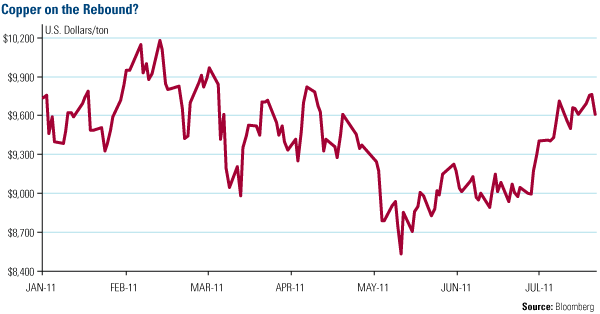
Copper on the Rebound?

Since the end of June, copper has been slowly inching its way up, with the past three weeks having produced positive results. Part of this rise is due to reduced supply issues. Chile, the world’s largest copper producer, has been plagued by power outages, strikes, accidents and heavy rains. Reuters recently reported that a “once in a half century winter storm” caused more than 12 mines to slow or stop operations after the open pit roads became too slippery in the South American country that mines about one-fifth of the world’s copper.

The election of Ollanta Humala in Peru–the second-largest producer of copper–has also been a drag on copper prices as investors debate the probability of Humala electing a mining friendly cabinet. As I discussed in “Is Peru’s Humala Jekyll or Hyde for Mining?,” investors have worried the president-elect could retract policies that encourage mining investment and help grow their economy.

The announcement came this week that Humala will appoint Luis Miguel Castilla, Peru’s former deputy finance minister, as the new finance minister. Carlos Herrera will lead the mines and energy ministry. However, according to the Financial Times, it is still not clear whether Humala will increase the corporate tax rate paid by miners and enforce tighter state controls. The actions of this leader will have an influence on the direction of copper prices for the remainder of the year.

In terms of demand, copper is a necessary ingredient for numerous building projects. Electrical power cables, electrical equipment, automobile radiators, cooling and refrigeration tubing, heat exchangers and water pipes all require copper. With all the construction and infrastructure building in China over the past several years, it’s not surprising that this country is the No. 1 world consumer of copper. It’s estimated that China accounted for nearly 40 percent of global copper consumption last year.

Because of this large demand, similar to our outlook for oil, copper prices hinge on China’s ongoing development. While some have begun to wonder about the health of the country’s continuing growth and development, Macquarie Research believes that “real demand in the country remains robust.”

Take developer activity, for example, which Macquarie says has been a huge driver of construction growth in 2011. The media has focused its attention on ghost cities and lagging sales of property in China. Yet Macquarie thinks it’s important to consider the property sales across all different sizes of cities. In its Commodities Comment, subtitled “Chinese social house – another reason to buy copper and iron ore,” Macquarie acknowledges a weakness in property transactions in China’s larger cities. This was due to the government restricting investment demand to slow growth. However, these larger cities only account for 20 percent of the total market, says Macquarie.

Conversely, many smaller cities, such as Anquing, Guizhou, Luzhou, Mudanjiang, and Shijiazhuang, have had double-digit year-over-year growth in unit sales so far this year. In the case of Hohhot, the capital city of Inner Mongolia, sales growth has tripled. Government investment has led to urban space increasing from 80 square kilometers in 2000 to 150 square kilometers last year, according to the city’s government website. Hohhot, which means “green city” in Mongolian, has grown to more than 2 million people and has become a hub for agriculture and manufacturing.
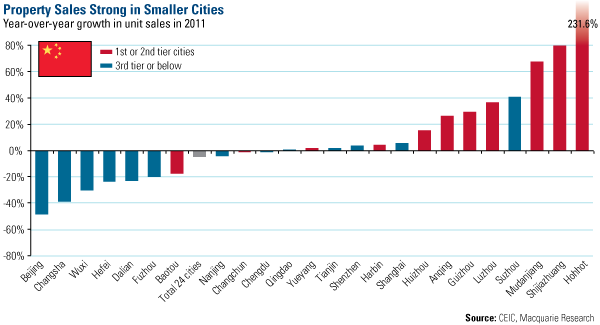
Property Sales Strong in Smaller Cities

Most importantly, Macquarie says the tremendous sales activity in these smaller cities indicates “there has been enough cash to keep construction activity going.”

In addition, China’s social housing project should drive incremental demand for copper. Macquarie indicated that China is “aiming for 10 million social housing units, up from 5.8 million in 2010.” The country has built only 3.4 million units so far this year, but based on China’s habit of exceeding its objectives, Macquarie thinks the target will be met.

Even if the naysayers think China’s growth will slow because of the government’s monetary policy restrictions, there’s consensus among research experts that the country’s inventory of copper is getting low. Goldman Sachs’ discussion of the copper market indicated that in the second half of 2011, the “winding down of destocking will lead to a stronger Chinese pull on global supply.” China seems to have no choice but to go back to the market for copper, if only to replenish its supply.

Tom Kendall, Credit Suisse’s vice president for commodities research, agrees. In a Mineweb interview on copper’s fundamentals and expectations of further growth, Kendall stated he has seen a “very sizeable drawdown” in Chinese copper inventories this year. He goes on to say, “some point in time, they will get to a point at which they have run down inventory levels to an uncomfortably low level and then there is no alternative to coming back to the international market.”

Portfolio Manager Evan Smith agrees that copper’s pricing looks promising. China is nearing the end of its tightening policies and has shown that its debt is under control based on released results of the country’s comprehensive debt audit. For the Global Resources Fund (PSPFX), he has been incorporating these macro thoughts into the team’s models to identify stocks with superior growth and value metrics that he believes could benefit the most.

Gerald Celente Trends Journal: PIIGS, PRESSTITUTES AND THE GLOBAL MELTDOWN

13 July 2011 — “Read All About It!” You couldn’t not read all about it! The media was full of reports about how happy stock market days were here again. After a stormy start, June closed and July began with US benchmark indexes racking up their biggest weekly gains in two years on good news: the US manufacturing index had unexpectedly risen, and the beleaguered debt-burdened Greeks were bailed out yet again – piling un-payable new debt on top of un-payable old debt.

Yes, there was some concern, but, as The New York Times reported on June 25th, “Two years into the official recovery, the economy is still behaving like a plane taxiing indefinitely on the runway. Few economists are predicting an out-and-out return to recession … analysts generally expect the economy to pick up in the second half.”

The economists were forecasting strong job growth for June. But two weeks later, when the numbers came in, the Bureau of Labor Statistics reported that only 18,000 jobs had been created – not the 125,000 jobs projected … by those same economists who were also not “predicting an out-and-out return to recession.”

Accordingly, without missing a beat, the Times changed its tune – writing new words to replace the old words they would never be forced to eat:

Feeble Job Numbers Show
Recovery Starting to Stall

Defying Economists Forecast for Hiring,
Unemployment Creeps Up to 9.2%

For the second consecutive month, employers added scarcely any jobs in June, startling evidence that the economic recovery is stumbling … The government also revised downward the small gain for the previous month to 25,000 new jobs, less than half the original estimate. (The New York Times, 9 July 2011)

“Dismal Jobs Data Rock US Recovery” and “Worries Grow Over Jobs,” read the respective headlines in the Financial Times and Wall Street Journal on July 9th, dissipating the air of optimism that had recently rallied equity markets.

“Employment!” More than factory orders, GDP, corporate profits, retail sales, durable goods … employment was the one big number that counted. There was no way to spin the consequences of 18,000 mostly low paying health care and hospitality jobs into the hopeful message implied by the 125,000 jobs forecast by most economists.

The equation was simple; the more people out of work, the less they consume. And in the United States, where consumer spending accounts for an estimated 70 percent of the GDP, without increased consumer spending, the economy was again recession bound.

Virtually overnight, one dire employment report unraveled two years’ worth of government spin and media complicity. In April 2010, Vice President Joseph Biden promised, “we're going to be creating between 250,000 jobs a month and 500,000 jobs a month." And in August 2010, Treasury Secretary Timothy Geithner declared that the “actions we took at its height [of the crisis] to stimulate the economy helped arrest the freefall, preventing an even deeper collapse and putting the economy on the road to recovery.”

But almost a year later, talking on “Meet the Press,” two days after the devastating employment data was released, the new, revised Geithner forecast was, “Oh, I think it’s [the recovery] going to take a long time still. This is a very tough economy. And I think for a lot of people it’s going to be – it’s going to feel very hard, harder than anything they’ve experienced in their lifetime now, for some time to come.”

Like the Biden boast long-buried and un-exhumed, the Geithner statement, a direct contradiction of his former projection went unchallenged, given the usual free pass by the “Meet the Press” Presstitutes.

There was, and is, no “return to recession.” As The Trends Research Institute had been forecasting since the onset of the Great Recession and the “Panic of ’08,” all those "bold actions" proudly cited by Geithner were no more than financial Prozac – multi-trillion-dollar band aids, palliatives, placebos and cover-ups packaged as TARP, the American Recovery and Reinvestment Act, QE2, and so on. At best, the “bold actions” merely guided the Great Recession into a brief remission, and that is all.

Global Ponzi
It was a cover-up, not a recovery. And while the US may have been the first, it was not the only nation to try to fraudulently finagle its way out of a crisis and into prosperity. Like the US bailouts, the Greek survival package – praised as an important stopgap success only last week – has neither guaranteed keeping the Greek banking system afloat nor guaranteed it won’t default.

Now Italy has caught the contagion. Fattest of the PIIGS (acronym for Portugal, Ireland, Italy, Greece and Spain) – the eurozone’s third largest economy – with its 120 percent public debt to GDP ratio, Italy is bleeding red ink all over its balance sheet. Borrowing more to service its debt load and imposing draconian austerity measures to reign in government spending will, at best, provide a respite from the financial crisis … or, at worst, foment a revolution. (
See, “Off With Their Heads, 2.0, Trends Journal, Autumn 2010
)


Then there’s China, who panicked when the “Panic of 08” blew out their export driven economy, and, like the West, used cheap credit and huge stimulus packages to prevent a major economic contraction. While China’s crisis differs from the West’s in that it has large currency reserves and its debt is homegrown and home-loaned, it’s still debt and has to be repaid.

And unlike the West, which pumped trillions into just keeping its economies afloat, the Chinese multi-trillion yuan infusions have created an immense, ready-to-pop property bubble. But this time, like the West, there will be no available fiscal or monetary government policies to re-inflate their faltering economy.

And as goes the US, Europe and China – so goes the rest of the world. From India to Israel, Brazil to Bangladesh, Chile to Russia, no nation will escape the economic fallout and few will escape the political consequences.

Yet, despite the widely available economic facts and the ample evidence of faulty forecasts and failed government policies, the mainstream media continues to sell the public the big lie. By providing cover for the politicians and financiers, the Presstitutes of the world – with their stable of “well respected” pundits – are accomplices in promoting the egregiously transparent cover-up as a “recovery.”

Trendpost:
After descending to $1,480 less than two weeks ago, as this is written, gold is flirting with $1,600. We see this surge as a recognition of the greater financial and socioeconomic collapse we have been forecasting since the onset of the “Panic of ’08.” We hold to our forecast of “Gold $2,000,” and depending on how the coming crisis unfolds and the responses to it made by governments and central banks, $2,000 may prove but a temporary ceiling before climbing higher.

Friday, July 22, 2011

The Jim Rogers interview you don't want to miss


Our colleague Frank Curzio just published a fantastic interview in this week's S&A Investor Radio podcast.

It's with Jim Rogers... and it's one of the most interesting interviews we've ever heard with the legendary investor. Frank and Jim cover a huge number of topics including:

How Jim would solve America's huge debt problem...
His favorite commodities to buy today, and how he personally prefers to buy them...
The U.S. stock sector he's shorting now and why...
His latest thoughts on China, including the one thing that could stop its amazing growth...
And a favorite emerging market investment that he's never mentioned before.

To listen to the full interview for free, click here. If you'd prefer to download it for free from iTunes, click here.

Keith Fitz-Gerald: The Latest Trick Goldman Could Be Playing On You

Money Morning's Chief Investment Strategist Keith Fitz-Gerald joined FoxBusiness' "Varney & Co." program to discuss what investors should do about the recent gloomy economic forecasts from Goldman Sachs Group Inc. (NYSE: GS). With Wall Street's track record, there may be more strategy than truth to the reports.

3 Safe-Haven Alternatives to Treasuries: IAU, DBA, GDX, FXF, CEW, CCX, ELD, PCY, EMB

Outside of burying your cash in the backyard, U.S. treasury bonds remain one of the safest places to keep your money. But that could change soon. Two major ratings agencies, Standard and Poor's and Moody's Investors Service, have said policymakers in Washington need not only to raise the debt ceiling by the August 2 deadline, but to raise it along with substantial cuts to the deficit. It's not clear how much the ratings agencies would like Congress to shave off the deficit, but they clearly don't believe the negotiations have gone far enough. If lawmakers can't come to an agreement, treasuries could lose their elite, top-notch rating. That has many in the investment community shaking their heads.

"Even the word 'safe haven' right now has basically lost its meaning, primarily because of this potential downgrade," says Jeffrey Sica, chief investment officer of Morristown, N.J.-based investment firm SICA Wealth Management. "Really what [treasuries] have become is the best of the worst. Money has flowed into treasuries primarily because everything in [the sovereign debt crisis in] Europe looks so horrendous." At this point, nothing can truly replace the safety, liquidity, and size of the treasury market, but here are a few alternatives for investors to consider:

Commodities. Generally, when investors lose faith in paper currencies, they turn to hard assets--especially gold--because of their inherent value. Just this week, gold hit a record of above $1,600 per ounce. Silver, often referred to as "the poor man's gold" because it's generally cheaper to purchase, has been on its own run lately, and currently trades around $40 an ounce. Christian Magoon, CEO of asset management consultant firm Magoon Capital based in Illinois, says investors should even consider "soft" commodities because of their finite nature. "Everything from gold to probably corn ... would now be more attractive because they're not able to be printed, and they're not linked to paper currencies, so you would expect them to hold their value," Magoon says. Two of the most popular exchange-traded funds that are physically backed by hard assets are iShares Silver Trust (symbol SLV) and iShares Gold Trust (NYSEArca: IAU - News). Sica recommends PowerShares DB Agriculture ETF (NYSEArca: DBA - News), which invests in a range of commodities, including corn, sugar, and soybeans.

Tom Lydon, editor of ETFTrends.com, offers a twist on investing in precious metals. "Instead of following the price of the metals, look to the mining companies," Lydon says. "It costs the same to pull the metals out of the ground, no matter the price of the metal." Since gold has recently reach new highs, he favors ETFs like Market Vectors Gold Miners (symbol GDX), which invests in the stocks of gold-mining companies.

Other currencies. The Swiss franc is one of the world's strongest and most stable currencies. Year-to-date, it has appreciated about 13 percent against the U.S. dollar. That's because Switzerland is a relatively stable country that isn't facing debt problems like many other European nations. Michael Cuggino, manager of thePermanent Portfolio Fund (PRPFX), maintains a fixed allocation of 10 percent of the fund's total assets to the Swiss franc. "We do [currency diversification] with the Swiss franc," Cuggino says. "It provides you with a true offset to what's going on with the dollar and the Euro." Investors can get exposure to the Swiss franc by owning bonds issued by the Swiss government, or through an ETF like CurrencyShares Swiss Franc Trust (NYSEArca: FXF - News).

While interest rates remain near zero in the United States, they're much higher in some emerging markets such as China and Brazil, where central banks have hiked interest rates in recent months. Magoon recommends currency ETFs like WisdomTree Dreyfus Emerging Currency (NYSEArca: CEW - News), which owns a basket of emerging markets currencies. He says investors can also take advantage of appreciating currencies in commodity-rich nations like Australia that generally have stronger currencies. To invest in such countries in both developed and emerging markets, he suggests WisdomTree Dreyfus Commodity Currency (NYSEArca: CCX - News), which also owns a number of different currencies.

Emerging markets bonds. In terms of growth, many emerging markets nations like China and Brazil are expected to far outpace developed markets countries like the United States and the U.K. Many emerging countries also have their fiscal houses in order. "In a lot of metrics, relative to developed countries, they're essentially safer," Magoon says. Granted, their currencies are more volatile and the markets aren't as liquid, but measured from a debt-to-GDP perspective, the sovereign bonds of emerging countries look attractive. Investors have two options for investing in emerging markets sovereign debt: funds that invest in local currency, or funds that invest in bonds denominated in U.S. dollars. Investors can get exposure to local currencies through ETFs like WisdomTree Emerging Markets Local Debt (NYSEArca: ELD - News). For investors that prefer dollar-denominated debt, Magoon suggests PowerShares Emerging Markets Sovereign Debt ETF (NYSEArca: PCY - News) or iShares JPMorgan USD Emerging Markets Bond ETF (NYSEArca: EMB - News).

The Next Great Bull Market Is Coming Soon: Belski


Wall Street may be bracing for a U.S. debt default, but volatility (^VIX) is falling and stocks are rising thanks to a continued streak of strong corporate earnings reports, with IBM (IBM) and Morgan Stanley (MS) among the latest to beat the street. The long-term picture looks rosy for corporate America according to Brian Belski, chief investment strategist at Oppenheimer. He says, "American companies are the best positioned companies right now for the next cycle, which we believe we're on the precipice of the next great secular bull market."

Belski says right here, right now staying invested matters. "The next 10-years we want investors to be overweight stocks. Over the next three to six weeks, two to three months, we think we have a lot of consternation and volatility involved in the equity markets around the world," he says.

Despite short-term headwinds (European contagion, U.S. debt negotiations), which are arguablyalready priced into the market, "2012 will be a year that will be defined by job growth," says Belski. This is a welcomed notion for the 9.2% of Americans looking for jobs.

But the optimistic view seems contingent upon Washington and Wall Street playing nice. Belski's hope is to see policy that will fuel business, thus jobs and the recovery. With corporate America sitting on a record-high $2 trillion in cash, he says U.S. companies need incentives to hire, to repatriate cash, and to pay dividends. "We have a burgeoning asset class developing called dividend growth and we have to provide investors with an outlet to sell their bonds, because the next great move collectively is that interest rates are going higher," says Belski.

Higher rates will cause a negative performance in bonds, send investors looking for new high quality assets, and Belski argues, dividend growth provides just the right opportunity.

Or does it? Macke doesn't see dividend growth driving stocks higher. He points to Microsoft (MSFT), a company that has increased its dividend for six years in a row, is yielding 2.4%, and recently sunk $8.5 billion to buy Skype. "As an investor, I'd rather be long Apple (AAPL), who has a huge cash pile, but they're putting it to work for me rather than getting that cash back," says Macke.

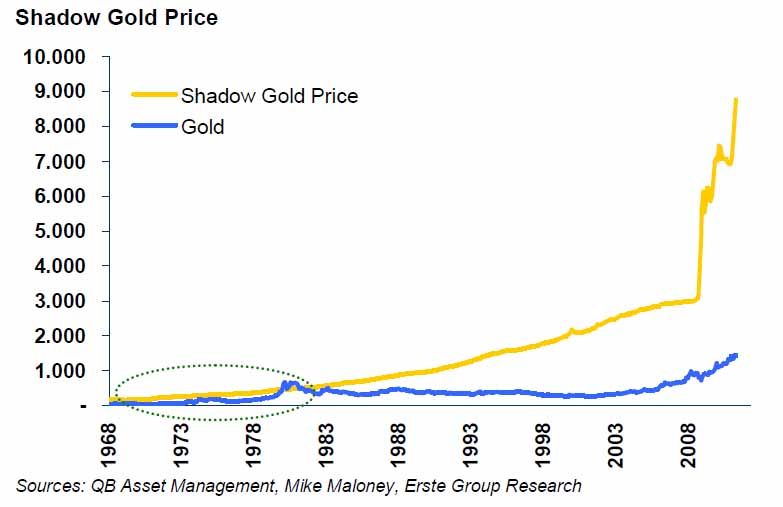
The Shadow Gold Price: $10,000 An Ounce

We realize that experts the world over say gold is not money, but we can’t help but consider that if central banks are stocking up (ex-US), pension funds are stocking up, big money investors are stocking up, and individuals on the street are moving to diversify into something other than stocks and bonds, that there might be something to this whole “gold is money” theory:

QB Asset Management calculates the so-called “Shadow Gold Price” (“SGP”). It divides the US Monetary Base by U.S. official gold holdings, the same formula actually used during the Bretton Woods regime to fix the exchange value of the dollar at USD 35.00/ounce. It would be the theoretical price of gold today were the Fed to depreciate the USD to a level that would cover systemic bank liabilities (transform a debt-based into a asset backed currency). The current Shadow Gold Price would be just under USD 10,000. This figure illustrates the magnitude of monetary inflation already embedded into the system, sitting latent and threatening to increase the general price level.

At the moment less than 2.6% of US government debt is covered by gold, which is clearly below the long-term median of 5%. Should the gold price therefore double, the coverage would only rise to the long-term median. But this would also require stable government debt, which is less than likely. The highs of the ratio dating from the 1980s would only be reached at a price of about USD 15,000.

If one were to fully cover the current debt with gold, the price would have to increase to USD 57,000/ounce. That said, a full coverage is extremely unlikely; at its highs the ratio was at 55% in 1915 and at slightly less than 25% in 1980.

Source: Zero Hedge

We find the following quote from Horace most applicable given the chart above:

Naturam expellas furca, tamen usque revenit.
-Horace (65-8 BC)

(You may drive nature out with a pitchfork, she will nevertheless come back)

The manipulators can play with precious metals all they want, but thousands of years of historical precedence simply cannot be erased by the ideologies of a handful of central bankers and politicians.

We would certainly advise our readers to prepare for future calamity by investing in long-term food storage, water reserves, tools, equipment, skills development and other preparedness supplies, but the future potential value of gold in a collapsing economy cannot be discounted. For those with the ability to do so, we recommend looking into silver first, and then gold, as a wealth preservation asset.

After the SHTF, those with real money will be able to use it to acquire assets that will have reached their bottom – for example real estate – and then ride those assets to higher values as the global economy resets and recovers. And in a worst case, even if the entire grid goes down and stock exchanges no longer function, there will always be a buyer for precious metals somewhere.