Friday, July 22, 2011

The Shadow Gold Price: $10,000 An Ounce

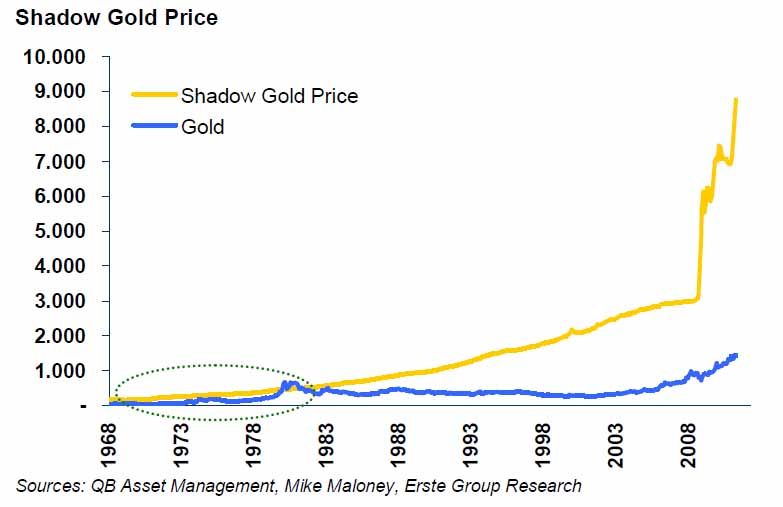
We realize that experts the world over say gold is not money, but we can’t help but consider that if central banks are stocking up (ex-US), pension funds are stocking up, big money investors are stocking up, and individuals on the street are moving to diversify into something other than stocks and bonds, that there might be something to this whole “gold is money” theory:

QB Asset Management calculates the so-called “Shadow Gold Price” (“SGP”). It divides the US Monetary Base by U.S. official gold holdings, the same formula actually used during the Bretton Woods regime to fix the exchange value of the dollar at USD 35.00/ounce. It would be the theoretical price of gold today were the Fed to depreciate the USD to a level that would cover systemic bank liabilities (transform a debt-based into a asset backed currency). The current Shadow Gold Price would be just under USD 10,000. This figure illustrates the magnitude of monetary inflation already embedded into the system, sitting latent and threatening to increase the general price level.
At the moment less than 2.6% of US government debt is covered by gold, which is clearly below the long-term median of 5%. Should the gold price therefore double, the coverage would only rise to the long-term median. But this would also require stable government debt, which is less than likely. The highs of the ratio dating from the 1980s would only be reached at a price of about USD 15,000.

If one were to fully cover the current debt with gold, the price would have to increase to USD 57,000/ounce. That said, a full coverage is extremely unlikely; at its highs the ratio was at 55% in 1915 and at slightly less than 25% in 1980.

Source: Zero Hedge

We find the following quote from Horace most applicable given the chart above:

Naturam expellas furca, tamen usque revenit.
-Horace (65-8 BC)

(You may drive nature out with a pitchfork, she will nevertheless come back)

The manipulators can play with precious metals all they want, but thousands of years of historical precedence simply cannot be erased by the ideologies of a handful of central bankers and politicians.

We would certainly advise our readers to prepare for future calamity by investing in long-term food storage, water reserves, tools, equipment, skills development and other preparedness supplies, but the future potential value of gold in a collapsing economy cannot be discounted. For those with the ability to do so, we recommend looking into silver first, and then gold, as a wealth preservation asset.

After the SHTF, those with real money will be able to use it to acquire assets that will have reached their bottom – for example real estate – and then ride those assets to higher values as the global economy resets and recovers. And in a worst case, even if the entire grid goes down and stock exchanges no longer function, there will always be a buyer for precious metals somewhere.

Jim Rogers : The Only Long Term Solution is to Face Reality

Jim Rogers latest interview 20 July 2011 ... Jim Rogers starts at 08:00


Jim Rogers : the only long term solution is to face reality , we had the greatest credit bubble in the history of the world in the United States , we had gigantic excess for thirty forty years , we can't deny that , you can't just wake one day and say well OK I made a mistake too bad now let's start over the only way you gonna do that is face reality now and start over , admit people are bankrupt let people go bankrupt do not bailout people who fail let's start this whole situation over we can never pay off the debt that we have encored , we have to cut spending dramatically , we should cut spending not with an axe but with a chainsaw , I mean this is a serious that the United states is in and therefor the world

Why Most Market Forecasters Get it Wrong

Be it a football game, the weather, an election, or the future of Middle East uprisings, people want to know what will happen before it does. We want to know the future, and we actively seek out experts who can predict it. But facts show that in most pursuits where dynamic and multiple variables determine what will happen, experts are not good at predicting the future. And to make matters worse, those who predict are rarely held accountable for their prognostications.

Take politics, for example. Philip Tetlock, a psychology professor at the University of Pennsylvania, conducted a study that became a book called Expert Political Judgement. He tracked about 80,000 forecasts from nearly 300 political experts over 20 years regarding political events in many countries. He tracked the outcomes of their forecasts against a group of college undergraduates making subjective predictions and a group who just made random guesses. The experts did slightly better, but not much. Nevertheless, they got on TV frequently and built their names and reputations.

Christina Fang, a professor of management at NYU's Stern business school, tracked the Wall Street Journal's Survey of Economic Forecasts to find out how accurate these highly paid analysts' forecasts were when billions of dollars were at stake. Surely this would lead to more accurate predictions. Her paper, "Predicting the Next Big Thing: Success as a Signal of Poor Judgement," draws some stunning conclusions.

Fang concludes that rather than being an indication of good judgment, accurately forecasting a rare event, such as business success, may in fact be an indication of poor judgment. On National Public Radio, she said, "If you look at the extreme outcomes, either extremely bad outcomes or extremely good outcomes, you see that those people who correctly predicted either extremely good or extremely bad outcomes, they're likely to have overall lower level of accuracy. In other words, they're doing poorer in general. ... Our research suggests that for someone who has successfully predicted those events ... they are not likely to repeat their success very often. In other words, their overall capability is likely to be not as impressive as their apparent success seems to be."

Consider how those who predict make money on Wall Street. Because there is no way to hold financial forecasters accountable for their incorrect predictions, they get more out of making wild ones. Wild predictions pay because the downside of being wrong is zilch, but the upside is lifelong fame. When those who make them are right, they get to manage more money, sell more books, and garner tremendous publicity for many years to come.

Consider the 2008 market crash. The best-selling books today are being written about those who called the crash such as John Paulson and those featured in Michael Lewis's book The Big Short. Those who were right will continue monetizing their correct prediction for many years to come. They are today's seers. But literally hundreds of pundits on CNBC got it wrong. Who were they? We'll never know--no one has any incentive to embarrass those who were wrong. Imagine seeing a pundit on CNBC with statistics showing how accurate their predictions were, like baseball statistics each time a player walks onto the mound.

We face a showdown between Congress and the president on lifting the budget deficit ceiling. The fact is, no one knows when or what deal will be cut. Those who are predicting this outcome are guessing. The ultimate effect on stocks and bonds in the short or long term is also unknown. But we keep tuning in, hoping for an answer, listening to confident and educated individuals making predictions.

As avid index investors, we make only one prediction: In a global, capitalistic economy, investors are rewarded for the risk they take in deploying their capital. If in bonds, investors will be rewarded as a lender. If in small-cap stocks, investors will be rewarded for increased equity risks. This prediction is rooted in empirical evidence and fundamental principals of our economic system. The rest is expensive and distracting noise. Predicting the ebbs and flows of that noise only serves to help money managers increase their assets under management and financial authors to sell more books and newsletters.

So next time you find yourself glued to a financial soothsayer making a prediction, stay far away from the trade button.

Analysis: Canadian Dollar within striking distance of modern-day high

The Canadian dollar looks set to extend a rally that's taken it to 3-1/2 year highs against the U.S. dollar this week, as more hawkish Bank of Canada comments lifted the currency and global investors pushed into the safety of Canadian assets.

Given the central bank's clear signal it would likely resume interest rate hikes later this year, analysts said the currency might even revisit its modern-day high. It reached C$0.9059 to the U.S. dollar, or US$1.1039, in November 2007, according to Thomson Reuters dealing data.

"Yes, Canada could hit post-Civil War highs once again," said Michael Woolfolk, a senior currency strategist at BNY Mellon in New York.

"(Hitting the high) would not be altogether unwarranted if Canada begins raising interest rates again. It's certainly not in our forecasts, but it's a nontrivial possibility of hitting C$0.90 within the next 12 months."

Based on available data, the Canadian dollar was at an all-time high of C$0.36 to the U.S. dollar, or $2.78 in 1864.

A survey on Wednesday of Canadian primary dealers found most expect a rate hike in September or October, perhaps as much as a year before the U.S. Federal Reserve starts raising interest rates.

"Against a background of firm commodity prices and continued global diversification flows to the relatively safe harbor of Canadian bonds, we look for the loonie to stay close to around US$1.05 even by the early part of 2012, before Fed rate hikes start to kick in," said Douglas Porter, deputy chief economist at BMO Capital Markets in a note.

DRIVING FORCES

The currency began rallying on Tuesday after the Bank of Canada signaled it was closer to resuming rate hikes. Governor Mark Carney indicated that the central bank's focus was on inflation and not the Canadian dollar, despite concerns that a strong dollar could hurt the economy.

But other G10 currencies are still outperforming the Canadian dollar, with part of its strength coming from U.S. dollar weakness, and general strength from the bloc of Australian, New Zealand and Canadian dollars.

A release of draft conclusions from a euro zone meeting on Thursday to tackle contagion from Greece's debt woes helped push the Canadian dollar to a 3-1/2 year high of C$0.9425 to the U.S. dollar, or $1.0610, its highest since November 2007.

"That was viewed very constructively by the market and lifted the euro up. It also helped bolster risk appetite, which undermined the U.S. dollar," said Woolfolk.

Canada, with its relatively robust economy, stable debt market and internationally recognized sound banks, has become particularly appealing to investors as the U.S. and European debt crises send investors elsewhere.

"As uncertainty in Europe continues to rise and problems in the U.S. remain at the forefront, there is likely increased appetite to diversify holdings away from both USD and EUR based assets," Scotia Capital chief currency strategist Camilla Sutton said in a research note.

"Small open economies, with strong sovereign positions and flexible FX regimes, like CAD, are in demand. We expect this is a long-term trend...that will help support CAD into year-end."

RISKY BUSINESS?

Currency analysts polled by Reuters said this month they expected global risks to drag the Canadian dollar down against a stronger U.S. dollar, with parity a possibility within the next 12 months.

Marc Chandler, global head of currency strategy at Brown Brothers Harriman, said a stronger Canadian dollar will hurt non-commodity aspects of the economy, such as manufacturing.

"The Bank of Canada will get more concerned about ... the higher currency and may dampen expectations of a rate hike," Chandler said.

"The exports are heavily weighted toward commodities, but part of the country doesn't produce commodities, they're consumers of commodities. They get hurt, so it leads to this bifurcation of the economy, which makes it all the more difficult to conduct monetary policy and has political ramifications."

Woolfolk disagreed.

"We think conditions warrant higher interest rates in Canada, but (the central bank) is likely holding back because of the obvious positive it would have for the currency," he said.

Smart Money - August 2011


Smart Money - August 2011
English | 88 pages | HQ PDF | 47,8 Mb


Fed Preparing For US Default Says Plosser

That giant whooshing, and humming, sound you hear are all the printers at the basement of Marriner Eccles getting refills and start the warm up process. Because according to the Fed Charles Plosser the Federal Reserve is actively preparing for the possibility that the United States could default. Which can only mean one thing: an immediate paradrop of millions of $100 bricks to every man woman and child in the US since as we all know by know Tim Geithner has repeatedly confirmed the Treasury has absolutely no default plans. None.

Per Reuters:

Philadelphia Federal Reserve Bank President Charles Plosser said the Fed has for the past few months been working closely with Treasury, ironing out what to do if the world's biggest economy runs out of cash on August 2.

"We are in contingency planning mode," Plosser told Reuters in an interview at the regional central bank's headquarters in Philadelphia. "We are all engaged ... It's a very active process."

Plosser said his "gut feeling" was that President Barack Obama and Congress will come to an agreement to increase the Treasury's borrowing authority in time to avert a default on government obligations.

And in addition to the warming up, the Fed is also engaging in the following:

The Fed effectively acts as the Treasury's bank -- it clears the government's checks to everyone from social security recipients to government workers.

"We are developing processes and procedures by which the Treasury communicates to us what we are going to do," Plosser said, adding that the task was manageable. "How the Fed is going to go about clearing government checks. Which ones are going to be good? Which ones are not going to be good?"

"There are a lot of people working on what we would do and how we would do it," he said.

Plosser added that there are difficult questions that the Fed itself had to grapple with.

The Fed lends to banks at the discount window against good collateral. But what happens if U.S. Treasuries no longer fit that bill?

"Do we treat them as if they didn't default, in which case we would be saying we are pretending it never happened? Or do we treat them as if they defaulted and don't lend against them?" Plosser said. "Those are more policy questions."s at the basement of Marriner Eccles getting refills and start the warm up process.

We urge the secretary of tax evasion to take a hint or two from his "Treasury Bank" brethren and start contemplating a Plan B since we now stand less than 48 hours away from D-Hour and there is still no consensus.

Thursday, July 21, 2011

Cramer: Apple to $500 AAPL

Cramer on Wednesday raised his price target on Apple from $400 to $500 a share. Yet at the $500 level, the technology stock will be selling at just 11.5 times his estimates for next fiscal year's earnings, only three quarters of what the average company in the S&P 500 index sells for.

Apple's stock [AAPL 386.90 10.05 (+2.67%) ] rallied 10 points on Wednesday while the overall market did nothing, yet Cramer said stocks are still the best asset class to own. To make his case, he compared the United States versus the "United States of Apple or more appropriately, iUSA." This comparison shows why stocks should be owned, he said, especially as companies are doing everything right while the country's leaders are doing so many things wrong.

For starters, Cramer noted the U.S. is deeply in debt. If the U.S. wasn't such a large part of the world economy with a currency that has a legacy of being worth something, he thinks the International Monetary Fund would be knocking on the U.S.'s door at this rate of spending.

Apple, on the other hand, has $76 billion in cash and no debt to speak of, Cramer said. Some critics have actually complained that Apple should be putting its cash to work. Cramer thinks it made the right decision to keep its cash, though. After all, he doesn't think there have been any companies worth acquiring. He would, however, like to see Apple pay a dividend. Being as there are only 30 companies in the U.S. with a market capitalization larger than the cash position of Apple, some may argue it already has more than enough money saved for a rainy day, he argued.

So when it comes down to it, would you rather invest in a country that is deep in debt or a company that's prudent enough to say it will sit on its money until it finds a company worth buying? Cramer is going with the latter.

Next, Cramer compared U.S. leaders to Apple's management. For a long time, people thought of Apple as an one-man band, Cramer said. Many people thought Steve Jobs was the brains behind the operation and the one guy calling all of the shots. Since Jobs took a medical leave of absence last year, though, we've learned that Apple is culture full of great minds, who develop innovative products and give the customers what they want, Cramer said. Apple's management seems to encourage innovation and then nurtures it.

Meanwhile, Cramer asked what innovation has Washington fostered?

"Who the heck can even afford to innovate in that horrible atmosphere of rancor and anger where partisanship is the worst it's been since the Civil War," Cramer complained. "Oh, and let's face it, with the United States, the customer is always wrong, or at least the domestic customer, since we give money away left and right to unfriendly foreign regimes that a less diplomatic man than myself might call our enemies."

Cramer then discussed the balance of trade. Many companies and unions are complaining that we need more protection from trade partners overseas, he said. They want the government to help them sell more, but Apple is taking share left and right. It's destroying its competition around the world, he noted. Thanks to ingenuity, execution and brainpower, Apple is doing well in market after market.

Many Americans believe our best days are behind us, Cramer said. Nobody believes Apple's future isn't as bright as its past, though. He thinks Apple's future prospects are strong.

So what's the bottom line? To Cramer, Apple is a great example of why capitalism is worth cheering for. Unfortunately, Apple also puts U.S. leaders to shame because all they can do is bicker.

"The United States of Apple?" Cramer said, "Now that's a place Cramericans can call home."