Wednesday, June 15, 2011

Household Net Worth (Total Wealth, RE)

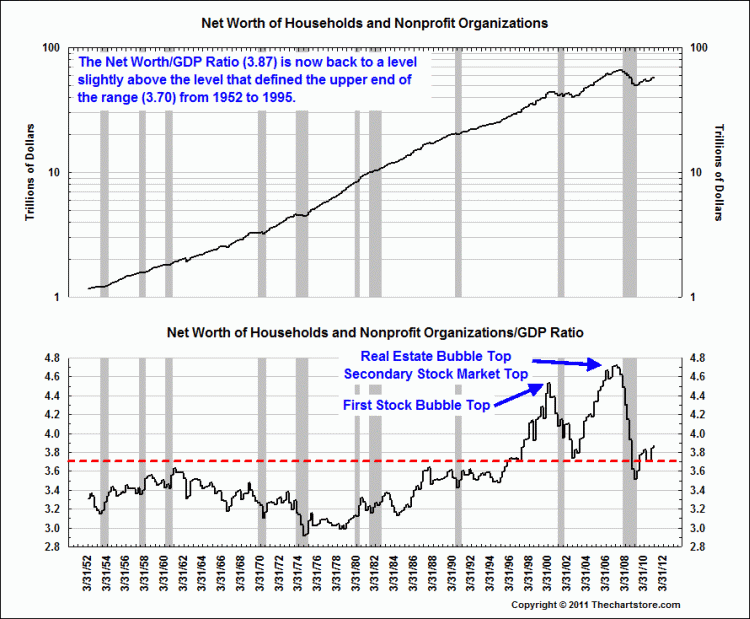
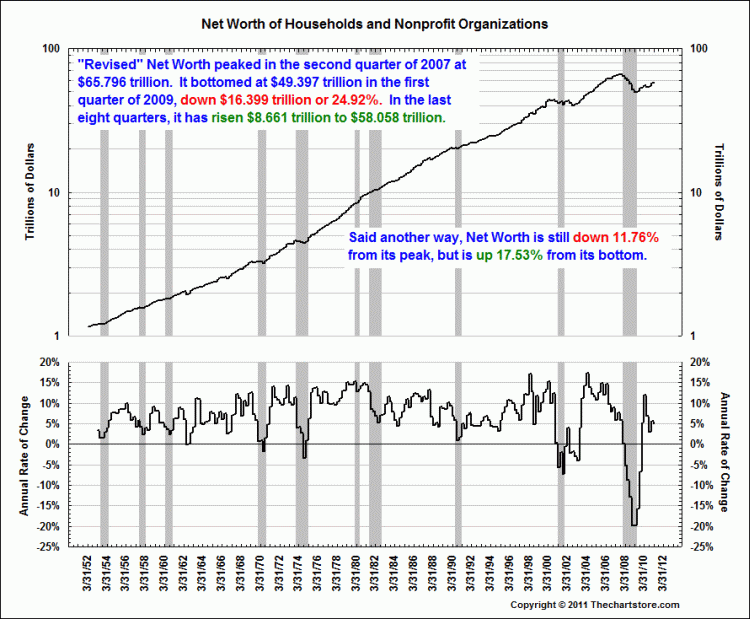
The Chart Store had a fascinating series of charts this weekend looking at Household Net Worth in a variety of ways:

>

Household Net Wealth Relative to GDP

~~~

Household Net Wealth Relative to Peak and Trough

~~~

Housing charts after the jump

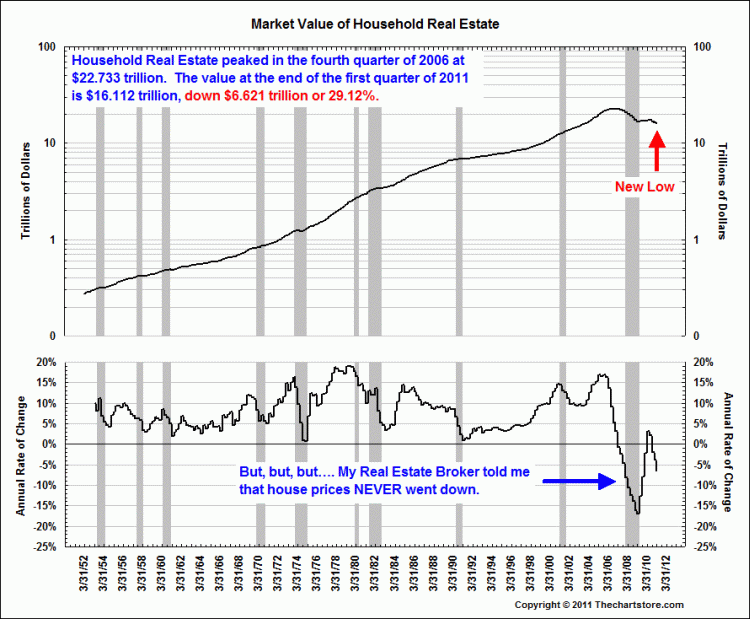
Total Residential Real Estate Value

~~~

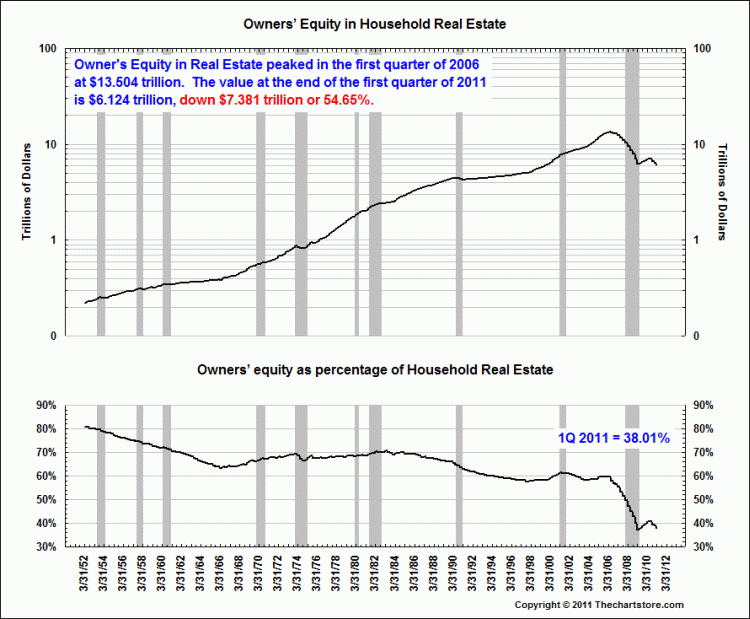
Owner’s RE Equity (Value minus Debt)

Ron Paul: Is the Gold in Fort Knox Real? Read more: Ron Paul: Is the Gold in Fort Knox Real?

No one would accuse Republican presidential candidate Ron Paul of being mainstream, including the Texas congressman himself, who relishes his role as an outsider.

So it’s not a huge surprise that Paul has asked Obama administration officials to audit the content of the nation's 700,000 gold bars held in Fort Knox, according to an internal Treasury document obtained by CNBC.

Talk has spread over the Internet that our government has secretly sold off the nation's gold supply and replaced it with metal bars that are merely painted gold.

ronpaul200gty.jpg
Ron Paul
(Getty Images photo)
Paul, chairman of the House Financial Services Subcommittee on Domestic Monetary Policy, has previously called for the U.S. gold reserve to be counted and for a return to the gold standard.

But now he wants Treasury Department and U.S. Mint officials to testify at a June 23 subcommittee hearing about the Fort Knox gold’s authenticity.

The Obama administration may not be too enthusiastic about his idea. The Treasury document says it would cost about $15 million, requiring 400 workers to spend six months on the job.

The Treasury's Office of the Inspector General audits the Mint once a year.

Meanwhile, gold prices have bounced back from a three-week low amid concern about inflation.

“Gold is embracing the inflationary discussion,” Adam Klopfenstein, a senior market strategist at Lind-Waldock, tells Bloomberg.

The precious metal traded at $1,522 an ounce Tuesday afternoon.

Jay Taylor: Turning Hard Times Into Good Times


The Clash of Cannabinomics & Big Pharma Medicine


click for audio HOUR #1 HOUR #2

Cult Stock CROX May Rise Again

Crocs Inc. (NASDAQ: CROX) – This footwear company first became famous for its obnoxiously colorful foam footwear. Over the past few years, however, the company has reinvented itself by expanding its footwear selection beyond its basic models to everything from sandals to loafers to sneakers. In fact, the original models make up only about 10% of the company’s total sales. At an investor conference last week, the company discussed the success of new product acceptance by customers, which means it is slowly growing from a one-product company into a more diversified shoe designer/manufacturer.

Looking at Crocs’ price history, we see a dramatic collapse of its share price in 2007 and 2008. Once the stock reached “cult” status at the peak in October 2007, there was really only one way for it to go. Over the span of just about 12 months, investors saw the stock price slid from $75 down to 80 cents. After struggling to get above $4 for a while, the stock started showing signs of life again in the second half of 2009, and marched from $4 to $21.64 in 24 months.

CROX Stock Chart

See full-size chart.

Presently the stock has several clear support levels worth pointing out:

  • $19.50 is a previous multi-month area of resistance that the stock successfully broke above in April.
  • The 50-day simple moving average (yellow line) comes in at $20.59, although looking back on the chart, the 50-day simple moving average has not been very well respected as a support or resistance level.
  • At about $18.80 currently, the stock would run into a strong uptrend line that originated in September 2010, which was the beginning of the massive rally in the broader market.
  • Further below is the 200-day sma (red line) around $17 presently, followed by an uptrend line dating back to December 2009.

CROX Stock Chart

See full-size chart.

My favorite area to buy this stock would be on a retest of the $19.50-$20 area, which by the time the stock gets there may even cross with the uptrend line from September 2010. As a first profit target, I see the May highs, followed by $25 and eventually as high as $30 for those inclined to hold on to the position longer term. Stops also depend on one’s time frame, but on a break below $18.50, I would more than likely get out of the entire position.

Given the overall market’s current weakness it is more difficult to suggest short-term trades to the long side. However, given the company’s fundamental growth story and the stock’s clearly defined support and profit target levels, CROX is worth looking at from the long side on a retest of the $19.50-$20 area.
The Hard Truth About Residential Real Estate

The Hard Truth About Residential Real Estate. Anyone who believes that housing is on the rebound, and that now is the time to buy, should take a very hard look at the numbers I dredged up for my spring lecture and luncheon tour. There are 140 million personal residences in the US. Today, there are 19 million homes either directly or indirectly for sale. According to a survey by Zillow.com, a real estate appraisal website, 5 million homeowners plan to sell on any improvement in prices. Add to that 4 million existing homes now on the market, 1 million new homes flogged by companies like Lennar (LEN) and Pulte Homes (PHM), and 1 million bank owned properties. Another 8 million mortgage owners are late on their payments and are on the verge of foreclosure, bringing the total overhang to 19 million homes. Now, let’s look at the buy side. There are 35 million who are underwater on their mortgages and aren’t buying homes anytime soon, nor are the 35 million unemployed and underemployed. That knocks out 50% of the potential buyers. Here is where it gets really interesting. There are 80 million baby boomers retiring at the rate of 10,000 a day. Assuming that they downsize over time from an average 2,500 sq ft. home to a 1,000 sq. ft. condo, and eventually to a 100 sq. ft. assisted living facility, the total shrinkage in demand is 4.3 billion sq.ft. per year, or 1.7 million average sized homes. That amounts to a shrinkage of aggregate demand for a city the size of San Francisco, every year. You can argue that the following Gen-Xer’s are going to take up the slack, but there are only 65 million of them with a much lower standard of living than their parents. Throw in the disappearance of state and federal first time buyer tax credit. You can count on a jump in long term capital gains taxes and state and local property taxes, further diminishing property’s appeal. If you are looking for a final stick to break the camel’s back, how about eliminating, or substantially reducing the home mortgage interest deduction? Add it all up, and there is a massive structural imbalance in residential real estate that will take at least a decade more to unwind. We could be looking at a replay of the same 26 year period from 1929 to 1955 when prices remained flat, and we are only 3 years into it! A second down leg in the real estate market seems a no brainer to me, as is the secondary banking crisis that follows. Perhaps that’s why hedge funds have been big sellers of the homebuilder’s ETF (XHB).What’s a poor homeowner to do? Don’t ask me. I sold everything in 2005 when my research threw up these numbers, and have been happily renting ever since. And, if the toilet blocks up, I just call the landlord.

-

xhb14

The Collapse Is Coming - Are You Ready? - Gerald Celente

14 June 2011 - Everything is not all right. And things are going to get worse much worse. The economy is on the threshold of calamity. Wars are spreading like wildfires. The world is on a razor's edge.
Not so, say world leaders and mainstream media experts. Yes, there are problems, but the financiers and politicians are aware of them. Policies are already in place and measures are being taken to correct them.
Whether it's failing economies, intractable old wars or raging new wars, the word from the top always maintains that steady progress is being made and comforts the populace with assurances that the brightest minds and the sharpest generals are in charge and on the case. On all fronts, success is certain and victory is at hand. Only "patience" is required along with more men, more time and more money.
As far as these "leaders" and their media are concerned, the only opinions that count come from a stable of thoroughbred experts, official sources and political favorites. Only they have the credentials to speak with authority and provide trustworthy forecasts. That they are consistently, if not invariably, wrong apparently does nothing to diminish their credibility.
How can any thinking adult possibly imagine that the same central bankers, financiers and politicians responsible for creating the economic crisis are capable of resolving it? Within days of its announcement, we predicted that Bush's TARP (Troubled Asset Relief Program) was destined to fail, and subsequently predicted the same for Obama's stimulus package (The American Recovery and Reinvestment Act). They were no more than cover-ups; there would be no recovery.
Meet the New Plan, Same as the Old Plan
Democrat or Republican, it makes no difference. Despite the heated rhetoric, solving economic problems had less to do with the party in power and more to do with professional competence. Both sides had their turn in office. Both used their power to initiate policies that created the problems. Both sides had their shot at fixing the messes they were responsible for. Both sides failed, as we predicted. Given who they are and what they've done, we confidently predict an unbroken sequence of bipartisan failures in the future.
The Beltway Incompetents are in the driver's seat. What person with a healthy instinct for self-preservation would believe the promises of politicians or trust the judgment of central bankers or Wall Street financiers whose only real interest is self interest?
Not "Business as Usual" In the 1920s, US President Calvin Coolidge declared, "The business of America is business." Four score and 10 years later, the business of America has become war: The forty-year War on Drugs; The ten-year War on Terror; the Afghan War (longest in American history); the eight-years-and-no-end-in-sight Iraq War; the covert wars in Pakistan and Yemen; and most recently, the "time-limited, scope-limited kinetic military action" in Libya.
While the justifications for engaging in these wars were all different, all were murderous, immoral, interminable, ruinously expensive and abject failures. Why would anyone believe the optimistic battle communiqués issued by the "czars" in charge and the battlefield brass who keep reassuring the public that reapplying previously failed strategies would, this time, lead to success?
Yet even in the face of their proven failures and gross incompetence, anyone daring to challenge the party line or the conventional wisdom is dismissed as an "alarmist," "fear monger," or "gloom-and-doomer." However unwelcome our forecasts may be ­ pessimism, optimism, like or dislike are all irrelevant ­ only their accuracy counts. We correctly forecast:
Afghan and Iraq Wars would be debacles
Bursting of the housing bubble
The "Gold Bull Run"
The "Panic of '08"
European Monetary Union crisis
Failure of US bailout/stimulus packages to revive housing and create jobs
Falling governments, spreading civil wars and social upheaval on a global scale
We also said that the Federal Reserve's sighting of economic "green shoots" in March 2009 was a "mirage" and predicted that their much vaunted "recovery" was no more than a temporary solution, a quick-fix to be followed by "The Greatest Depression." And now, in June 2011, with the Dow on a down trend and the economic data increasingly pointing in the direction of Depression, Washington and Wall Street remain in denial. The only debate among the "experts" is whether or not a "double dip" recession is likely.
However, for the man on the street ­ pummeled by falling wages, higher prices, intractable unemployment, rising taxes and punitive "austerity measures" ­ "Depression," not "recession," and certainly not "prosperity," is just around the corner.
According to a June 8th CNN/Opinion Research Corporation poll, 48 percent of Americans believe that another Great Depression is likely to occur in the next year ­ the highest that figure has ever reached. The survey also indicates that just under half of the respondents live in a household where someone has lost a job or is worried that unemployment may hit them in the near future.
Suddenly, after years of obvious economic hardship experienced by tens of millions of Americans ­ only when the suffering and pain can no longer be cloaked in abstractions and cooked statistics ­ does an emboldened media dare utter the forbidden "D" word.
For Trends Journal readers, alerted to this emerging trend some three years ago, the prospect of Depression should come as no surprise. Neither should the idea that, when it hits and can no longer be denied, a long suffering public will take to the streets.
When I made this forecast back then it was written off by most of the major broadcast and print media. Now, however, when one of their own, belatedly and hesitantly, raises that possibility he is elevated to sage status and it becomes big news. In early June, Democratic strategist James "It's the Economy, Stupid" Carville, having finally mastered the higher math of adding two plus two, warned that decaying economic conditions heightened the risk of civil unrest.
As I described it all those years ago: "When people lose everything, and have nothing left to lose, they lose it."
Trend Forecast: The wars will proliferate and civil unrest will intensify. As we forecast, the youth-inspired revolts that first erupted in North Africa and the Middle East are now breaking out in Europe (See "Off With Their Heads," Trends Journal, Autumn 2010)
Given the trends in play and the people in power, economic collapse at some level is inevitable. Governments and central banks will be unrelenting in their determination to wring every last dollar, pound or euro from the people through taxes while confiscating public assets (a.k.a. privatization) in order to cover bad bets made by banks and financiers.
When the people have been bled dry financially and have nothing left to give, blood will flow on the streets.
Trend Lesson: Learn from history. Do you remember when it first became apparent that the US economy was in deep trouble and heading toward the "Panic of 08"? Not many will. Most people were in a summer state of mind and in holiday mode. It was late July 2007 when the stock market suddenly plunged from its euphoric 14,000 high.
Though we had warned in our Summer 2007 Trends Journal (released that June) that "trends indicators point to a major crisis hitting the financial markets between July and November," the diving Dow was downplayed as a mere "hiccup" a time to pause between more mouthfuls of expansion.

Tuesday, June 14, 2011

US Is in Even Worse Shape Financially Than Greece: Gross

When adding in all of the money owed to cover future liabilities in entitlement programs the US is actually in worse financial shape than Greece and other debt-laden European countries, Pimco's Bill Gross told CNBC Monday.

Much of the public focus is on the nation's public debt, which is $14.3 trillion. But that doesn't include money guaranteed for Medicare, Medicaid and Social Security, which comes to close to $50 trillion, according to government figures.

The government also is on the hook for other debts such as the programs related to the bailout of the financial system following the crisis of 2008 and 2009, government figures show.

Taken together, Gross puts the total at "nearly $100 trillion," that while perhaps a bit on the high side, places the country in a highly unenviable fiscal position that he said won't find a solution overnight.

"To think that we can reduce that within the space of a year or two is not a realistic assumption," Gross said in a live interview. "That's much more than Greece, that's much more than almost any other developed country. We've got a problem and we have to get after it quickly."

Gross spoke following a report that US banks were likely to scale back on their use of Treasurys as collateral against derivatives and other transactions. Bank heads say that move is likely to happen in August as Congress dithers over whether to raise the nation's debt ceiling, according to a report in the Financial Times.

The move reflects increasing concern from the financial community over whether the US is capable of a political solution to its burgeoning debt and deficit problems.

"We've always wondered who will buy Treasurys" after the Federal Reserve purchases the last of its $600 billion to end the second leg of its quantitative easing program later this month, Gross said. "It's certainly not Pimco and it's probably not the bond funds of the world."

Pimco, based in Newport Beach, Calif., manages more than $1.2 trillion in assets and runs the largest bond fund in the world.

Gross confirmed a report Friday that Pimco has marginally increased its Treasurys allotment—from 4 percent to 5 percent—but still has little interest in US debt and its low yields that are in place despite an ugly national balance sheet.

"Why wouldn't an investor buy Canada with a better balance sheet or Australia with a better balance sheet with interest rates at 1 or 2 or 3 percent higher?" he said. "It simply doesn't make any sense."

Should the debt problem in Greece explode into a full-blown crisis—an International Monetary Fund bailout has prevented a full-scale meltdown so far—Gross predicted that German debt, not that of the US, would be the safe-haven of choice for global investors.