Tuesday, May 24, 2011
Bob Chapman - 05-23-2011
A good day for Gold today , the demonstrations in Spain are not political , unemployment amongst the youths is around 35% says Bob Chapman , there is a real trouble in Europe and it is going to get worse , the young people will not accept any austerity measures , it is not their fault it is the banks fault why should they pay for it , there will be a partial default in Greece , the Euro and Europe will break up in a couple of years , the Euro won't be the next reserve currency the dollar has a good chance to be the world currency again but it is going to be a very rocky road ahead ....

This is what could happen after Greece defaults
When it comes to the topic of Greece, by now everyone is sick of prevaricating European politicians who even they admit are lying openly to the media, and tired of conflicted investment banks trying to make the situation appear more palatable if only they dress it in some verbally appropriate if totally ridiculous phrase (which just so happens contracts to SLiME). The truth is Greece will fold like a lawn chair: whether it's tomorrow (which would be smartest for everyone involved) or in 1 years, when the bailout money runs out, is irrelevant. The question then is what will happen after the threshold of nevernever land is finally breached, and Kickthecandowntheroad world once again reverts to the ugly confines of reality. Luckily, the Telegraph's Andrew Lilico presents what is arguably the most realistic list of the consequences of crossing the senior bondholder Styx compiled to date.
What happens when Greece defaults. Here are a few things:
- Every bank in Greece will instantly go insolvent.
- The Greek government will nationalise every bank in Greece.
- The Greek government will forbid withdrawals from Greek banks.
- To prevent Greek depositors from rioting on the streets, Argentina-2002-style (when the Argentinian president had to flee by helicopter from the roof of the presidential palace to evade a mob of such depositors), the Greek government will declare a curfew, perhaps even general martial law.
- Greece will redenominate all its debts into “New Drachmas” or whatever it calls the new currency (this is a classic ploy of countries defaulting)
- The New Drachma will devalue by some 30-70 per cent (probably around 50 per cent, though perhaps more), effectively defaulting 0n 50 per cent or more of all Greek euro-denominated debts.
- The Irish will, within a few days, walk away from the debts of its banking system.
- The Portuguese government will wait to see whether there is chaos in Greece before deciding whether to default in turn.
- A number of French and German banks will make sufficient losses that they no longer meet regulatory capital adequacy requirements.
- The European Central Bank will become insolvent, given its very high exposure to Greek government debt, and to Greek banking sector and Irish banking sector debt.
- The French and German governments will meet to decide whether (a) to recapitalise the ECB, or (b) to allow the ECB to print money to restore its solvency. (Because the ECB has relatively little foreign currency-denominated exposure, it could in principle print its way out, but this is forbidden by its founding charter. On the other hand, the EU Treaty explicitly, and in terms, forbids the form of bailouts used for Greece, Portugal and Ireland, but a little thing like their being blatantly illegal hasn’t prevented that from happening, so it’s not intrinsically obvious that its being illegal for the ECB to print its way out will prove much of a hurdle.)
- They will recapitalise, and recapitalise their own banks, but declare an end to all bailouts.
- There will be carnage in the market for Spanish banking sector bonds, as bondholders anticipate imposed debt-equity swaps.
- This assumption will prove justified, as the Spaniards choose to over-ride the structure of current bond contracts in the Spanish banking sector, recapitalising a number of banks via debt-equity swaps.
- Bondholders will take the Spanish Banking Sector to the European Court of Human Rights (and probably other courts, also), claiming violations of property rights. These cases won’t be heard for years. By the time they are finally heard, no-one will care.
- Attention will turn to the British banks. Then we shall see…
2 TECHNICAL TRENDS THAT WORRY RICHARD RUSSELL
In his most recent letter, Richard Russell of the Dow Theory Letters discussed why he is growing increasingly concerned about the state of the bull market. Russell believes there is “technical deterioration” when looking under the hood at the market:
“Late yesterday I was playing around with various formations on the stock averages, and, to my surprise, I came up with the pattern that you see below. Here is the Dow over a period of a decade. What we see here is a so-called “Broadening formation” or “megaphone pattern.” This pattern often appears towards the end of a bull market (as it did in 1919).”
“The broadening formation is made up of five successive reversals, four of which you see on the chart below. The rationale behind the it attempts to “find” the true trend. The broadening pattern represents an semi-hysterical market that first discounts one trend, then changes its mind and discounts an opposite trend.
At the fifth reversal (we’re not there yet) the item rallies to a new highs and then executes a final reversal prior to a collapse. Anything is possible where markets are concerned, and I’m wondering whether what we’re seeing now is a text-book example of a broadening formation. If so, I would expect the Dow to advance to a new high and then reverse violently to the downside.
Another Russell worry — Below we see a chart of the bullish PERCENTAGE of stocks on the NYSE. Here we see a picture of technical deterioration. The bullish percentage is now down to 66.67%, and it is below the March bullish percentage of 67%”


Source: Dow Theory Letters
Illinois on the Brink of Financial Disaster
Illinois, California, Wisconsin, New Jersey, New York, etc. are all near brink of financial disaster. Cutting spending as the economy rolls over is political suicide. This means the economic can will be kicked down the road, i.e. issuing more debt through support of QE(n), despite a growing number of voices suggesting change. The public will once again come to realize that the market will force the necessary changes, and it won’t be pretty.
Day of reckoning for commercial real estate in 2012 – largest amount of loans maturing next year as $150 billion in CRE debt comes due
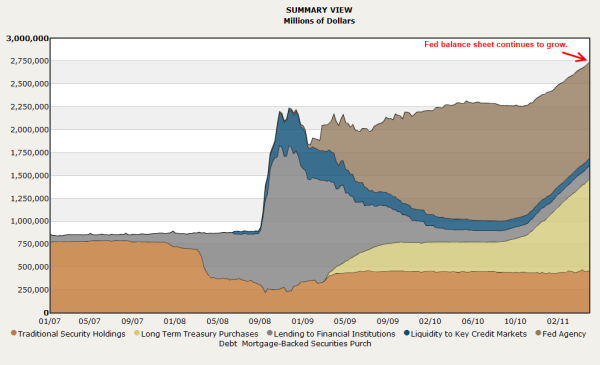
The Federal Reserve has tried its best to hide the secrets of past banking blunders deep in its balance sheet. Commercial real estate (CRE) loans made in haste during the real estate bubble are part of this national disgrace in banking folly. As theFederal Reserve and U.S. Treasurydigitally print the dollar into oblivion the bad CRE loans still linger in the Fed balance sheet. As it turns out the Fed has become the dumping ground for all things real estate and has traded toxic loans for quality liquidity to fuel the banks back up. CRE debt in the form of empty shopping malls, failed hotels, and tumbleweed occupied strip malls is only a flavor of what the Fed is taking on. Yet many of these loans are still occupying the balance sheet of many banks. As it turns out, there was so much junk in the CRE market that the Fed could only balloon their balance sheet and still not encompass one half of the CRE market. Many CRE loans are coming due in 2012. Is the day of reckoning for CRE coming in 2012?
$150 billion coming due in CRE loans in 2012
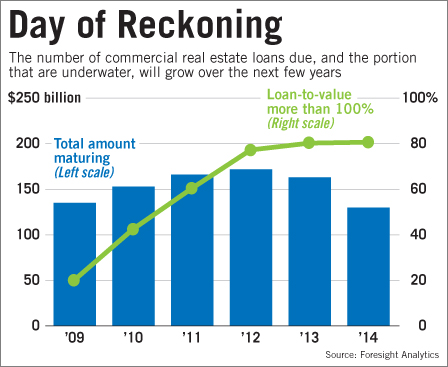
Over $150 billion in CRE loans are maturing in 2012 bringing the day of reckoning closer. Why is this a problem? First, the CRE market has completely imploded:
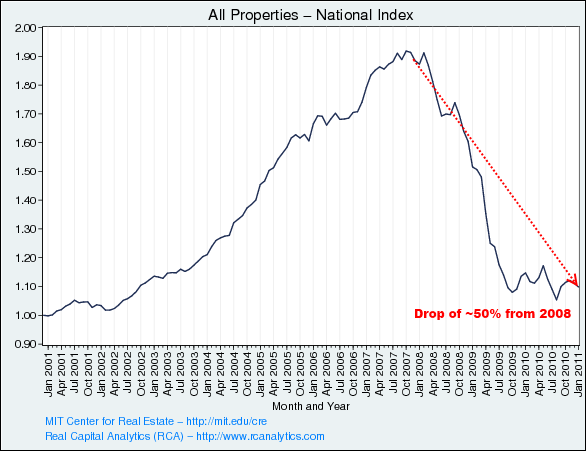
Source: MIT
CRE values just like residential real estate have cratered and are down over 50 percent since their peak. Much of these properties require actual economic streams of income coming in for example in strip mall rents or hotel occupancies to keep servicing the debt. Unlike a home that has other sentimental values a CRE property is strictly a business decision. The Federal Reserve is seeing the tanking of valuations at the absolute worst time. The Fed treating the crisis as one of liquidity simply exchanged U.S. Treasuries for toxic CRE debt to drinking buddy banks. After all what is the harm in keeping the junk for a few years and when prices recover, a simple hand off and the public has no idea what happened except they just have to contend with greater goods inflation as their purchasing power falls through the floor. However the bailouts of 2007 never helped the overall economy because the crisis is one of solvency, not liquidity. The working and middle class are struggling because their purchasing power has washed away over the decades and the bailouts were simply geared to the too big to fail banks.
CRE is a giant problem because the number of buyers vying for a strip mall is relatively small. Unlike a residential property, if the price drops low enough on a home the market will respond. If a strip mall was poorly built in a bad location you may have no buyers regardless of cost. And make no mistake banks have shut the door on CRE fairly hard:

Source: World Property Channel
The fiasco in CRE can only last so long. The Fed balance sheet has exploded during this crisis and you can rest assured billions of dollars in CRE loans are floating in the un-audited figures:
CRE is merely following the pattern outlined by the residential real estate bubble effectively creating a situation where a double bubble developed:

Source: The American
2012 is looking like the day of reckoning for CRE debt. First, you have an American public that is absolutely frustrated by the ineffective handouts to the banking system of the country. The hunger for a full Fed audit is getting louder and louder. Politicians will sway in the way of their financial backers but only to the extent they feel they can get away with their smoke and mirrors and deceive the public. That shell game is becoming harder and harder to maintain. At what point does the government step in and do what is best for the economy and not the big banking interests? How does bailing out a failing hotel or empty strip mall really help the average working American? It doesn’t. Banks were eager to make these loans and profited handsomely during the bubble. Now they don’t want to deal with the consequences of taking on too much risk so they rather socialize the losses on the public. This is not capitalism but a banking corporatocracy. CRE debt will come due in large amounts in 2012 and unless prices soar to the sky in the next year, some major rebalancing will need to occur.
There is no inflating out of the real estate mess and CRE is no exception. Unless household incomes go up disposable income is going to get tighter. We are already seeing more money being eaten up by food and energy and baby boomers will definitely see more money flowing into the healthcare industry complex. From one frying pan to another it will become about priorities and CRE will move lower on the list. The day of reckoning for CRE is coming next year and only time will tell how the market will respond.
Treasury yields drop on eurozone worries

Worries over Europe's sovereign debt crisis returned to the Treasury market with a vengeance Monday, sending prices higher as investors sought the familiar safety of U.S. government debt.
The crisis, which has persisted for months despite attempts by European countries to stem the tide, was put back in focus over the weekend by some saber rattling on the part of rating agencies.
On Friday, rating agency Fitch cut Greece's credit rating by three notches to "highly speculative," putting it in junk bond territory.
In addition, Standard & Poor's slashed Italy's outlook to 'negative' from 'stable.'
Investors are worried that the massive amounts of debt carried by European countries -- including Ireland, Portugal, Greece and Spain -- will cripple their economies, and spread across the eurozone.
"This is the crisis that just won't go away," said David Coard, director of fixed income sales and trading at The Williams Capital Group.
World markets tumble
The impact doesn't stop at the Atlantic's edge, as investors rush to buy safe-haven U.S. Treasuries, sending prices higher while yields drop.
On Monday, the benchmark 10-year note dropped to 3.13% after closing at 3.15% on Friday.
A year on, the crisis in Europe shows no real signs of letting up. And the actions taken by European governments to dampen its effect are not calming markets.
Investors continue to demand higher and higher yields in return for holding eurozone debt. Greek, Irish and Portuguese spreads continue to rise vs. the German bund, a sign that investors aren't convinced the various austerity measures and bailouts undertaken have made much of a difference.
In Spain, one of the region's largest economies, the 10-year bond yield has jumped from 5.21% to 5.48% in just the past 10 days.
Politics is now complicating matters on the Iberian Peninsula. Spain's socialist ruling party was hit with its worst election defeat in years over the weekend, as citizens continued to protest the weak economy and high unemployment.
Dollar hits 2-month high against euro
"According to Spain, austerity is 'overrated' and they seem to think that they can elect local officials who won't support a budget cutting, belt-tightening program in an effort to avert default," Kevin Giddis, managing director of fixed income at Morgan Keegan, wrote in a research note.
All the worry means investors are now searching out safe-haven assets. Much of that attention is directed at U.S. Treasuries, and the Swiss franc rose to its highest-ever level against the euro in trading Monday, another example of the phenomenon.
What yields are doing: The 30-year yield ticked down to 4.27%, the 2-year yield rose to 0.53%, and the 5-year yield slipped to 1.78%.
The 10-year note's yield closed at 3.13%, down from 3.15% late Friday.
US Stocks Plunge On Worries Of Worsening European Finances
U.S. Stocks plunged on worries of worsening European finances and the Euro hit its lowest level against the dollar in two months. The selloff continued into its fourth week, the Dow is down 155.34 to 12,357, Nasdaq is down 48.53 to 2,755, and the S&P 500 dropped 17.89 to 1,315.
Standard & Poor’s revised its outlook for Italy to negative from stable on Saturday. Fitch warned Belgium its rating may be downgraded if the government misses fiscal targets. Both come on the heals of a cut of Greece’s credit rating last Friday by Friday by three notches, taking it deeper into junk.
With the global upheaval, oil fell 2.43 to 97.67. However, investors seeking a safe haven bid gold up 9.33 to 1,516.72, its highest level in two weeks.
U.S. Treasury Secretary Timothy Geithner warned that if the debt ceiling is not raised by August 2, the government will not be able to spend more than it collects in revenue, forcing it to cut spending by about 35%. Items likely to be cut will be payments to contractors, soldiers’ salaries, social security, and Medicare. The Congressional Budget Office estimates cuts at a rate of $3.8 billion per day. According to the Wall Street Journal’s calculations, over a period of 95 days, those cuts will be enough to negate all the economic growth forecasted for 2011.
The Republican field of candidates is taken shape as more players announce their intentions. Indiana Governor Mitch Daniels emailed supporters on his decision not to run while former Minnesota Governor Tim Pawlenty officially entered the race in a video address. Gov. Mitch Daniels adds to the list of high profile potential candidates to drop of the running, prompting John Freehery, a Republican lobbyist and congressional aide to comment that although he doesn’t believe the field is weak, there isn’t a candidate that unifies the Republican establishment.
Congress is widening its probe into trades made by SAC Capital Advisors on the suspicion of trading on insider information. The Senate Judiciary committee is now investigating about 20 trades completed in the last 10 years including those involving shares of healthcare companies who’s shares often move on the outcome of clinical trials. SAC has over $14 billion in assets and is managed by Steven A. Cohen. The probe underscores the government’s increasingly tough stance on insider trading including prosecution of individual traders.
Hon Hai Precision Industry Co (OTC:HNHPF) closed all its workshops that handle polishing for electronic parts following a blast last which that killed three employees and injured an additional 15. Hon Hai is majority owner of Foxconn International Holdings (OTC:FXCNF). Foxconn is a large contract manufacturer based in China, producing and assembling components for major electronics companies including Apple (NASDAQ:AAPL) and Nokia Corp (NYSE:NOK). The workshop is expected to come back online after testing is completed. In the meantime, its closure will add further to Apple’s iPad2 shortage.
A tornado ripped through the city of Joplin in Missouri Sunday evening, killing at least 89 people and destroying 2000 buildings. The giant tornado cut a path a half mile wide and six miles long through the town’s center. About 20% to 30% of the city is estimated to have suffered damage. This year has seen a record number of tornados, with over 600 in April alone, surpassing the previous record of 267 in April 1974. The Joplin twister was one of 68 spotted in seven Midwest states during that weekend alone.
Microsoft’s (NASDAQ:MSFT) fortunes continue to decline. Its market cap has now been overtaken by industry titan, IBM (NYSE:IBM). This is the first time IBM has had a larger market cap than Microsoft since 1996. Microsoft was recently overtaken by Apple only last year. It now stands in third place with a valuation of $201.3 billion, IBM at $203.5 billion, and goliath Apple at $308.3 billion. Microsft’s shares have been stagnant for the last 10 years.
Standard & Poor’s revised its outlook for Italy to negative from stable on Saturday. Fitch warned Belgium its rating may be downgraded if the government misses fiscal targets. Both come on the heals of a cut of Greece’s credit rating last Friday by Friday by three notches, taking it deeper into junk.
With the global upheaval, oil fell 2.43 to 97.67. However, investors seeking a safe haven bid gold up 9.33 to 1,516.72, its highest level in two weeks.
U.S. Treasury Secretary Timothy Geithner warned that if the debt ceiling is not raised by August 2, the government will not be able to spend more than it collects in revenue, forcing it to cut spending by about 35%. Items likely to be cut will be payments to contractors, soldiers’ salaries, social security, and Medicare. The Congressional Budget Office estimates cuts at a rate of $3.8 billion per day. According to the Wall Street Journal’s calculations, over a period of 95 days, those cuts will be enough to negate all the economic growth forecasted for 2011.
The Republican field of candidates is taken shape as more players announce their intentions. Indiana Governor Mitch Daniels emailed supporters on his decision not to run while former Minnesota Governor Tim Pawlenty officially entered the race in a video address. Gov. Mitch Daniels adds to the list of high profile potential candidates to drop of the running, prompting John Freehery, a Republican lobbyist and congressional aide to comment that although he doesn’t believe the field is weak, there isn’t a candidate that unifies the Republican establishment.
Congress is widening its probe into trades made by SAC Capital Advisors on the suspicion of trading on insider information. The Senate Judiciary committee is now investigating about 20 trades completed in the last 10 years including those involving shares of healthcare companies who’s shares often move on the outcome of clinical trials. SAC has over $14 billion in assets and is managed by Steven A. Cohen. The probe underscores the government’s increasingly tough stance on insider trading including prosecution of individual traders.
Hon Hai Precision Industry Co (OTC:HNHPF) closed all its workshops that handle polishing for electronic parts following a blast last which that killed three employees and injured an additional 15. Hon Hai is majority owner of Foxconn International Holdings (OTC:FXCNF). Foxconn is a large contract manufacturer based in China, producing and assembling components for major electronics companies including Apple (NASDAQ:AAPL) and Nokia Corp (NYSE:NOK). The workshop is expected to come back online after testing is completed. In the meantime, its closure will add further to Apple’s iPad2 shortage.
A tornado ripped through the city of Joplin in Missouri Sunday evening, killing at least 89 people and destroying 2000 buildings. The giant tornado cut a path a half mile wide and six miles long through the town’s center. About 20% to 30% of the city is estimated to have suffered damage. This year has seen a record number of tornados, with over 600 in April alone, surpassing the previous record of 267 in April 1974. The Joplin twister was one of 68 spotted in seven Midwest states during that weekend alone.
Microsoft’s (NASDAQ:MSFT) fortunes continue to decline. Its market cap has now been overtaken by industry titan, IBM (NYSE:IBM). This is the first time IBM has had a larger market cap than Microsoft since 1996. Microsoft was recently overtaken by Apple only last year. It now stands in third place with a valuation of $201.3 billion, IBM at $203.5 billion, and goliath Apple at $308.3 billion. Microsft’s shares have been stagnant for the last 10 years.
Subscribe to:
Posts (Atom)