Wednesday, May 11, 2011

Spanish Revenues Collapse by 16.8%, GDP Misses Target; Is a Bailout of Spain in the Cards?
Every day I get emails from a friend Bran who lives in Spain. Today Bran writes ...
Hello MishFor those who can read Spanish, here is the link Bran sent: Zapatero, abocado a una subida de impuestos por no cumplir el crecimiento
The big news here today is with government accounts. GDP is lower than expected, and revenue are down way more than expected (down 16.2% compared with a predicted drop of 12.8%).
Therefore, the government is looking at another few billion in borrowing this year and its schedule of deficit targets is thrown out of line.
Spain's budget is already tight after spending cuts and salary reductions, so the article suggests higher taxes might be need to get back on target.
All the best, Bran.
Google offers a rough translation Zapatero, heading to a tax increase for failing to meet growth from which it is easy to glean a few more facts.
- The deficit compromises growth objectives for 2012 through 2014.
- Staff reductions are increasingly difficult.
- Spain is in a very problematic situation.
- Personal income taxes are down 19.4%
- Corporate incomes taxes are down 42.7%
- VAT collection is down 22.4%
- Excise duties are down 40%
Judging from the above, I am wondering how overall revenues are downonly 16.2%. I am also wondering how soon the interest rates in Spain soar as they did in Greece, then Ireland, then Portugal.
Spain 10-Year Government Bond Yield

click on chart for sharper image
If the Spanish economy continues to deteriorate (and I believe it will), don't expect that "low" yield to last.
"Low" is in comparison to Greece where 10-year government bonds yield 15.4% as opposed to Germany where 10-year bonds yield a mere 3.12%.
Is a bailout of Spain in the cards, or is Spain simply too big to bail? We will have our answer in due time.
Mike "Mish" Shedlock

Jim Rogers says may short U.S. Treasuries, later today

Jim Rogers, the veteran investor and commodity bull, plans to short U.S. Treasuries, maybe today if he "gets around to it" and wants to buy more silver, he told Reuters in an interview.
Rogers, who rose to prominence as co-founder of the former Quantum Fund with billionaire investor George Soros four decades ago, said he expects bond prices to fall and the U.S. dollar to rally when the Federal Reserve halts its government bond buying program at the end of June.
"I'm not short bonds yet but I plan to short bonds -- maybe this afternoon if I get around to it," Rogers told Reuters Insider television on Tuesday.
To see the Reuters Insider interview, click here:link.reuters.com/baw49r
The Fed in November launched a second round of purchases of long-term securities, which investors and traders refer to as QE II, pumping $600 billion into the financial system.
Rogers added a cautionary note on bonds, however.
"The problem is that polls show 95 percent of investors are bearish on bonds. One reason that I'm not short on bonds yet is that there are too many bears," he said.
The long-time commodities investor said he was unruffled by last week's commodities rout that knocked 13 percent off oil prices. Silver also fell 25 percent in its biggest correction since prices collapsed in 1980, hit by a succession of margin increases that nearly doubled trading costs. Silver had risen 27 percent in April.
Now he sees a buying opportunity.
"It's not the end of the silver market," he said. "I want to buy more silver."
The price of increasingly scarce commodities like oil and precious metals will be rising for a number of years, Rogers said, regardless of impressive market corrections.
"We are in a bull market that has several years to go. I don't know when it is going to end," Rogers said. "We have virtually no new supply of anything. The world's known reserves of oil continue to decline."
He described the commodity crash as "nothing unusual".
"Corrections happen all the time in markets," he said.
Despite his insistence that he's the worst market timer out there, before last week's plunge Rogers had expressed concern a sudden rise in silver prices could lead to a correction.
But now that silver has fallen back, he is optimistic.
Cost of U.S. Imported Goods Rises More Than Estimated on Food, Fuel Prices
Prices of goods imported into the U.S. rose more than forecast in April as a slumping dollar and growing economies overseas pushed up the cost of fuel and food.
The 2.2 percent increase in the import-price index followed a revised 2.6 percent gain in March, according to figures from the Labor Department today in Washington. Other reports showed distributors boosted inventories and small businesses lost confidence.
The increase in prices from overseas may put pressure on companies like Whole Foods Market Inc. (WFMI) to pass on higher costs, calling into question Federal Reserve Chairman Ben S. Bernanke’s view that the surge in commodities will have temporary effect on inflation. The report on small businesses showed the share of those surveyed who planned to raise prices held in April at the highest level in 30 months.
“While many policy makers have described recent commodity cost increases as ‘transitory,’ the reality is that even at the small business level, producers are increasingly more confident in their ability to pass on costs to customers,” Joseph LaVorgna, chief U.S. economist at Deutsche Bank Securities in New York, said in a note to clients.
The median forecast of 51 economists surveyed by Bloomberg News called for a 1.8 percent increase in import prices last month. Projections ranged from increases of 1 percent to 2.5 percent.
Compared with a year earlier, import prices increased 11 percent, exceeding the 10 percent increase projected by economists surveyed and the biggest 12-month gain in a year.
Shares Climb
Stocks rose, sending the Standard & Poor’s 500 Index higher for a third straight day, as companies including Dean Foods Co. and Fossil Inc. forecast earnings that topped analysts’ projections. The 500 Index climbed 0.4 percent to 1,352.25 at 11:43 a.m. in New York.
Confidence among small companies fell to a seven-month low in April, damped by a deteriorating outlook for the economy, a report from the National Federation of Independent Business showed. The Washington-based group’s optimism index decreased to 91.2, the lowest since September, from 91.9 the prior month. Seven of the measure’s 10 components dropped.
Small businesses planning to increase prices held at a net 24 percent of owners for a second month, according to the report.
Increasing sales are also prompting wholesalers to increase stockpiles, according to figures from the Commerce Department. Inventories climbed 1.1 percent in March as sales jumped 2.9 percent. At the current pace of sales, distributors had enough goods on hand to last 1.13 months, matching the level in June 2008 as the lowest on record.
Fuel, Food
The report on prices from overseas showed the cost of imported petroleum increased 7.2 percent from the prior month and was up 37 percent from a year earlier. Excluding all fuels, import prices climbed 4.3 percent from April 2010, matching the prior month’s 12-month increase as the biggest since October 2008.
Imported food was 1.8 percent costlier last month and was up 20 percent from a year earlier, the biggest 12-month increase since records began in 1977.
Whole Foods, the largest U.S. natural-goods grocer, says prices may continue to climb later this year, according to A.C. Gallo, president and chief operating officer of the Austin, Texas-based company. Beef, dairy, corn and soy are major among commodities experiencing inflation, he said.
Pass Through
“We have been able to pass some of them through,” Gallo said in a May 4 earnings call with analysts, referring to cost increases. “There is some uncertainty based on not quite understanding what kind of inflation we’ll be seeing in our costs and what will be able to pass through.”
Following a two-day meeting in Washington last month, Fed officials said the effect on inflation from the jump in fuel and other commodities will probably be “transitory,” according to a statement released April 27.
The officials also lowered their forecasts for U.S. growth, saying the economy is recovering at a “moderate pace,” and agreed to finish $600 billion of bond purchases on schedule in June, according to the statement.
A weakening U.S. currency has also made imported goods more expensive. The dollar fell 7.7 percent against a basket of major currencies from the beginning of the year to the end of April.
The dollar has since strengthened, gaining 2.4 percent from April 29 as commodity prices have fallen.
Today’s report showed the cost of goods from China rose 0.4 percent, while those from Japanwere increased 0.3 percent. Goods from Latin America climbed 3.5 percent and those from the European Union increased 0.8 percent. Prices of Canadian imports rose 2.4 percent, and goods from Mexico advanced 2.5 percent.
The import-price index is the first of three monthly price gauges from the Labor Department. Producer prices are due May 12 and the consumer-price index on the following day. The Bloomberg survey median for those measures indicates inflation excluding volatile food and fuel expenses remains contained.
Irish Bombshell: Government Raids PRIVATE Pensions To Pay For Spending

Without the ability sell debt due to soaring interest rates, and with severe spending rules in place due to its EU-IMF bailout, Ireland has few ways of spending to stimulate the economy. Today's jobs program includes specific tax increases, including the tax on pensions, aimed at keeping government jobs spending from adding to the national debt.
The tax on private pensions will be 0.6%, and last for four year, according to the report.
From the jobs initiative release:
The various tax reduction and additional expenditure measures which I am announcing today will be funded by way of a temporary levy on funded pension schemes and personal pension plans. I propose that the levy will apply at a rate of 0.6% to the capital value of assets under management in pension funds established in the State.
It will apply for a period of 4 years commencing this year and is intended to raise about €470 million in each of those years. The levy will not apply to pension funds established here and providing services and benefits solely to non-resident employers and members. Further details regarding the proposed application of the levy are set out in the Summary of Initiative Measures.
Ireland's ability to levy further taxes on other parts of the economy is restricted because its economic growth has been inhibited in the wake of a financial crisis that crippled its banking sector and decimated its public finances.
Unwilling to budge on the country's low corporate tax rate, Enda Kenny's Irish government has chosen to target pensioners for funds to grow the economy. Whether it turns out to be an example to other countries seeking alternative ways to raise revenues with aging populations is yet unknown.
Tuesday, May 10, 2011
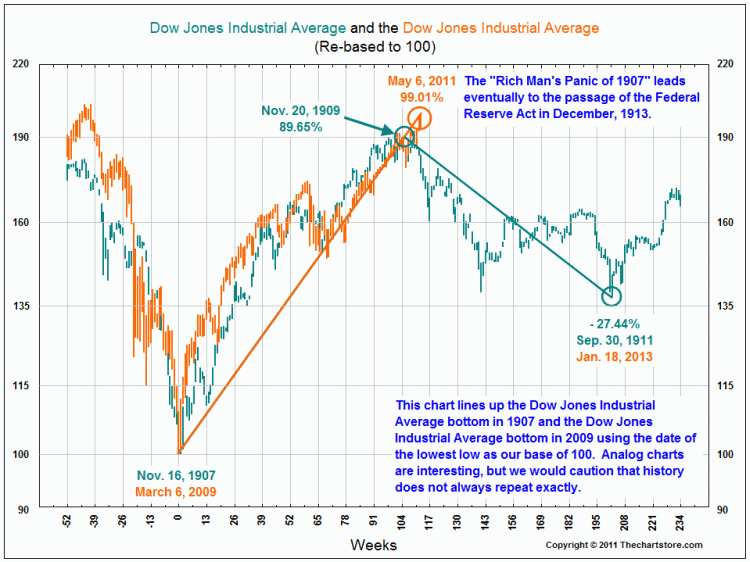
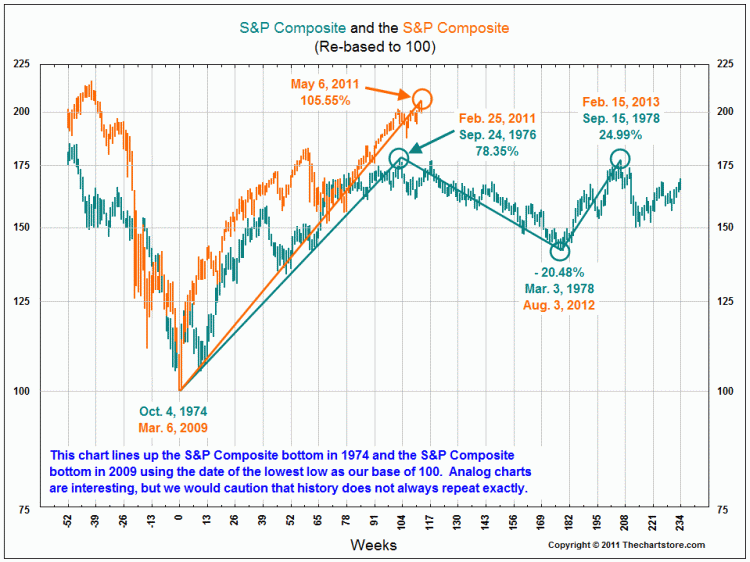
Best Market Analogy: 1973 or 1907 ?
For most of the selloff and recovery, I have mentioned that my favorite market analogy to our current situation has been 1973-74, which had a 55% collapse and 74% snapback rally.
However, as this market has continued to power higher, it has left 1973 behind, and is looking more and more like the Great Panic of 1907:
>
1973-75 Market versus 2008-11
Click for bigger charts
>
1907-09 Market versus 2008-11
All charts courtesy of The Chart Store