Wednesday, March 30, 2011

Could a Japanese U.S. Debt Selloff Trigger a Dollar Meltdown?

With the disaster in Japan being far from over, the question of how Japan will finance their reconstruction efforts has, for the most part, stayed out of focus. According to reports, the damage is estimated in excess of $300 billion, nearly four times higher than hurricane Katrina. This number will likely rise the longer the nuclear crisis remains unresolved. Karl Denninger of Market Ticker says there are several problems facing the Japanese:

(Video interview of Denninger on Fox Business follows excerpts and commentary)

The Tsunami did a tremendous amount of damage to the landscape and once they get that cleaned up they’re going to have to rebuild. And then you’ve got about 8 gigawatts of electrical generation that’s been taken offline and there’s no hope of restoring that anytime in the near future.

So, the capital flows that have gone into Japan from exports are going to turn into capital flows going the other direction because Japan has to buy the materials that it needs in order to rebuild its society.

The main issue in terms of rebuilding is one of funding. While the US may send foreign aid to help get Japan back on its feet, such measures are not very popular due to our already troubled debt levels and spending problems, so any support we provide will be limited. Japan can’t depend on international aid of any significance either, because, well, no one else gives like the US. Private donations may help people on the ground with food, clothing and shelter, but those are a drop in the bucket compared to what is necessary.

Considering that Japan is the third largest economy in the world, they will be left to come up with the money themselves.

Karl Denninger says that how Japan will come up with the money is “an open question.”

How they’re going to manage to do that without either printing more money, which at some point will cause problems over there, or selling some of their Treasuries is an open question.

Japan owns about 20% of all US debt. It’s safe to say that Japan’s regular purchases of US Treasuries are about to come to a screeching halt, or at least, be reduced significantly. This fact alone means someone is going to need to step in to buy up that excess debt. We can all guess, fairly accurately, who will end up with those new issues.

But even if the Federal Reserve were to buy up the new debt that Japan won’t, there is the question of how Japan is going to fund the $300 billion plus in recovery efforts. And given that there is no end in sight, we may be talking about double that amount – no one really knows.

So, the question is, will Japan need to sell off some of its US debt in order to pay for recovery and reconstruction efforts? And if so, could that be the black swan that could trigger the domino effect that will lead to a US debt sell off, and ultimately, a currency collapse? Until a month ago this was nowhere on the radar. Now, we have every reason to be concerned about this possible black swan event. Karl Denninger weighs in:

The obvious thing to do is to sell some of those holdings. The danger for the United States is not tomorrow, it’s a few months out. Right now, they’re still trying to clean up the mess. But once they actually start actively rebuilding they’re going to have to have a way to finance this.

And that’s where the danger comes from, because if Japan was to start unloading Treasuries, it would be reasonable to assume that the Chinese, who hold an even larger amount, would look at that activity and say ‘well, if we don’t sell now we lose even more. Maybe we want to be selling some ourselves.’ And, that puts quite an interesting squeeze into our budget picture for the United States.

In January, Treasury Secretary Tim Geithner confirmed that we are literally on the brink of a catastrophic debt collapse resulting from a need for money and raising of our debt ceiling. So, it is clear that we’re already in serious trouble as it is. If Japan were to stop buying our treasuries and actually start selling their existing US debt holdings, it could potentially accelerate the already destructive path on which we find ourselves.

As we’ve suggested previously, all it will take is for buyers and holders of US debt to say ‘no more’ and the jig is up. Mainly, we’re talking about China, and if they pull the plug on all of the credit they have thus far extended, then we could literally be talking ‘lights out’.

This may be a low probability event, but so was an earthquake driven Tsunami wiping out the generators that powered the fuel rod cooling stations in Fukuskima. Click below for video.

http://www.shtfplan.com/karl-denninger/could-a-japanese-u-s-debt-selloff-trigger-a-dollar-meltdown_03292011

Warning Signals for Gold Investors

Precious metals market, gold in particular, has been highly influenced by economic indicators and currency market, historically. In our previous essay entitled No Breakout in Gold So Far, Strong Resistance Seen in Silver, we have analyzed the situation in metals, however since no market moves on its own, this essay will provide complementary information regarding other markets.

Relating general stock market and currency fluctuations with metal prices is a widely accepted gauge to measure the strength in precious metal market moves. To connect the relationship between economic scenario and metals fluctuations, let’s take an example.

We had been asked recently by one of our Subscribers "it would appear considerable rebuilding will be necessary in Japan. Any indications this will impact stocks of companies that export timber products?"

We agree that the rebuilding process in Japan will put positive pressure on commodities' prices, also on timber, if... there is money for that. And we know that there will be money for that based on the recent G-7 decision, so not only is this decision inflationary (in the end even if the powers that be decide not to simply print money at this time, they will most likely be forced to do so later on as they will not have enough cash left for other – domestic expenses), but particularly positive for commodities.

Now let's move to another question about the Japan: "has it not struck you that selling US treasuries will increase the price of Yen relative to US dollars which the Japanese Govt. does not want to see happen. More than likely the Japanese will print money over the rest of this decade to pay for most of the reconstruction caused by the Earthquake and Tsunami. Could be wrong but it makes more sense to me notwithstanding it is bad policy."

Actually that makes sense to us and could very well happen. The Japanese are very well acquainted with quantitative easing. They just about invented the concept. Japan was the first economy in recent times to have tried a full-scale version of quantitative easing for a significant period, well before Ben Bernanke. The Bank of Japan lowered the policy rate to zero in February 2001 and then went to quantitative easing the next month. It ended both quantitative easing and its zero interest rate policy only in 2006. Whether you call it “quantitative easing” or量的金融緩和, ryōteki kin'yū kanwa, we tend to think that it makes for bad policy in the end but is good for commodities.

To have a broader overview on precious metals and currencies/economic indicators, let’s see how stock market and currencies are performing at this moment. To do that, let’s turn to the technical portion with analysis of the USD Index. We will start with the long-term chart for the USD Index (charts courtesy by stockcharts.com.)


On the long-term chart we can see a recent breakdown below the rising support line which is clearly in play. Its support has been invalidated and this level has now in fact become a resistance line. In short-term USD Index chart, the index levels have temporarily moved below the support line created by the November 2010 low.


Zooming in, we may see a positive sentiment, possibly a rally to the 78 level or so based on the rising resistance lines from the previous long-term chart, and the Fibonacci retracement levels on the short-term one. It is not clear at this time when this can be expected.

Moreover, the RSI level, which is near 30, is in the range of past local bottoms. Although the breakdown below previous important index lows has not been confirmed, we will find further confirmation based on the Euro Index performance.


The Euro Index has rallied to the declining resistance line formed by the 2008 and 2009 tops. The question now is “Will a breakout be seen?” Furthermore, “Will the index level move above this resistance line and then manages to stay there?” The answers to these questions will likely determine the direction of the next trend in both the USD and Euro Indices.

Overall, no breakout has been seen yet in Euro Index and the trend seems to remain down. With the situation in Portugal, the European debt crisis is still a factor that could stop the current rally in the European currency.

So, what does the above mean for Gold and Silver Investors? It suggests caution for bulls as the rally in the USD Index might ignite a decline in the metals. Please take a look below for details.


Gold and silver are currently negatively correlated to a great extent with the US dollar as far as short term is concerned. Please note the values of the correlation coefficient for gold/USD (-0.83) and silver/USD (-0.88).

As we discussed earlier, the breakdown below the rising support line has not been confirmed in the USD Index. No breakout has been seen in the Euro Index. All this points to a slightly bullish situation for the dollar, which does not signal strong support for precious metals overall at this moment.

Before summarizing we would like to let you know about the recent development in the GDX:SPY ratio.


The GDX:SPY ratio measures mining stocks’ performance against the general stock market. The important news is that we have just seen a spike high in volume.

The sell signal is generally given when we see a single spike high in the volume levels, meaning that the volume in gold and silver mining stocks has been much bigger than that seen in the general stock market. The quality of this signal is enhanced if the ratio encounters a resistance level as well. Such is the case here, as the 200-day moving average and the early March highs are both in play.

While this is not an overly important resistance level, it has stopped rallies in the past. With the recent spike high volume and these resistance levels in play, the outlook is not much promising in the near-term.

This is a big deal because this ratio has been quite reliable in the past in terms of giving a buy/sell signal for gold and silver mining stocks. Based on its previous performance we believe that it should not be ignored.

Summing up, the euro has reached a long-term resistance line and this suggests a likely rally in the USD Index. Based on the recent correlation between USD and precious metals, the above should make Precious Metals Bulls particularly cautious, especially that we have also seen a negative signals from the GDX:SPY ratio.

To make sure that you are notified once the new features are implemented, and get immediate access to my free thoughts on the market, including information not available publicly, we urge you to sign up for our free e-mail list. Sign up for our gold & silver mailing list today and you'll also get free, 7-day access to the Premium Sections on my website, including valuable tools and charts dedicated to serious PM Investors and Speculators. It's free and you may unsubscribe at any time.

Thank you for reading. Have a great weekend and profitable week!

P. Radomski

U.S. Stocks Advance Amid Gains From Home Depot, Energy Shares

U.S. stocks advanced, sending the Standard & Poor’s 500 Index to a three-week high, as Home Depot Inc. (HD) drove consumer companies higher and energy shares rose amid speculation production will increase in the Middle East.

Home Depot rose 2.9 percent, the most in the Dow Jones Industrial Average, as the largest U.S. home-improvement retailer sold $2 billion in bonds to help finance buybacks. Rowan Cos. and Schlumberger Ltd. (SLB) rallied more than 4.4 percent as oil gained 0.8 percent. AK Steel Holding Corp. (AKS) gained 5.2 percent as SAC Capital Advisors LP reported a stake. Apollo Group Inc. (APOL), owner of the biggest U.S. for-profit college, fell 4.3 percent following lower enrollment.

The S&P 500 rose 0.7 percent to 1,319.44 at 4 p.m. in New York. It rebounded after falling to 1,305.26, compared with yesterday’s 50-day average of 1,306.11, a bullish sign to some traders. The Dow gained 81.13 points, or 0.7 percent, to 12,279.01, three days before a U.S. government report forecast to show non-farm payrolls increased by 190,000 in March.

“It’s hard not to want to be a part of this market when there’s clear economic momentum being driven by the jobs market,” said James Paulsen, chief investment strategist at Minneapolis-based Wells Capital Management, which oversees about $340 billion. “Any other week, these downgrades of Greece and Portugal would knock the market down.”

Four Times

The S&P 500 fell below 1,306.11 -- its 50-day average as of yesterday’s close -- at least four times today, and rebounded within three minutes each time, according to data compiled by Bloomberg. The benchmark measure of U.S. shares closed at a 32- month high of 1,343.01 on Feb. 18.

“There are a lot of technical factors also playing out,” Paulsen said. “You’re bowling through the 50-day moving average and zeroing in on a run at whether we’ll get to that 1,345 level” on the S&P 500, he said.

The S&P 500 fell as much as 0.4 percent earlier after S&P reduced Portugal and Greece’s debt ratings, bolstering speculation Europe’s debt crisis will hamper the global economy. Portugal’s sovereign credit ratings were cut to the lowest investment grade of BBB- and Greece was shifted to BB- at S&P, which said more reductions are possible.

“The market is not surprised by the Portugal and Greece cuts,” said Liam Dalton, president of Axiom Capital Management Inc. in New York, which oversees $1.2 billion. “It’s really more a factor of the market having a sharp move upward and consolidating those gains rather than reacting in a harsh way to the news of Portugal and Spain.”

Home Depot, Energy

Home Depot rose 2.9 percent to $37.70 after it sold $2 billion of 10- and 30-year bonds. The Atlanta-based company will use proceeds to replace $1 billion of 5.2 percent notes issued in 2006 that matured March 1 and to buy its own stock, according to a Securities and Exchange Commission filing.

Energy companies in the S&P advanced 1 percent for the second-biggest gain as a group. Baker Hughes Inc. (BHI) Chief Executive Officer Chad Deaton said Saudi Arabia will deploy more drilling rigs, boosting its count by 28 percent to 118.

Rowan, the U.S. oil and natural-gas driller that also builds rigs, gained 5.2 percent, the biggest increase in the S&P 500, to $43.46. Schlumberger, the world’s largest oilfield contractor, rallied 4.4 percent to $94.36. Baker Hughes, the world’s third-largest oilfield services provider, rose 0.5 percent to $74.16.

Oil, AK Steel

Crude for May delivery gained 81 cents to settle at $104.79 a barrel on the New York Mercantile Exchange. Oil has risen 28 percent in the past year.

AK Steel rallied 5.2 percent to $16.42, the second-biggest gain in the S&P 500. SAC Capital, the hedge fund run by Steven A. Cohen, reported a 4.8 percent stake in the third-largest U.S. steelmaker by sales.

Apollo Group plunged 4.3 percent to $40.55 for the biggest drop in the S&P 500. New student enrollment at the University of Phoenix fell 45 percent, compared with the average analyst estimate that called for a 42 percent drop. An index of 13 for- profit education companies in the U.S. tumbled 1.5 percent.

Amazon climbed 3.1 percent to $174.62. It joined the ranks of music-streaming services today by unveiling Cloud Player, allowing users to buy tracks, store them on the company’s servers and play them on computers and Android smartphones.

Apple gained 0.2 percent to $350.96 and Google rose 1.1 percent to $581.73.

Molycorp

Molycorp Inc. (MCP), the owner of the world’s largest rare-earth deposit outside China, jumped 7.5 percent to $59.65. JPMorgan Chase & Co. (JPM) raised its share-price estimate to $74 a share from $66, saying a recent increase in domestic rare-earth prices in China point to a healthier market than previously thought.

Starwood Hotels & Resorts Worldwide Inc. (HOT), the owner of the St. Regis and W hotel brands, gained 3.9 percent to $57.51 after sliding 5.7 percent yesterday. Chief Executive Officer Frits van Paasschen today said at a JPMorgan Chase & Co. conference in Las Vegas the company is seeing strong travel demand, a day after competitor Marriott International Inc. warned of weakness in North America.

Sprint Nextel Corp. (S) fell 3.4 percent to $4.62 for the third-biggest drop in the S&P. AT&T Inc. (T)’s planned $39 billion takeover of T-Mobile USA “still looks doable,” Stifel Nicolaus & Co. said in a note to clients. Sprint, the third-largest U.S. wireless provider, said this week that the transaction will damage industry competition and called on the government to block it. AT&T, the second-largest U.S. wireless carrier, rose 2.4 percent to $30.05.

Lennar Corp. (LEN), the third-biggest U.S. homebuilder, tumbled 3.4 percent, the second-biggest drop in the S&P 500, to $19.07 after the Miami-based company posted a 13 percent decline in consolidated orders during the first quarter. That missed the average 2 percent increase expected by analysts, according to Deutsche Bank AG, which estimated a 9 percent drop.

“The market is resilient because investors are realizing that stocks are the more compelling game in town after we’ve moved into a more consistent growth phase in the economy,” said Michael Gibbs, the Memphis, Tennessee-based chief equity strategist at Morgan Keegan Inc., which manages $80 billion.

Invest in Microsoft for Windows 7 (MSFT)

According to International Data Corporation, Nokia's (NOK) recent announcement to shift from Symbian to Windows Phone will have significant implications for the smartphone market going forward. "Up until the launch of Windows Phone 7 last year, Microsoft (MSFT) has steadily lost market share while other operating systems have brought forth new and appealing experiences," added Llamas. "The new alliance brings together Nokia's hardware capabilities and Windows Phone's differentiated platform. We expect the first devices to launch in 2012. By 2015, IDC expects Windows Phone to be number 2 operating system worldwide behind Android."

Sounds like crazy talk right? Chew on this -- Windows 7 phones are now predicted to surpass iPhone sales by 2015.

Apple (AAPL) and Research In Motion (RIMM) are expected to stagnate. IOS, which powers the iPhone, iPad and iPod Touch, is forecast to maintain its roughly 15.5% market share, while BlackBerry is projected to slip to 14% from 15%.

MASTERY Bottom line:

It almost feels like Microsoft (MSFT) is the underdog these days - and everyone loves the underdog. The company has already announced the shipments of 10 million Kinect units, and the trend in the market is moving ahead with no change as the demand for the revolutionary gaming platform is still remaining strong.

Shares are down nearly 10% in the last 3 months, if the company can pull off another winner with Windows 7, shares are looking very compelling at current levels. Microsoft Corp shares are 10.72% from its 52-week low and trading at $25.46 per share.

Tuesday, March 29, 2011

Currency Speculators add to US Dollar Shorts. British Pound, Euro Positions rise

The most recent Commitments of Traders (COT) report, released on Friday by the Commodity Futures Trading Commission (CFTC), showed that futures speculators added to their short positions of the US dollar against the other major currencies. Non-commercial futures positions, those taken by hedge funds and large speculators, were overall net short the US dollar by $29.82 billion against other major currencies as of the March 22nd data release. This is an increase from the total short position of $27.07 billion on March 15th, according to the CFTC data and calculations by Reuters which calculates the dollar positions against the euro, British pound, Japanese yen, Australian dollar, Canadian dollar and the Swiss franc.

This week’s notable changes included British pound sterling positions returning to the long side after a week with net short positions and the Canadian dollar positions falling for a second straight week.

EuroFx: Currency speculators increased their net long positions for the euro against the U.S. dollar after a decrease the previous week. Futures positions in the euro rose to a total of 48,353 long positions as of March 22nd following a total of 46,316 long positions on March 15th.

euro cot data sentiment traders

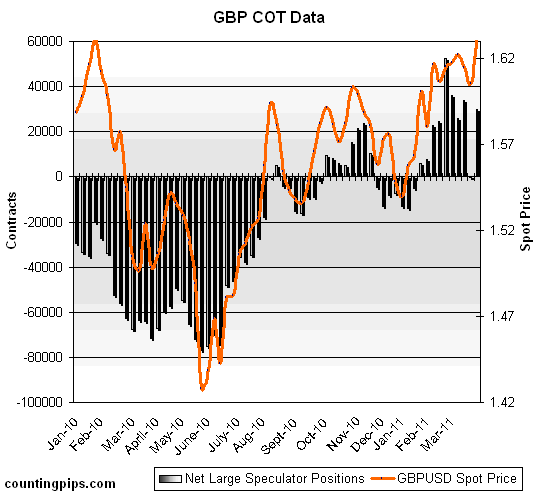
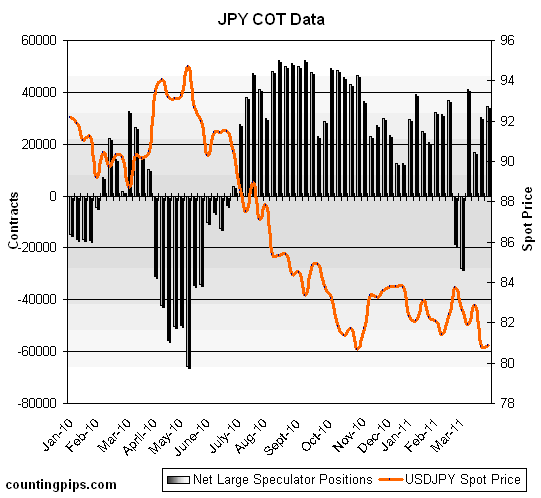
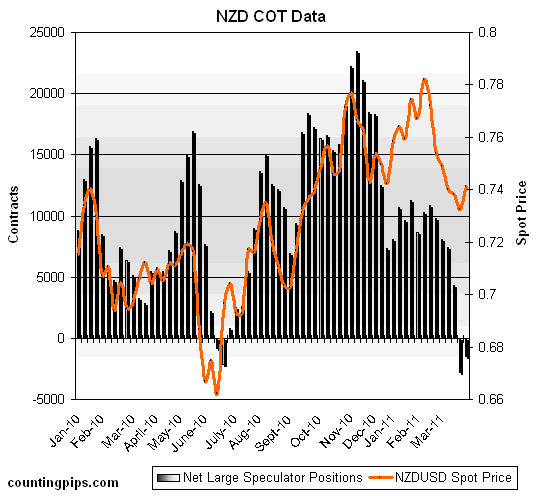
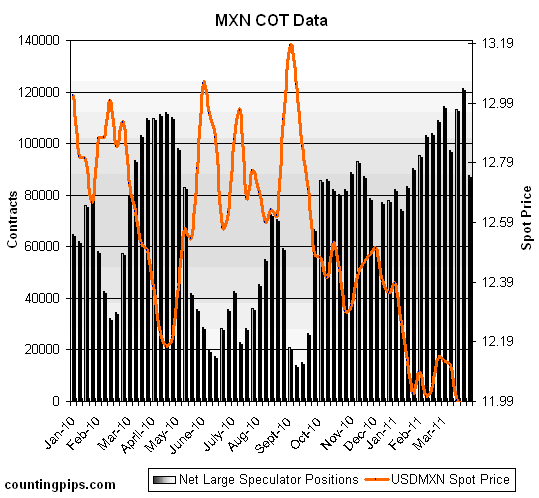
The COT report is published every Friday by the Commodity Futures Trading Commission (CFTC) and shows futures positions as of the previous Tuesday. It can be a useful tool for traders to gauge investor sentiment and to look for potential changes in the direction of a currency or commodity. Each currency contract is a quote for that currency directly against the U.S. dollar, where as a net short amount of contracts means that more speculators are betting that currency to fall against the dollar and net long position expect that currency to rise versus the dollar. The graphs overlay the forex spot closing price of each Tuesday when COT trader positions are reported for each corresponding spot currency pair.

GBP: British pound sterling bets rebounded last week after dropping over to the short side on March 15th. GBP rose to a total of 29,724 long contracts as of March 22nd after registering 225 short contracts on March 15th.


JPY: The Japanese yen net contracts advanced for a second straight week as of March 22nd to a total of 34,525 long contracts following a total of 30,230 net long contracts reported on March 15th.


CHF: Swiss franc long positions dipped as of March 22nd after increasing for five consecutive weeks. Franc positions level at a total of 21,301 net long contracts as of March 22nd following a net of 27,640 long contracts on March 15th. The March 15th positions represented the highest level for franc positions since late 2009.


CAD: The Canadian dollar positions continued to fall lower for a second consecutive week to a total position of 45,977 contracts as of March 22nd. CAD net contracts had declined to a total of 56,991 net long contracts as of March 15th.


AUD: The Australian dollar long positions rose last week after decline on March 15th. AUD contracts totaled a net amount of 51,734 long contracts as of March 22nd after AUD positions had totaled 47,951 net long contracts on March 15th.


NZD: New Zealand dollar futures positions stayed on the short side for a second consecutive week. NZD contracts increased to a total of 1,482 short positions as of March 22nd from a total of short 2,809 long contracts on March 15th. NZD contracts had fallen for five consecutive weeks through March 15th.


MXN: Mexican peso long contracts fell sharply from a total of 121,575 net long contracts on March 15th to a total of 87,548 long contracts as of March 22nd. The MXN positions on March 15th represented the highest level in over a year.

COT Data Summary as of March 22, 2011
Large Speculators Net Positions vs. the US Dollar

EUR: +48,353
GBP: +29,724
JPY: +34,525
CHF: +21,301
CAD: +45,977
AUD: +51,734
NZD: -1,482
MXN: +87,548

Buffett: Avoid Long-Term Bonds Tied to Dollar

Warren Buffett, the billionaire who urged Congress in 2009 to guard against inflation, said investors should avoid long-term fixed-income bets in U.S. dollars because the currency’s purchasing power will decline.

“I would recommend against buying long-term fixed-dollar investments,” Buffett, chairman and chief executive officer of Berkshire Hathaway Inc., said in New Delhi. “If you ask me if the U.S. dollar is going to hold its purchasing power fully at the level of 2011, 5 years, 10 years or 20 years from now, I would tell you it will not.”

Buffett, 80, has shortened the duration of Omaha, Nebraska- based Berkshire’s bond holdings since 2009 as the U.S. Federal Reserve eased monetary policy to stimulate the economy. Over the same period, he has added to cash holdings and committed more than $35 billion to company takeovers.

“I would much rather own businesses,” he said. “It’s very easy to take away the value of fixed-dollar investments.”

The Fed and U.S. Treasury Department have pumped money into the economy since the financial crisis through bank bailouts, government stimulus and near-zero interest rates. Buffett said in an August 2009 op-ed in the New York Times that the government must address this “monetary medicine.”

Outlook for Inflation

Inflation expectations among consumers rose in March to the highest level since August 2008, according to the Thomson Reuters/University of Michigan final index of consumer sentiment. Consumers said they expect inflation at 3.2 percent over the next five years, compared with 2.9 percent last month.

Buffett, traveling in India to review Berkshire’s operations and scout opportunities, took questions at a meeting with insurance customers and spoke on topics from the economy to investments. Buffett, who built Berkshire through stock picks and takeovers, advised investors to be wary of valuations for social-networking websites as some of the industry’s biggest companies prepare to sell shares.

“Most of them will be overpriced,” Buffett said. “It’s extremely difficult to value social-networking-site companies,” he said, without naming firms. “Some will be huge winners, which will make up for the rest.”

Buffett has shunned technology investments in favor of industrial, financial and consumer-goods holdings in his four decades at Berkshire. As of Dec. 31, the company owned about $61.5 billion of stocks, $34.9 billion of fixed-maturity securities and $23 billion of “other investments.”

Berkshire’s securities maturing in more than 10 years fell 31 percent to $2.72 billion in the 18 months ended Dec. 31, according to regulatory filings. In that span, the company’s cash holdings surged 56 percent to $38.2 billion.

Buffett completed his biggest takeover, the $26.5 billion acquisition of railroad Burlington Northern Santa Fe Corp., last year. On March 14, he agreed to buy Lubrizol Corp., the world’s largest producer of lubricant additives, for about $9 billion.

HUMOR: THE RECESSION HITS EVERYBODY

I got a pre-declined credit card in the mail.

CEO's are now playing miniature golf.

Exxon-Mobil laid off 25 Congressmen.

A stripper was killed when her audience showered her with rolls of pennies while she danced.

I saw a Mormon polygamist with only one wife.

If the bank returns your check marked "Insufficient Funds," you call them and ask if they meant you or them.

McDonald's is selling the 1/4 ouncer.

Angelina Jolie adopted a child from America .

Parents in Beverly Hills fired their nannies and learned their children's names.

My cousin had an exorcism but couldn't afford to pay for it, and they re-possessed her!

A truckload of Americans was caught sneaking into Mexico .

A picture is now only worth 200 words.

When Bill and Hillary travel together, they now have to share a room.

The Treasure Island casino in Las Vegas is now managed by Somali pirates.

Congress says they are looking into this Bernard Madoff scandal. Oh Great! The guy who made $50 Billion disappear is being investigated by the people who made $1.5 Trillion disappear!

And, finally...

I was so depressed last night thinking about the economy, wars, jobs, my savings, Social Security, retirement funds, etc., I called the Suicide Hotline. I got a call center in Pakistan , and when I told them I was suicidal, they got all excited, and asked if I could drive a truck.